


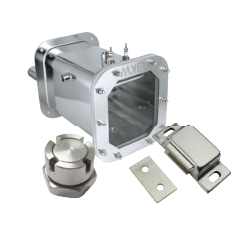
IP66 & NEMA 4X at a Glance: What Each Rating Actually Means
IP66 and NEMA 4X come from two different worlds, and that origin story explains most of the confusion.
| Dimension | IP66 (IEC 60529) | NEMA 4X (NEMA 250) |
|---|---|---|
| Governing body | International Electrotechnical Commission (IEC) | National Electrical Manufacturers Association (NEMA), enforced via UL 50E in North America |
| Scope | Ingress of solids and liquids only | Ingress + corrosion + ice + gasket aging + oil resistance + mechanical construction |
| Core protection | Dust-tight + powerful water jets | Dust-tight + hose-directed water + corrosion resistance |
| Certification model | Often manufacturer self-declared | Typically requires third-party listing (UL/ETL/CSA) |
| Typical materials | Powder-coated carbon steel, aluminum, polycarbonate | 316 stainless steel, FRP (fiberglass-reinforced polyester), UV-stabilized polycarbonate |
Think of IP ratings as a focused lab report: they measure exactly what they measure, nothing more. NEMA ratings are closer to a comprehensive qualification. They test a wider set of environmental threats and require third-party verification to back it up. This distinction runs through every difference that follows.
Head-to-Head: Where IP66 and NEMA 4X Diverge
IP66 and NEMA 4X look equivalent for dust and water, and that is precisely where the danger lies. NEMA 4X covers three additional dimensions that the IP system does not address at all: corrosion, ice formation, and gasket aging. Here is the actual test data.
Water Protection: Powerful Jets vs. Hose-Directed Water
Both ratings promise serious water protection. But the test apparatus tells a different story.
| Test Parameter | IPX6 (IEC 60529) | NEMA 4X Hose-Down (UL 50E) |
|---|---|---|
| Nozzle diameter | 12.5 mm | 25 mm (1 inch) |
| Flow rate | 100 L/min ±5% | ≥ 240 L/min (65 GPM) |
| Distance | 2.5–3.0 m | 3.0–3.5 m |
| Duration | 1 min per m² of surface (min 3 min) | 5 min for enclosures ≤ 75 inches |
The NEMA 4X hose-down test delivers 2.4 times the water volume through a nozzle with twice the diameter. It simulates the kind of drenching a fire hose or storm-driven rain produces, not a precisely aimed laboratory jet. IPX6, by contrast, tests a narrower, faster stream from all practicable directions.
Practically speaking, an enclosure that passes the NEMA 4X hose-down test will almost certainly meet IPX6 requirements. The reverse is not guaranteed. An IPX6-rated enclosure may not survive a full hose-down.
Dust Protection: Where Both Ratings Align
Here is the one dimension where you can stop worrying. Both IP66 (first digit “6”) and NEMA 4X require complete protection against dust ingress. The IP6X test uses talcum powder with particle size ≤ 75 μm suspended at 2 kg/m³ in a sealed chamber. NEMA 4X addresses dust through its broader environmental assessment rather than a standalone dust-chamber test.
For engineering purposes, treat them as equivalent on dust. The differences lie elsewhere.
Corrosion & Ice: The “X” Factor That Changes Everything
This is where NEMA 4X pulls decisively ahead, and where IP66’s silence becomes a liability.
NEMA 4X mandates corrosion resistance validated through ASTM B117 salt spray testing: 200 hours of continuous exposure to a 5% sodium chloride fog at 35°C, with the enclosure surface showing no more degradation than a Type 304 stainless steel reference sample run in the same chamber (Stahlin, 2025).
IP66 has no corrosion requirement whatsoever. A plain carbon steel box with a decent powder coat passes IP66. It will not pass NEMA 4X, because the standard demands that the base material itself resists corrosion — not just the coating.
Add to this NEMA 250’s requirements for external ice formation (the enclosure must remain undamaged and operable after ice buildup) and gasket aging (seals must maintain integrity after prolonged UV and ozone exposure), and the cost gap between the two ratings suddenly makes sense. NEMA 4X is not just “IP66 with a nicer sticker.” It is IP66-level ingress protection built on a fundamentally more durable material platform.
The Cross-Reference Trap: Why “Equivalent” Doesn’t Mean Interchangeable
Every engineer has seen the conversion chart. NEMA 4X ≈ IP66. NEMA 6 ≈ IP67. It looks authoritative. It is also routinely misapplied.
Here is the actual cross-reference table, sourced from NEMA 250 and manufacturer technical documentation (Gore, 2025; Eaton, 2025):
| NEMA Rating | Approximate IP Equivalent | Key Limitation |
|---|---|---|
| NEMA 1 | IP10–IP20 | Indoor only, no liquid protection |
| NEMA 3R | IP14–IP24 | Outdoor rain/sleet, no dust protection |
| NEMA 4 | IP66 | No corrosion or ice requirement |
| NEMA 4X | IP66 | No single IP rating covers corrosion + ice + gasket aging |
| NEMA 6 | IP67 | No corrosion requirement |
| NEMA 6P | IP67–IP68 | Duration of submersion not directly comparable |
| NEMA 12/12K | IP52–IP54 | Indoor only, circulating dust + dripping |
The chart is useful as a starting point. It becomes dangerous when treated as a substitution license. Two real-world failure patterns repeat across industries:
Pattern A — Coastal substitution. A project in Southeast Asia specified NEMA 4X for a desalination plant’s field enclosures. The contractor substituted IP66 powder-coated steel enclosures, citing the cross-reference table as justification. Within 18 months, salt-laden monsoon rain had penetrated pinhole defects in the coating. The enclosures rusted through at the hinge mounting points. Replacement cost: roughly three times the original procurement budget.
Pattern B — Contract language ambiguity. An international equipment contract stated “IP66 or equivalent.” The buyer assumed this covered NEMA 4X requirements. The supplier shipped IP66 enclosures with standard carbon steel hardware. When the equipment arrived at a North American site requiring NEMA 4X, the entire batch failed inspection. The word “equivalent” does not mean what a conversion chart implies it means, especially in a courtroom.
The working rule: NEMA → IP conversion is generally safe. IP → NEMA conversion requires independent verification of every additional NEMA requirement (corrosion, ice, gaskets, and construction). Skip that verification, and you are not saving money. You are deferring cost to the moment of failure.
Choosing the Right Rating for Your Application
Choosing between IP66 and NEMA 4X is not about which rating is “better.” It is about which attack vectors your installation environment deploys against your equipment. Ask yourself three questions before you decide: Is there salt or chemical exposure? Is there a risk of ice formation? Is this for a single-market project or international deployment?
When IP66 Is the Practical Choice
For a significant majority of outdoor industrial applications, IP66 is the right call. Spending 2–3 times more on NEMA 4X enclosures adds no practical value in these settings.
IP66 fits well in these scenarios: inland industrial plants with no chemical exposure, outdoor telecom cabinets in temperate climates, utility distribution enclosures, and agricultural equipment shelters. In each case, the primary threats are rain, windblown dust, and occasional hose-down cleaning. IP66 handles all of them competently.
Choosing IP66 in these environments is not cutting corners. It is allocating the materials budget where it actually matters.
When You Must Specify NEMA 4X
There is a specific category of environments where specifying IP66 alone crosses the line from cost optimization into active risk. Here are the five scenarios where NEMA 4X is non-negotiable:
Coastal installations (within 5 km of shoreline). Salt spray is relentless and finds every microscopic coating defect. The molybdenum content in 316 stainless steel (2–3%) forms a passive film that resists chloride ion attack. No coating on carbon steel can replicate this. Specify IP66 here, and you will be replacing enclosures within two years.
Chemical and petrochemical plants. Acidic vapors, alkaline dust, and solvent exposure degrade standard gasket materials and attack zinc-rich coatings. NEMA 4X’s material requirements (316 SS or FRP) and gasket aging tests exist precisely for this environment.
Food and beverage processing. Frequent CIP (clean-in-place) cycles use aggressive chemicals — sodium hydroxide at 1–3%, nitric acid at 0.5–1%, peracetic acid at 0.1–0.2% — that standard IP66 enclosure coatings and NBR seals cannot withstand. Even 304 stainless steel can struggle here; 316L is the safer bet.
Marine and offshore platforms. Salt, continuous high humidity, mechanical vibration, and limited maintenance access combine to create the harshest test of enclosure integrity. NEMA 4X’s combined corrosion-plus-ice-plus-construction requirements map directly to this threat profile.
Pharmaceutical cleanrooms. While corrosion may not be the primary concern, frequent VHP (vaporized hydrogen peroxide) sterilization demands material compatibility that standard IP66 enclosures do not guarantee.
What you save on the enclosure purchase in these environments, you will pay back several times over: replacement labor, production downtime, and equipment damage behind a failed enclosure.
(coastal enclosure failure)
What you save on the enclosure, you pay back in replacement labor, production downtime, and equipment damage behind a failed enclosure.
When Neither Rating Is Enough
IP66 and NEMA 4X cover a broad range of applications, but they have limits worth acknowledging:
- Continuous submersion requires IP68 or NEMA 6P — neither IP66 nor NEMA 4X is rated for underwater service.
- Explosive atmospheres (Class I Division 1 or Zone 0/1) demand ATEX/IECEx certification or NEMA 7/9 enclosures with flamepath engineering.
- High-temperature, high-pressure washdown in food production may require IP69K (tested at 80°C, 100 bar, close-range spray), which is outside the scope of both IP66 and NEMA 4X.
If your application falls outside these edge cases, IP66 or NEMA 4X will likely cover your needs well.
The Component Blind Spot: Why Enclosure Hardware Decides the Real Rating
When was the last time you checked the IP or NEMA rating of the handles, hinges, and locks on your enclosures? This question does not appear in any comparison article on the first page of search results.
An enclosure achieves its rating as a system. The box passes the test with specific hardware installed. Change the hardware — a different handle, a cheaper hinge, a lock from a different supplier — and the system’s rating is no longer valid. The enclosure body earned its certificate. The hardware may not have.
Every penetration through the enclosure wall is a potential leak path. The hardware mounted in those penetrations is the gatekeeper. And yet, in most procurement processes, enclosure hardware is selected by appearance and price, not by its protection rating.
Handles & Latches — The Most Exposed Penetration Point
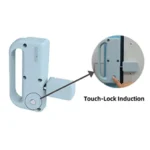
The handle is the largest through-hole component on most enclosures, and the one operated most frequently. Every turn of the handle cycles the shaft seal through compression and relaxation. Over time, even micron-level wear in the shaft bore creates a path for pressurized water.
The failure mechanism is invisible until it is too late: shaft-to-bore clearance exceeds the O-ring’s compression reserve, water penetrates during the next high-pressure event, corrosion starts inside the mechanism, and the handle seizes or the seal fails completely.
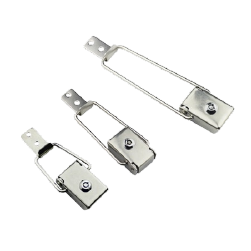
For NEMA 4X applications, handles should meet three minimum criteria. First, the shaft and body must be 316 stainless steel — not 304, not plated carbon steel. Second, dual O-ring sealing should use FKM/Viton elements. Nitrile rubber (NBR) degrades under UV and chemical exposure, while fluorocarbon elastomers maintain elasticity from -20°C to 200°C and resist most industrial chemicals. Third, the design must prevent the shaft from rotating the seal against its housing during operation.
The difference between an IP66-rated handle and a NEMA 4X-rated one is not cosmetic. It is the difference between an NBR O-ring in a carbon steel housing and a dual FKM seal in 316 stainless. Coastal installations reveal that difference within 12 to 18 months.
Hinges — The Constant-Motion Weak Link
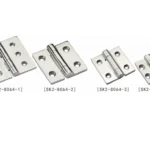
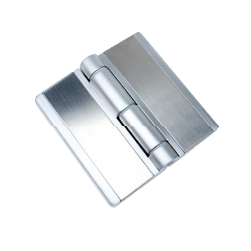
Hinges suffer from a problem that no static seal faces: every door cycle applies shear stress to the sealing interface. A gasket that seals perfectly at rest degrades incrementally under the rotational friction of opening and closing.
Beyond the wear mechanism, hinge mounting creates a second vulnerability. Bolt-through installation, where fasteners pass entirely through the enclosure wall, adds a penetration point for every mounting screw. Weld-on or blind-hole mounting eliminates these secondary leak paths and is strongly preferred for NEMA 4X assemblies.
A less obvious failure mode is crevice corrosion, particularly on 304 stainless hinges. Where the hinge leaf meets the enclosure surface, stagnant moisture creates an oxygen-depleted micro-environment that breaks down 304’s passive layer. 316 stainless, with its molybdenum content, is far more resistant to this specific mechanism. This is why NEMA 4X hinge specifications almost always call for 316 material.
- Adds penetration point per screw
- Creates crevice corrosion site
- Breaks coating at each hole
- Zero additional penetrations
- No crevice initiation
- Preserves coating integrity
And a practical note easily overlooked: the hinge must support the door at its installed weight. An empty enclosure door is light. Add a transformer, a VFD, or a bank of terminals mounted on the door panel, and the hinge loading changes significantly. A hinge that meets NEMA 4X corrosion standards but fails mechanically under a loaded door is still a system failure.
Locks & Access Hardware — Security Without Compromising the Seal
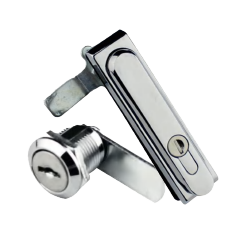
The lock cylinder is a penetration by design: a deliberate hole through the enclosure wall. Managing that hole’s seal while maintaining mechanical access is the lock designer’s core challenge.
A properly engineered NEMA 4X lock addresses this through layered sealing: a face gasket between the lock body and enclosure surface, plus an internal seal around the lock cylinder itself. In applications where water could pool around the lock (outdoor enclosures in heavy rain), a drain path incorporated into the lock design prevents standing water from finding its way inward over time.
Common lock types — compression latches, swinghandles, quarter-turn locks — each have different sealing characteristics. A compression latch actively pulls the door against the frame gasket during closing, creating uniform compression pressure around the entire seal perimeter. This is mechanically more robust than a simple cam lock that relies on the gasket’s resting compression alone.
One principle applies regardless of lock type: the lock’s protection rating must be verified independently. A lock does not inherit NEMA 4X protection simply by being installed on a NEMA 4X enclosure. It must be tested, or sourced with its own rating documentation.
The enclosure hardware industry remains largely invisible to the engineers who depend on it. Most procurement lists specify the enclosure in detail — material, rating, dimensions, gland plate configuration — and then add “handle and lock” as an afterthought. That afterthought is the most common root cause of enclosure system failures in the field. When evaluating suppliers, ask for three things: material certifications that match the enclosure specification, test reports (particularly ASTM B117 salt spray data for NEMA 4X components), and application-specific selection guidance. A supplier who cannot produce all three is selling commodity hardware, not rated enclosure components. The distinction matters more than the price difference.
Don’t Let Commodity Hardware Compromise Your Enclosures
With 20 years of expertise, Kunlong specializes in industrial-grade structural hardware—including locks, hinges, and handles—engineered to maintain strict NEMA 4X integrity. Serving 20,000+ global clients, our hardwares are backed by rigorous 1,000-hour salt spray testing and full material traceability.
Stop guessing with your specs. We offer instant 3D model downloads, custom engineering within 7 days, and free standard samples.
Explore Kunlong SolutionsVerifying Dual-Rating Claims in International Procurement
You have the technical knowledge. You have the application guidance. The final step is making sure what arrives on site matches what the spec sheet promised. Here is a five-step verification checklist for international procurement:
- Check the UL file number (E-number). A legitimate NEMA 4X listing should be traceable in the UL Product iQ database at productiq.ul.com. If the supplier cannot provide an E-number, the NEMA claim is unverified.
- Read the test report — specifically the corrosion section. Many products marketed as “IP66 / NEMA 4X” have test documentation covering IPX6 water jet testing only, with no ASTM B117 salt spray data. A missing corrosion test means the “4X” claim is unsubstantiated.
- Verify material declarations for both enclosure and hardware. The enclosure material grade and the hardware material grade should be stated separately. A 316 stainless enclosure with 304 stainless hardware will fail in coastal environments at the hardware first. The failure will be attributed to “enclosure corrosion” even though the box itself was fine.
- Evaluate the supplier beyond the certificate. ISO 9001 is the baseline — do not treat it as a differentiator. Look at export track record, industry-specific client references, and whether the supplier understands the regulatory environment in your installation country. A supplier who has never shipped to a North American project may not understand what NEMA 4X compliance documentation looks like.
- Avoid “or equivalent” in contract language. Specify the exact rating, the testing standard, and the certification body. “NEMA 4X per NEMA 250, UL 50E listed” leaves no room for interpretation. “IP66 or equivalent” leaves all the room in the world — none of it in your favor.
References
- IEC. “IEC 60529:1989+AMD1:1999+AMD2:2013 — Degrees of Protection Provided by Enclosures (IP Code).” International Electrotechnical Commission.
- NEMA. “ANSI/NEMA 250-2020 — Enclosures for Electrical Equipment (1000 Volts Maximum).” National Electrical Manufacturers Association, 2020.
- UL. “UL 50E — Enclosures for Electrical Equipment, Environmental Considerations.” Underwriters Laboratories.
- ASTM International. “ASTM B117 — Standard Practice for Operating Salt Spray (Fog) Apparatus.”
- Stahlin. “FAQ — NEMA 4X Corrosion Testing.” 2025. https://stahlin.com/resources/technical-library/faq
- Gore. “IP & NEMA Ratings — What They Mean for Enclosure Protection.” 2025. https://www.gore.com/resources/ip-and-nema-ratings-and-what-they-mean
- Eaton. “IEC (IP) and NEMA Rated Enclosures.” 2025. https://tripplite.eaton.com/products/enclosure-ratings
- F2 Labs. “NEMA 250 Testing Services.” 2025. https://f2labs.com/nema-250-ul-50-testing
- Keystone Compliance. “IPX5 & IPX6 Water Jets Testing Lab.” 2025. https://keystonecompliance.com/ipx5-ipx6-water-jets/