


Introduction
The variable of motion is the foe of quality in the field of industrial production and fine assembly. In a high-speed CNC setting, a welding station exposed to thermal expansion, or an automated testing station, the capability to hold a workpiece with perfect repeatability is the basis of production integrity.
One of the most beautiful solutions to this problem is the toggle clamp. It is a mechanical system in which geometry and material science meet to offer reliable clamping stability and efficiency, incorporating elements such as control systems. This guide discusses the working principle, common uses, specific application cases, and the engineering standards that you need to choose the specific toggle action device that fits your application requirements for optimal performance across various industries.
What is a Toggle Clamp and How it works?
.webp)
A vertical toggle clamp is a fastening device that is a fast-acting mechanical fastener used in various applications to hold workpieces together using a clamp arm and clamping mechanism based on a lever system, rather than the slow threads of conventional C-clamps. It was developed to address the inefficiency of repetitive operations, transforming a simple movement of the handle of the vertical toggle clamp into high static clamping force. This enables operators to lock parts securely and apply the necessary release force with ease of operation, ensuring precise alignment of the workpiece. This mechanical leverage multiplies the slightest manual effort into hundreds of kilograms of holding force, which significantly shortens the cycle times in manufacturing facilities.
This mechanical advantage multiplies the slightest manual effort into hundreds of pounds of force, significantly shortening cycle times. A closer look at the clamping system reveals it operates on the over-center principle. When the handle is operated, the pivot points cross a dead center threshold often aligning along a horizontal line into a fixed locking position. Beyond this point, the clamping action becomes self-locking; the force of the workpiece acts in the opposite direction against the linkage system, pushing it against a hard stop rather than popping it open. This makes the clamp firmly locked in place during machining or sawing, which offers some degree of stability and safety that cannot be matched by friction-based clamps.
The 4 Major Toggle Clamping: Technical Selection Guide
It is important to know the common types of toggle clamps to maximize manufacturing efficiency in various industrial applications. Selecting the right type of clamp depends on understanding the mechanism, application, and key performance metrics. Below is a comparison of different toggle clamps which brings out holding power, compatibility, and durability features of interest to professional engineers and buyers.
| Type | Mechanism | Best Application | Holding Capacity | Mounting Style | Interchangeability | Durability Feature |
| Vertical Handle | Locks Upright | Drilling & Welding | Light to Heavy Duty | Flanged Base | Universal Fit | Hardened Rivets |
| Horizontal Handle | Locks Flat(Horizontal position) | Milling & Low Clearance | Light to Medium Duty | Low Profile Base | Standard Pattern | Reinforced Arm |
| Push/Pull | Linear Motion | Positioning & Corners | High Precision Force | Flanged or Threaded | Standard Strokes | Ground Plunger |
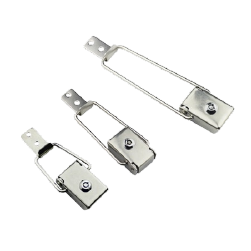
| Latch Type | Pull Action | Molds, Lids & Doors | Maximum Tension | Adjustable U-Bolt | Standard Catch Plate | High-Tensile Steel |
Operation: Toggle Clamps: How to Use Toggle Clamps Safely
.webp)
To ensure efficient operation and safety, regardless of the distinct handle configuration, follow these steps:
- Secure Mounting: Ensure the part of its base is firmly bolted or welded to the mounting surface. Any flex in the base will weaken the over-center lock.
- Spindle Adjustment: Adjust the spindle length to ensure that the clamp snaps into place with a firm snap, but not excessive force is needed. When the operator has to hammer the handle of toggle clamps to close it, the spindle is too tight.
- Engage: Slide the handle until the linkage passes over the center point.
- Check: Check that the clamp is completely closed and the workpiece is stationary on the work surface.
- Release: Use force on the handle to release the toggle lock. Do not touch the pinch points in the linkage.
The 3 Pillars of Application: Workholding, Fixturing and OEM Components
Toggle clamps are common in the manufacturing industry, but their application varies radically based on their location of use. In order to choose the appropriate clamping solution, one must look outside the mechanism and see the application environment. Generally, the use of toggle clamps can be classified into three pillars: Workholding to be used in active processing, efficient clamping in Fixturing used for assembly and testing, and OEM Integration as a permanent part of machinery.
Workholding: Active Processing and Fabrication
During the Workholding stage, the clamp is exposed to the most severe conditions. In this case, the main objective is to protect the raw materials against the violent forces of cutting, heating and shaping, regardless of the dimensions of the objects.
- Welding and Fabrication: Clamps used in automotive chassis jigs or welding of pipe flanges should be able to withstand heat and thermal expansion. Speed is paramount in this case; operators must be able to change parts quickly to keep cycle times. Also, copper-plated spindles are commonly necessary to prevent the adhesion of weld spatter.
- CNC Machining: Be it milling aluminum housings or drilling, the foe is vibration. Toggle clamps offer the rigidity required to ensure high down-force to avoid chatter and achieve precision cuts. Moreover, horizontal clamps with low profiles are essential in such systems to make sure that the handle does not interfere with the cutter.
- Woodworking: In the case of cabinet assembly and glue-up presses, the emphasis is on surface protection. The clamp should be able to exert even pressure to make the glue joints tight, but it is also necessary to have rubber-tipped spindles to avoid marring or denting the fragile wood surfaces.
Fixturing: Accurate Assembly and Test
The pillar is known as Fixturing, unlike the brute force needed in workholding, it focuses on precision, repeatability, and accessibility. These clamps serve as the third hand of operators and testing equipment.
- Electronic Testing: In ICT (In-Circuit Test) or FCT fixtures, accuracy is not a bargaining point. Toggle clamps provide precise, vertical force to pogo pin PCBs. The movement should be regulated to prevent bending or cracking of delicate circuit boards.
- Assembly Aids: To glue fixtures or position components, repeatability is the primary benefit. Toggle clamps make sure that all units are fitted in the same orientation, leaving the operator with free hands to do complex assembly operations without having to hold the part in their hands.
- Quality Inspection: The part holding of CMM (Coordinate Measuring Machine) or optical gauging should have an unobtrusive fixture. The clamps are carefully positioned to firmly hold complex geometries such as curved automotive parts and expose important measurement points to cameras and probes.
OEM Components: Product Integration
In this last pillar, the toggle clamp is no longer a product-making tool but it is an integral component of the product. They are incorporated into the design of machinery and equipment.
- Vibration Equipment: In vibrating sifters, feeder bowls, and separators, regular latches may open. In this case, Secondary Safety Locks are incorporated in the form of clamps to make sure that the latch is not released even when the resonance is high.
- Industrial Enclosures: The clamp is used as a high-force sealing device on HVAC access doors and generator sound shields. Latch-type clamps offer the tensile force required to squeeze gaskets to a large extent, which guarantees air-tight or water-tight seals.
- Specialized Machinery: Durability is the most important in heavy-duty applications such as injection molding or rotational molding machines. These clamps are commonly composed of high grade heat treated steel to resist the high internal pressure and thermal cycling that are part of the molding process.
Engineering Selection Guide: Selecting the Right Specs
Choosing the right clamp is a calculated decision based on load, environment, and geometry. Consider these factors to find the unit that best fits your needs. Take this line of thought to arrive at the right specification.

Calculation of Holding Capacity and Safety Factors
A crucial factor is determining the appropriate clamping force. Unlike a direct hydraulic clamp where pressure is automated, manual toggle selection requires careful calculation. Under-specification is a common cause of failure. Do not select a clamp whose rated capacity merely matches your working load. To avoid deformation or accidental unlocking, you need to use a safety buffer:
- Static Loads: When holding is steady (e.g. gluing or welding fixtures), use a 1.3x safety factor.
- Dynamic Loads: For clamping force of this range involving vibration, use a 2.0x – 3.0x safety factor. For example, if you need a desired clamping force of 100kg, specify a model rated for at least 200kg to ensure rigidity.
Environmental-based Material Selection
To meet durability requirements and balance cost, match the material to the environment:
- Zinc-Plated Steel: The most common option in 80 percent of indoor applications. It is economical and adequate to dry assembly lines.
- Stainless Steel (SUS304): Essential for corrosion resistance in food processing. to comply with hygiene requirements and withstand simple moisture.
- High-Grade Stainless (SUS316): Must be used in marine or chemical conditions. When subjected to saltwater or acids, standard 304 will pit; 316 is required to retain structural integrity.
Geometry of Handling and Operational Clearance
The physical form of the clamp will either assist or be a hindrance to the operator.
- Ergonomics: When the operator has to lean over a workstation, A hand grip or cushioned handle grip reduces operator fatigue. A low profile horizontal handle is better in case of reaching into a shelf or tight space.
- Loading Clearance: A standard 90 degree opening is adequate in the case of manual loading. Consider the deep depth or reach required. For robotic loading, select an appropriate toggle clamp type with a wide opening angle (>100°) to ensure the arm clears the loading path.
Base Style, Bar Type and Vibration Safety
This is to align the clamp with your interface and stability needs of your fixture.
- Mounting: Explore available mounting options, such as Flanged Bases for flat surfaces or Straight Bases for side mounting.
- Bar Style: Select a U-Bar to be flexible (enables the spindle to slide to a desired position) or a Solid Bar to be heavy-duty rigid (no spindle slippage).
- Vibration Control: When you are using motors, vibratory feeders, or transporting vehicles, you need to order a clamp with a second “Safety Lock” feature. In the absence of this, the harmonic vibrations may make standard clamps walk open resulting in disastrous release.
Spindle Tip Selection (Surface Protection)
The force is given by the clamp, but it is the tip of the spindle or clamping jaws that comes in contact with your part or clamping pad. Selecting an incorrect tip may ruin your workpiece.
- Neoprene/Rubber Tips: Provides a better grip on plastic or finished surfaces without marring.
- Steel/Swivel Tips: These are necessary to weld (where rubber would melt) or to grip rough castings that require a hard, high-friction bite.
Common Failure Modes: The Reason Standard Clamps Fail
Although the toggle design is mechanically elegant, conventional toggle clamps of commodity grade often do not perform well in harsh industrial settings. These failures are not accidental; they are the natural outcome of poor metallurgy and slack manufacturing tolerances.
Pivot Elongation is the most common problem. Soft, low-carbon steel rivets are frequently used in standard clamps. These rivets are worn away by friction after repeated cycling, extending the pivot holes and creating mechanical slop. When this play is present, the clamp loses the exact geometry required to achieve the over-center lock, and it will pop open during vibration.
Structural Yielding is also important. A large number of generic units are stamped using thin-gauge steel. The arm may permanently bend under the peak loads of CNC machining, ruining the clamping alignment. Moreover, bad surface plating causes Corrosion Seizure, in which rust in the tight pivot joints raises friction until the unit is completely frozen.
In the end, all these failures can be traced to one cause, which is the absence of precision. In high-stakes production, the use of good enough hardware is merely a time bomb waiting to go off. To eradicate these dangers, engineers should go beyond commodity choices and collaborate with manufacturers that emphasize intensive testing and micron-precision- a criterion of engineering that turns a mere part into a promise of dependability.
The reason why Professional Manufacturers prefer Kunlong Hardware
In order to remove the typical failure modes of a typical toggle clamp, KUNLONG engineers solutions that focus on structural integrity. Whereas generic pivots relax and form play, our automated production has an error margin of 0.0005mm. This micron precision guarantees a close, consistent connection that is assured to last 20,000+ cycles, virtually eliminating the so-called slop that causes engagement failure.
In areas where corrosion normally takes hold, our high quality toggle clamp finishes are proven by 1,000-hour salt spray tests, which is three times the protection of conventional plating. Each part is supported by a team of 30 engineers with an average of 10 years experience and a 15 point inspection protocol that provides 100 percent quality assurance. Supported by complete CQC, ISO, CE, and ROHS certifications, KUNLONG offers the certified reliability to ensure that your fixtures are safe and your production lines are running.
Maintenance and Care: Optimizing Toggle Clamp Performance
To be safe and accurate, use your toggle clamps as precision tools and not as fixed hardware. An active maintenance plan will avoid workpiece slip and mechanical breakdown.
- Smart Lubrication: It is not enough to add oil. Wipe pivot points clean and apply a suitable lubricant. A dry PTFE lubricant should be used in place of wet oil in woodworking or dusty conditions. Wet lubricants draw dust together to create an abrasive paste that wears the bushings and makes the handles stiff.
- Spindle and Contact Pad Inspection: Rubber tips become hard and crack with time, which significantly decreases friction. Check the clamping pad or rubber tips weekly and change them as soon as they become brittle. Moreover, examine the spindle threads to strip. The wobbling spindle leads to uneven clamping force and scraped parts.
- Vibration Control: Base bolts are always loosened by high-frequency vibration caused by machining. Do not just tighten; replace with nylon-insert lock nuts or use a medium strength thread-locking fluid (e.g. Loctite) on the mounting bolts.
- Pressure Adjustment: Over-tightening is the most frequent cause of clamp failure. Periodically measure the spindle depth. The clamp must lock with moderate pressure; over-tightening can break the lever system.
Conclusion
The toggle clamp is an efficiency study–a little thing with a big burden. To select it, you must have a clear idea of the physics of your application: what forces it must deal with, what environment it must operate in, and what accuracy it must have.
Manufacturers can reduce the risks of motion and vibration by adhering to a systematic selection guide and selecting high-precision components. The right toggle clamp is the silent protector of quality in the high-stakes world of industrial production.
FAQ
Q: What is a toggle clamp?
A: A toggle clamp is a device that firmly holds workpieces during machining, welding, assembly, or inspection, making it stable and safe.
Q: What are the special characteristics of the toggle clamp that make it so handy?
A: The toggle clamp is very practical due to its over-center locking mechanism, high holding force, fast operation, and high repeatability.
Q: What are the advantages of a toggle latch?
A: A toggle latch offers quick and secure closure, uniform clamping pressure, vibration resistance, and simple manual operation.