


What a Cabinet Hinge Actually Is
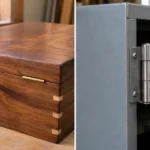
Open a kitchen cabinet and you will see one of two things: a metal barrel poking through the face frame, or nothing at all. That small barrel, or its absence, is the fastest identification signal you will ever get, and it is the first stop in telling hinge types apart.
Every cabinet hinge, from the cheapest butt hinge to a torque-controlled enclosure hinge, is built from the same three elements: two leaves, a pin or knuckle, and a mounting base. The leaves screw into the door and the cabinet, the pin joins them, and the base decides how the hinge sits against both surfaces. What separates one type from another is not the anatomy. It is where the hinge sits, how much door weight it carries, and what it makes the door do.
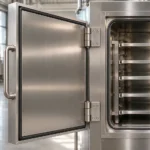
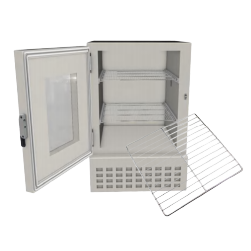
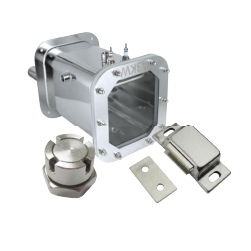
The word “cabinet” covers two very different worlds, and this guide keeps both in view. In homes and workshops, a cabinet means kitchen cabinets, wardrobes, and furniture built around face frames or frameless boxes. In industry, a cabinet means an electrical enclosure, a server rack, an oven door, or an environmental test chamber door that can weigh more than 100 kg. The hinge vocabulary is shared across both worlds. That shared vocabulary is exactly why the same words keep causing confusion: a “concealed hinge” in a furniture catalog is a different object from a “concealed hinge” in an enclosure catalog. Once you can name structures precisely, the confusion disappears.
The Core Cabinet Hinge Types, and How to Tell Them Apart
Furniture and enclosure catalogs use one axis to organize nearly everything: hinge structure. Learn the structures once and every catalog, whatever it sells, starts to sort itself. The table below is the working map.
Cabinet hinge structures at a glance
| Structure | What it looks like | Typical cabinet | Watch out for |
|---|---|---|---|
| Butt hinge | Two flat leaves, barrel visible when door is closed | Traditional face-frame cabinets, electrical panels, oven doors | Barrel finish and screw count matter on visible doors |
| Face-frame (semi-concealed) | One leaf visible, barrel exposed on the frame side | American-style kitchen cabinets | Door thickness range of the leaf |
| Concealed cup hinge | Cup bored into the door, arm hidden inside | Frameless and modern kitchen cabinets | Cup diameter and mounting plate must match |
| Piano (continuous) hinge | Runs the full length of the door or lid | Long doors, workbench lids, machine guards | Needs a straight, full-length mounting surface |
| Lift-off / detachable hinge | Splits into two parts so the door lifts free | Equipment doors that need full removal | Handedness: left and right versions differ |
| Torque / friction hinge | Internal friction holds the door at any angle | Control panels, displays, small enclosures | Not for primary load bearing on heavy doors |
| Offset hinge | Leaf offset so the door wraps past the frame | Wrap-around enclosure panels | Frame must provide the offset geometry |
Visible-barrel types: butt and face-frame hinges
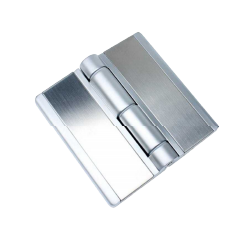
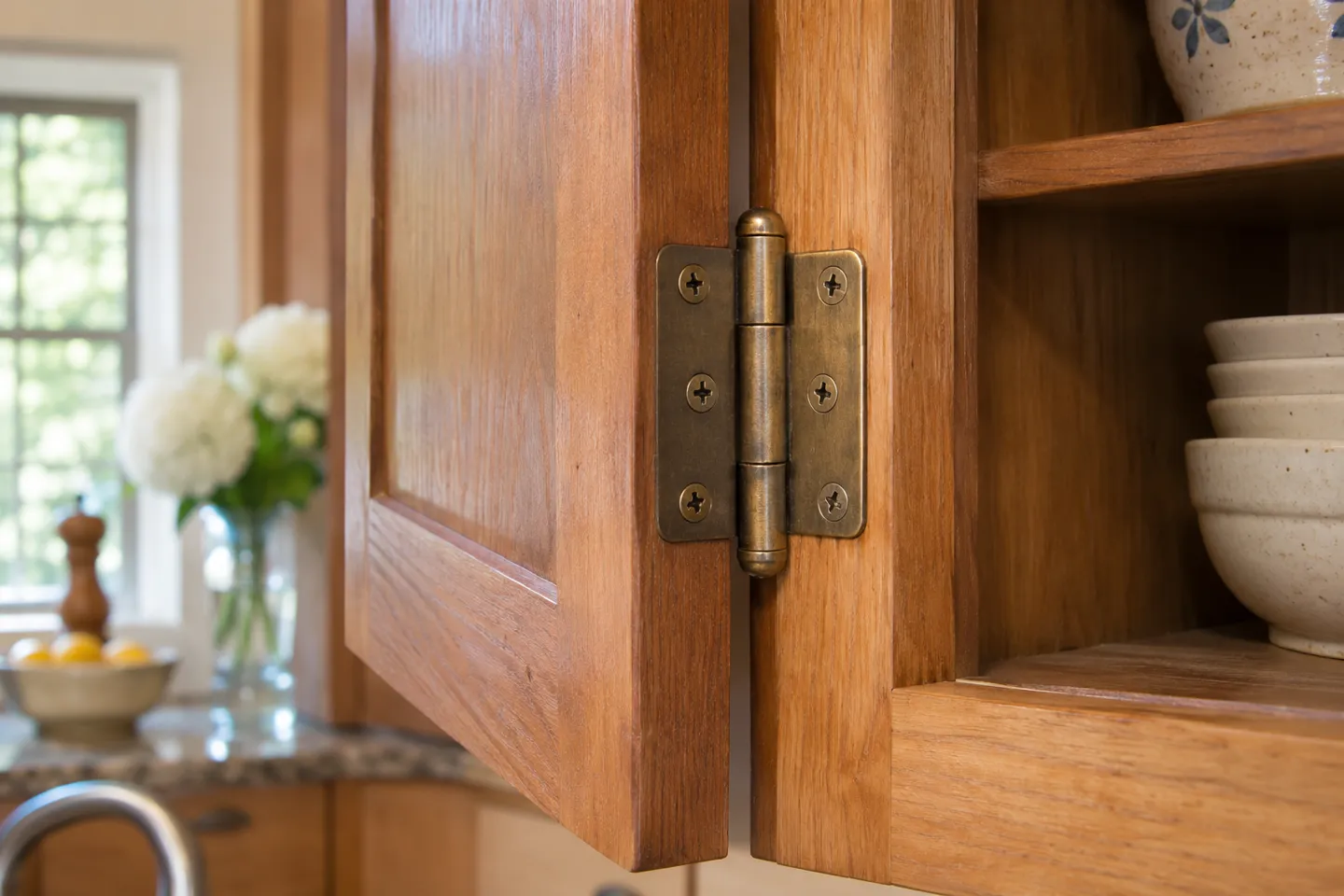
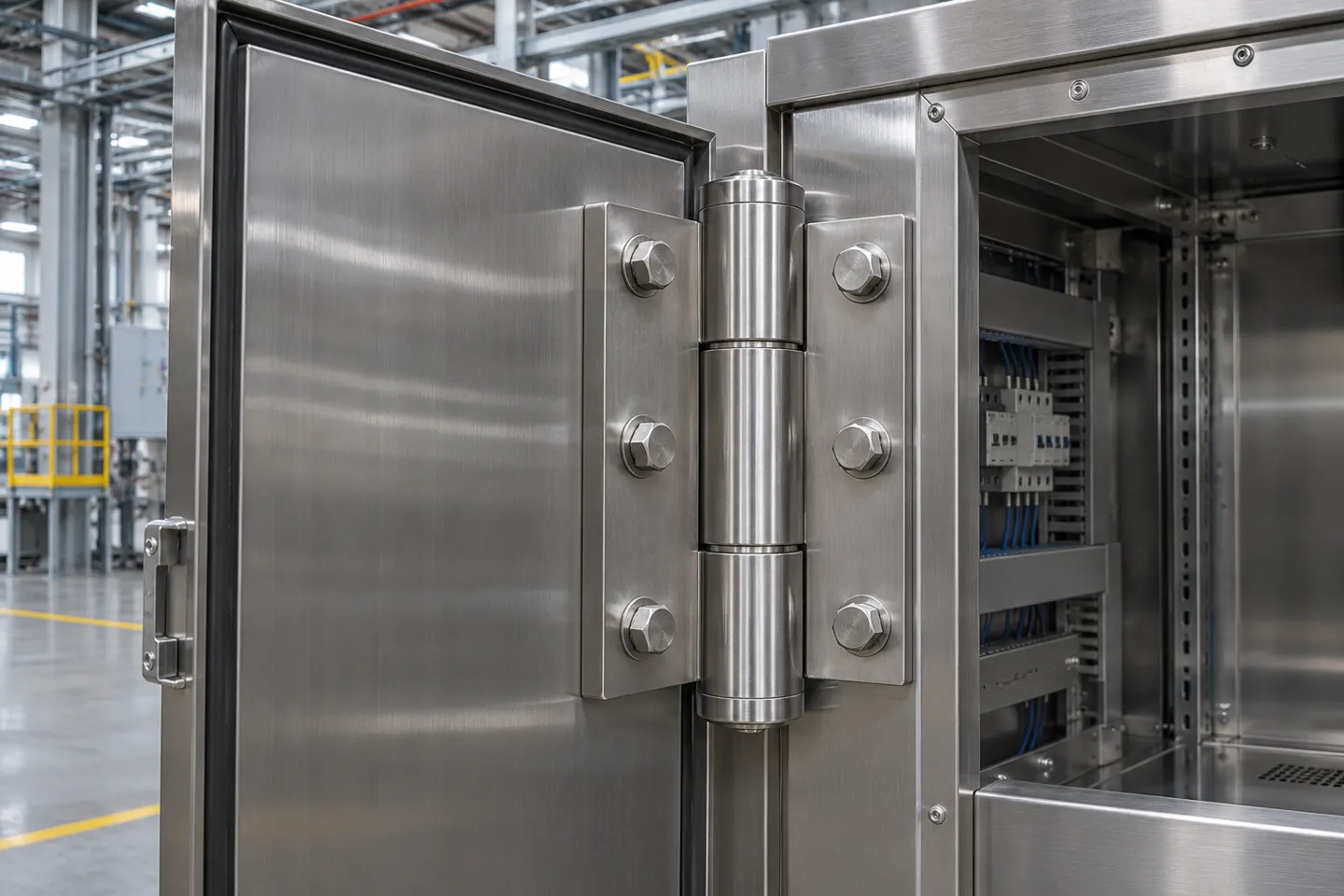
A butt hinge is the oldest structure and still the most universal. Two rectangular leaves fold against each other, the barrel holds the pin, and when the door closes, the barrel stays visible. Traditional kitchen cabinets use them on the face frame, and so do electrical panels, oven doors, and tool cabinets. The industrial versions change the details, not the idea: thicker leaves, stainless steel bodies, opening angles specified from 90 to 180 degrees. Because the barrel shows, finish matters on furniture; because the load matters, leaf thickness matters on equipment.
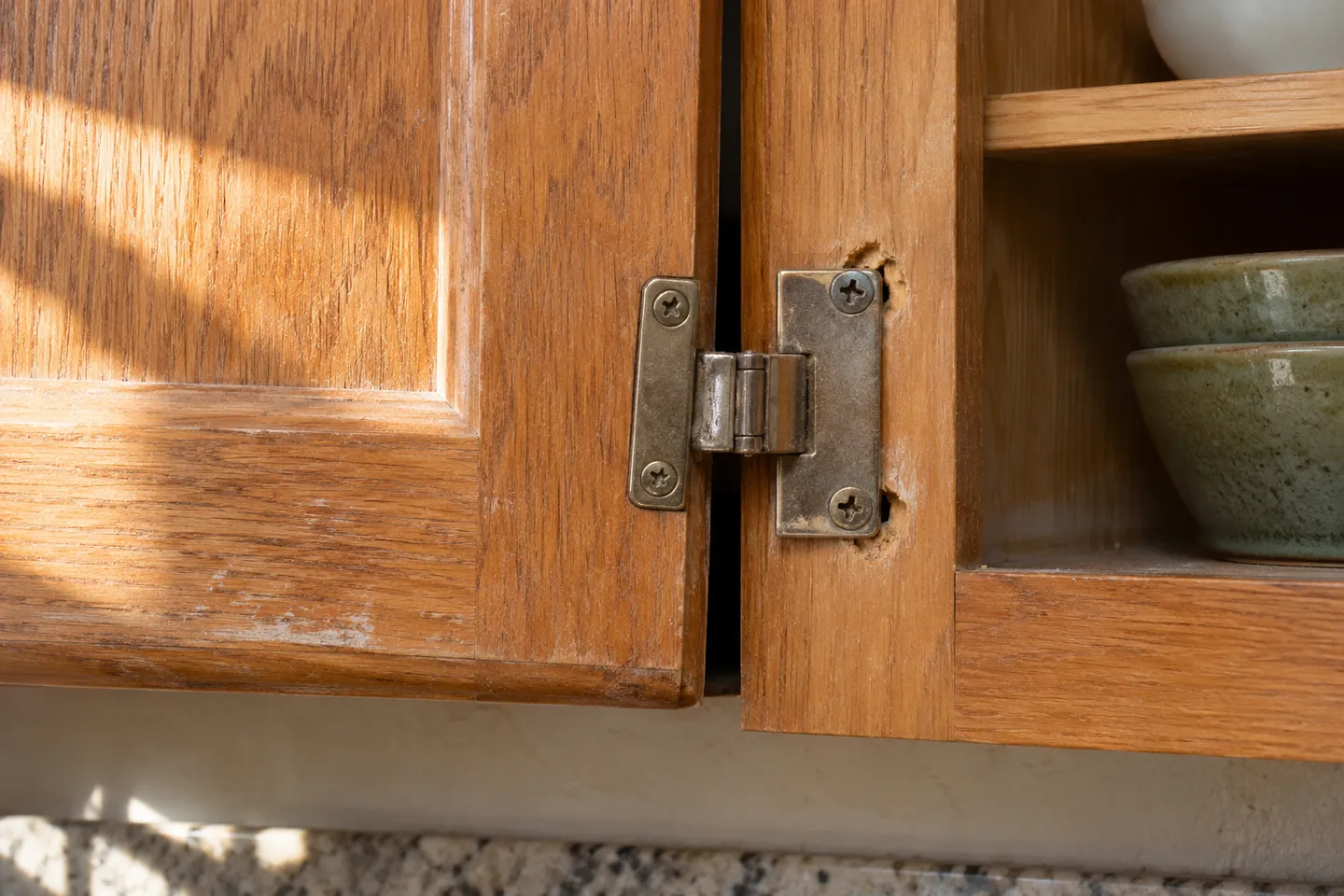
Face-frame hinges, often called semi-concealed, are the furniture-specific refinement. The frame-side leaf stays visible, but the door-side arm is shaped so most of the hinge disappears when the door closes. If your cabinet has a frame around the opening and the hinge barrel shows when the door shuts, you are holding a face-frame hinge.
Concealed cup hinges: the 35 mm system
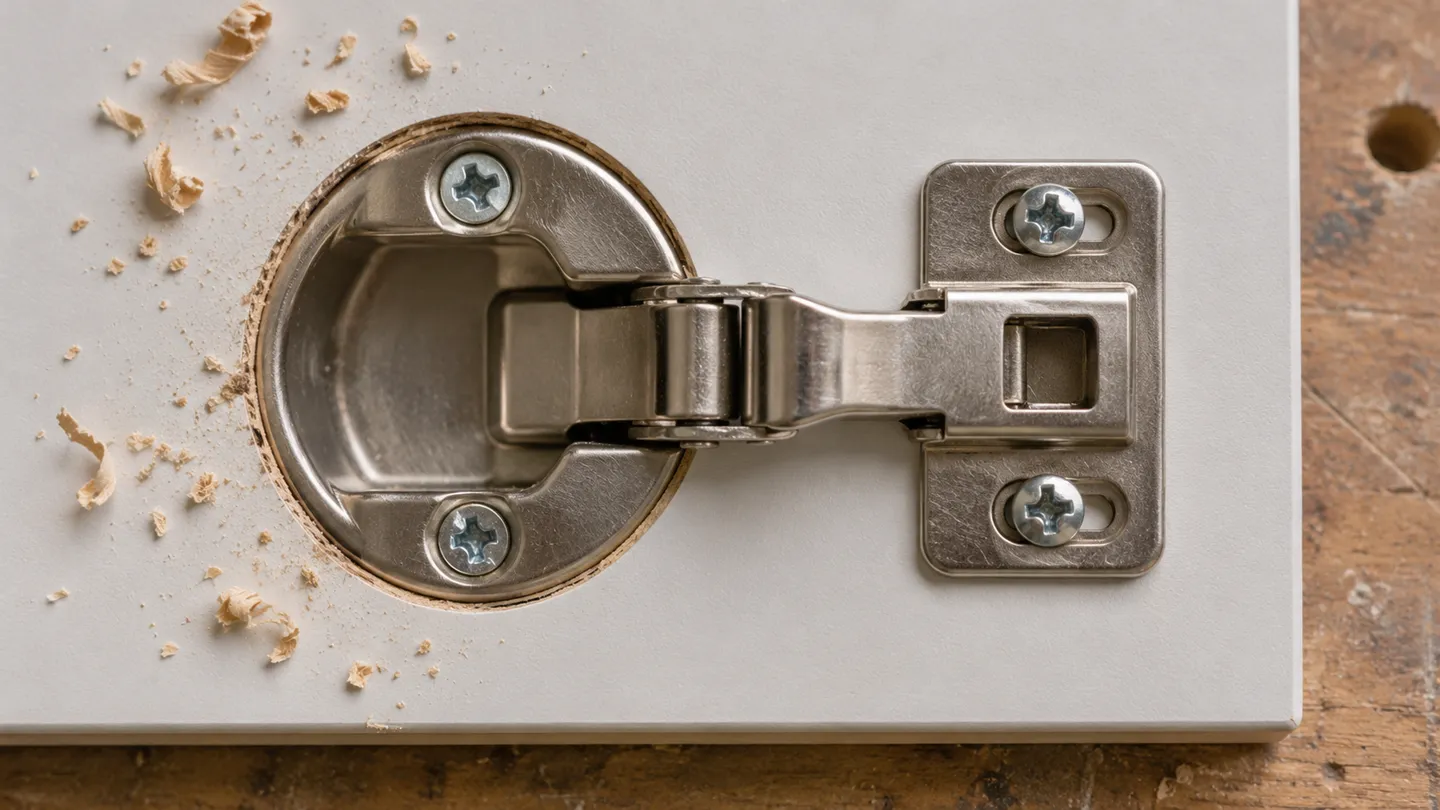
Modern frameless cabinets almost all use concealed cup hinges. A 35 mm cup is bored into the back of the door, the arm folds inside, and nothing shows when the door is closed. The 35 mm cup diameter is the industry standard, which is why replacement cups from different brands are largely interchangeable.
What you must match is the mounting condition, and there are three. An overlay door covers most of the cabinet side, a full-inset door sits flush inside the opening, and a partial-inset door sits between the two. The same cup hinge family covers all three; the difference is the arm angle and the mounting plate. Buy a hinge set up for overlay and try to fit it on an inset door, and the door will not close square. Before ordering, measure two things: whether the cabinet is face-frame or frameless, and how much the door overlaps the opening.
A three-step identification routine
Identification fails when people start with the hinge in their hand instead of the cabinet it came off. Work in this order. First, open the door and look at the barrel: visible barrel points to butt or face-frame structure, no barrel points to a concealed cup. Second, look at the cabinet itself: frame around the opening means face-frame construction; clean box sides mean frameless. Third, only then measure the hinge: cup diameter for concealed types, leaf thickness and hole spacing for butt types. This order matters because the cabinet’s construction, not the hinge’s appearance, is what actually determines which structure fits.
The rest of the map, in one paragraph
Spring hinges close the door by themselves and live mostly on lightweight cabinet doors. Pivot hinges rotate the door on a single point at top and bottom, common on glass and cabinet doors. Strap hinges carry barn doors and heavy lids on long decorative leaves. The piano hinge, which runs the door’s full length, deserves its own section below because it belongs to the commercial and industrial side of the map.
One warning before moving on: “concealed” does not mean the same thing everywhere. In furniture catalogs it names the 35 mm cup system. In enclosure catalogs, a concealed hinge is any hinge mounted inside the cabinet so the hardware hides behind the closed door. That placement improves security and shields the hinge from the environment. Same word, two different hinges. When you cross from furniture sources to equipment sources, re-read the definition before you order anything.
Choosing by Cabinet, Door Weight and Usage
Structure tells you what a hinge is. Three practical checks tell you which structure your cabinet needs: door weight, environment, and how the door gets used.
Start with weight, and calculate per hinge rather than per door. A door hangs on at least two hinges, so divide the door weight by the hinge count, then keep a safety margin on top. A 10 kg kitchen door on two hinges asks roughly 5 kg of capacity from each hinge with room to spare, which any decent cup hinge provides. The failure case is the heavy door that still gets light hinges. Weight concentrates toward the bottom of the door, so the lower hinge carries more than its share and fails first.
Then look at the environment. Damp kitchens, outdoor kitchens, and anything washed down with a hose or wiped with solvents push you toward stainless steel bodies. Dry interiors give you the freedom to choose on finish and price instead.
Then look at frequency and feel. Here a quiet shift has happened on both sides of the market. Soft-close dampers, once an upgrade option on kitchen cabinets, are now the default expectation, to the point where catalogs list them without comment. The industrial side made the same move with torque and positioning structures: adjustable-torque hinges and quick-detach mounting now sit in standard catalog sections rather than custom requests. Friction and damping moved from luxury to baseline because both markets reached the same conclusion, that door feel and door control are part of the product, not accessories to it.
Long doors get one extra rule. A single long door or a wide lid, on a workbench or a machine guard, should run on a piano (continuous) hinge that spreads the load along the whole length instead of concentrating it at two points.
Run this sequence before you order, in order, because the first unanswered step is always the one that produces sagging doors.
Door hinge self-check
- 1Estimate door weight and divide by hinge count, then add a safety margin.
- 2Confirm the environment: dry interior, damp, outdoor, or washed down.
- 3Decide frequency and feel: free swing, soft-close, or held-open position.
- 4Long door or wide lid: move to a continuous piano hinge.
- 5Only now pick structure and finish.
Specifying Hinges for Equipment Doors
At the equipment level, hinge selection stops being a furniture decision and becomes a specification exercise. The door of an electrical enclosure, an industrial oven, or a test chamber is part of a sealing and safety system, so the hinge is chosen against parameters, not looks. The four questions below are how design engineers actually work through it.
The four mounting styles, and what each one commits you to
Industrial catalogs group mounting into four styles, and each style is really a decision about maintenance and sealing. External (surface) mounted hinges are the simplest to fit and give the widest choice of structure and material; the trade is that the hinge lives in the environment. Concealed (internally mounted) hinges hide behind the closed door, which protects the hardware, improves security, and keeps the panel line clean. Lift-off and removable hinges split into two parts so the whole door can be lifted or pulled free without tools, built for enclosures that get serviced; if two or more lift-off hinges are mounted in the same orientation, the door comes off in one motion. Embedded and weld-on options integrate the hinge into the panel itself, common on large-scale manufactured enclosures where the hinge must never work loose.
Choose by asking what the maintenance schedule looks like. A sealed outdoor cabinet that no one opens favors concealed stainless mounting. A server or telecom cabinet that technicians enter weekly wants lift-off or removable hardware. A control panel that must hold itself open at reading angle wants torque, not hinges at all.
Send us your door weight, environment, and duty cycle, and our engineers will match the mounting style, material grade, and torque class to your enclosure.
Get a mounting recommendationStructure and parameter pairings
The catalog parameters are where “industrial” stops being an adjective. Industrial oven and test chamber doors commonly exceed 100 kg, and heavy-duty butt hinges are rated to carry doors above that figure (KUNLONG, 2026). Temperature range matters just as much: equipment hinges are specified to run from -70°C up to +260°C, the span an oven or cold-chamber door actually sees (KUNLONG, 2026). Life is measured in cycles, not years; a catalog-grade industrial hinge line is tested to a minimum of 24,000 opening cycles. Torque hinges add a holding specification: positioning hinges divide into constant-torque and adjustable-torque types, where the adjustable kind uses a set screw to fine-tune the friction that holds the door at any angle; stock catalog torque hinges list values in the 0 to 1 N·m class. Materials complete the spec: zinc alloy and plated steel for general cabinets, SUS304 stainless for most corrosive settings, SUS316 for chemical and salt-heavy environments, and engineering plastics such as POM where weight and damping matter more than load.
Opening angle is a real constraint on equipment doors. Catalog hinges specify 90, 125, 180, 245, and 270 degree versions, and the angle you need depends on what sits beside the door: a door swinging 180 degrees flat against the cabinet needs clearance that a 90-degree hinge never provides.
The boundary matrix
Every structure has a condition that breaks it. The matrix below is the selection tool: find your scenario in the left column, then read across before you commit.
Structure selection matrix: fit, capacity, and failure boundaries
| Structure | Best fit | Load and environment | Fails when |
|---|---|---|---|
| Heavy-duty butt hinge | Oven, test chamber, machine doors | Doors over 100 kg, -70 to +260°C spec range | Undersized for the per-hinge load share, or mounted on a warped frame |
| Concealed (internal mount) | Outdoor and sealed enclosures, clean panel lines | Protected from weather and wash-down | Specified on a door that needs frequent full removal |
| Lift-off / detachable | Service doors on server, telecom, HVAC cabinets | Light to medium doors, frequent access | Handed wrongly (left/right), or paired with heavy sealed doors |
| Torque / friction hinge | Control panels, displays, small doors | Light panels, holding torque 0 to 1 N·m class | Used as primary support on a heavy door, torque drifts under load |
| Piano (continuous) hinge | Long doors, lids, machine guards | Spreads load along full length | Mounting surface not straight, so load concentrates at screw points |
| Stainless SUS316 version | Chemical, salt, wash-down environments | Corrosion class above SUS304 capability | Substituted with SUS304 in salt spray service |
Translating “industrial grade” into checkable parameters
Three moves turn a supplier’s adjective into a specification you can hold them to. First, ask for the cycle rating: how many opening cycles is the hinge tested to, and is that a catalog-listed minimum? Second, ask for the environment pair: the temperature range and the corrosion resistance, each stated as a tested figure or a material grade. Third, ask what is in the test list: salt spray, load, life, and torque testing are the entries that separate a real test program from a brochure. Any supplier who cannot answer those three questions is selling the adjective, not the hinge.
Why Cabinet Doors Fail, and What to Check
A cabinet door almost never fails without warning. The failure chain is short enough to check in order, and the first two causes account for most of what shows up as “the door is broken.”
The first cause is sag. A door that drops on the latch side is telling you the per-hinge load exceeds the hinge rating, or the mounting plane has shifted. Diagnosis order: recalculate the load share, then check the mounting screws and the frame surface before you condemn the hinges. On long doors, sag at one end usually means the load is concentrating at the hinge nearest the sag, which is a piano-hinge conversation, not a screw-tightening one.
The second cause is the door that will not close or seal. On equipment cabinets this is rarely the hinge alone: industry diagnosis of enclosure doors that will not shut points to four stacked causes, sheet metal tolerance, hinge sag, gasket compression, and shipping damage (TopCabinet, 2026). A sagged hinge compresses the gasket unevenly, the seal line breaks, and on an oven or chamber door that seal failure becomes a temperature drift. This is why the hinge is treated as part of the sealing system, not just a moving joint.
The third cause is fastener pull-out, where the screws leave the mounting surface. It is a substrate problem more than a hinge problem: screw thread and panel thickness have to match, and thin sheet metal needs thread-forming fasteners rather than wood screws.
What makes these three causes expensive is that they chain. A slightly undersized hinge sags a millimeter a month, the sag compresses the gasket at the latch corner, and months later the door “suddenly” stops sealing. That is why the diagnostic order matters more than the diagnosis itself: work from load share to mounting geometry to gasket, and the real cause shows up before you have spent money on parts that were never the problem.
Before replacing hinges, measure the door: check diagonal deviation and frame flatness first. A warped cabinet or a compressed gasket will sag a new hinge just as fast as the old one. Replace hardware only after the mounting geometry checks out.
Acceptance closes the loop. When you install or replace equipment door hinges, the specification to hold is written in cycles: catalog-grade industrial hinges carry a tested minimum of 24,000 opening cycles with a 1-year warranty (KUNLONG, 2026). That is the floor worth remembering: an industrial cabinet hinge is not proven by the word “industrial,” it is proven by a 24,000-cycle test rating you can ask to see.
The acceptance floor
Minimum life acceptance for industrial cabinet hinges, as published on the category listing, with a 1-year warranty behind it.
Reading Hinges Like a Buyer
Everything above converts directly into buying language. The buyer’s job is different from the engineer’s: the engineer picks a structure, the buyer picks a supplier who can actually deliver that structure to specification, batch after batch.
Turn the spec sheet into RFQ questions
Write the inquiry around the parameters, and the supplier list sorts itself. Ask for the cycle rating in writing. Ask which test items the product passes, and ask for the material grade by designation, not by color name. Ask whether the quoted delivery applies to stock items or customized production, because the two answers differ by weeks: stock ranges ship in about 7 days while customized production typically takes 30. Ask the minimum order quantity as a plain question; suppliers with mature production lines run low or no MOQ on catalog items. Ask whether 3D models are available before you commit, because a supplier who publishes CAD files lets your engineer verify fitment without a sample round-trip.
The RFQ question list
Stock structure and acceptance clauses
Stocking follows the same structure map the engineers use. General-purpose butt and cup hinges are commodity volume; the margin lives in the specialized structures, stainless grades for corrosive environments, detachable hardware for service doors, and torque hinges for panels, because those are the items a buyer cannot source from a general hardware shelf. A stance worth stating plainly: weight your stock toward the specialized structures and accept the slower turns, because the commodity end of the range is a price war you will not win.
On acceptance clauses, hold one line: a supplier quote that arrives cheaper because the test list got shorter is not cheaper. Write the cycle rating, the temperature range, and the test items into the purchase specification, then compare prices on equal footing.
This is also where we can put numbers behind that reading. KUNLONG’s hinge line is catalog-tested to a minimum of 24,000 cycles with a 1-year warranty, ships stock items within about 7 days, and carries no minimum order quantity on catalog hinges; you can check the industrial cabinet hinge catalog against the RFQ questions above before you talk to anyone.
If you want to test that workflow on a specific door, our 3D model library lets you drop the exact hinge geometry into your cabinet model and confirm the fit before the first sample ships.
Hold your next hinge quote to these numbers
Cycle ratings, test lists, temperature ranges, and torque classes are published on every KUNLONG catalog page; stock hinges ship in about 7 days with no MOQ on catalog items.
Start your hinge RFQReferences
- TopCabinet. “Enclosure Door Won’t Close? Tolerance & Hinge Fixes.” 2026. https://topcabinet.com/enclosure-door-wont-close-tolerance-hinges-sheet-metal/