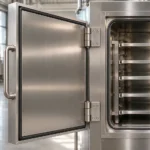



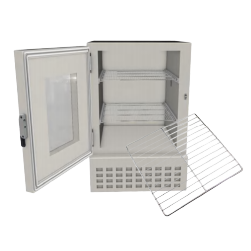
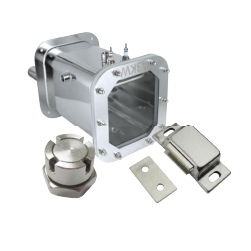
A 200-kilogram oven door swings on two steel barrel hinges, six times an hour, in a chamber that cycles from -40°C to +180°C. The hinge catalog says “heavy duty, 500 lbs.” The door drops anyway, eighteen months in, and the hinge manufacturer points out that the rating assumed a narrower door, a different mounting plate, and room-temperature testing. Nothing on the spec sheet was technically false. The number just never described this door.
This article is about that gap between the printed number and what your door actually gets. The numbers span three orders of magnitude under one label, the rating conditions hide in fine print, and the mounting hardware fails before the hinge does. We will walk the full chain. First, what a capacity rating actually rates, and the real ranges by hinge type. Then the calculation that comes first, and how to read the fine print on a rating. Last: what heat, corrosion, and cycling do to the number, and what to demand from a supplier before you commit a door design to it.

What a Hinge Weight Capacity Rating Actually Rates
A hinge load capacity rating defines the load a hinge can support within limits for deformation, wear, and service life. That load is not just the weight of the door sitting still. It bundles three different things: the static load of a closed door, the dynamic load of repeated cycling, and the moment load created by door width and center of gravity. Published maximum-door-weight figures assume specific door dimensions, hinge spacing, and mounting conditions. When any of those change, the effective capacity changes with them.
Here is the first trap. “Heavy duty” is not a standardized weight classification (Gate Openers Unlimited, 2025). Manufacturers attach the phrase to polymer self-closing hinges rated for a pedestrian gate of roughly 150 pounds, and to industrial roller-bearing weld-on hinges rated for several thousand pounds per pair. Same aisle, same words, numbers three orders of magnitude apart.
The workable fix is to sort doors into layers before comparing any numbers:
Where Your Door Sits: Three Capacity Layers
| Application layer | Typical capacity (as rated) | Typical door examples | Rating style |
|---|---|---|---|
| Residential gates and light doors | 50-150 lbs per pair | garden gates, picket gates, interior doors | per pair, self-closing polymer or light steel hinges |
| Commercial gates and heavy leaf doors | about 150 lbs to several thousand lbs per pair | driveway gates, security doors, farm gates | per pair, weld-on or bolt-on barrel hinges |
| Industrial equipment doors | 100+ kg (about 220 lbs) up to multi-ton doors, rated per hinge with stated conditions | test chamber and oven doors, cold storage doors, large cabinet doors | per hinge or per set, bearing construction and test conditions specified |
Sources: Gate Openers Unlimited (2025); GForce Hinge (2025); Kiesler Machine (2025)
Find your layer first. A walk-in chamber door and a garden gate both get sold hinges labeled “heavy duty,” and they have almost nothing else in common. The rest of this article follows the layers upward. The questions change at each layer. The homeowner asks why the gate sags. The installer asks which hinge family fits the door. The equipment maker asks what test conditions stand behind the number.
Weight Capacity by Hinge Type: Real Ranges and Rating Conditions
Hinge families differ in how they carry load, so their capacity figures are not directly comparable. What follows is the practical range map, with the rating unit spelled out for each family. Per-hinge and per-pair figures get mixed on catalog pages more often than most buyers expect.
Hinge Families: Capacity Ranges and What to Watch
| Hinge family | Typical capacity (as rated) | Typical applications | Boundary: where it stops working |
|---|---|---|---|
| Butt hinges (machine/surface) | light to medium duty; commonly specified under building-grade rules by door weight bands | cabinet doors, control panels, light enclosures | wrong grade for the door weight band, or screw fixings into weak substrate |
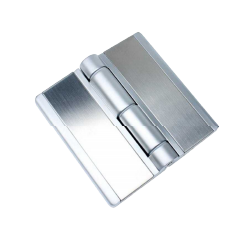
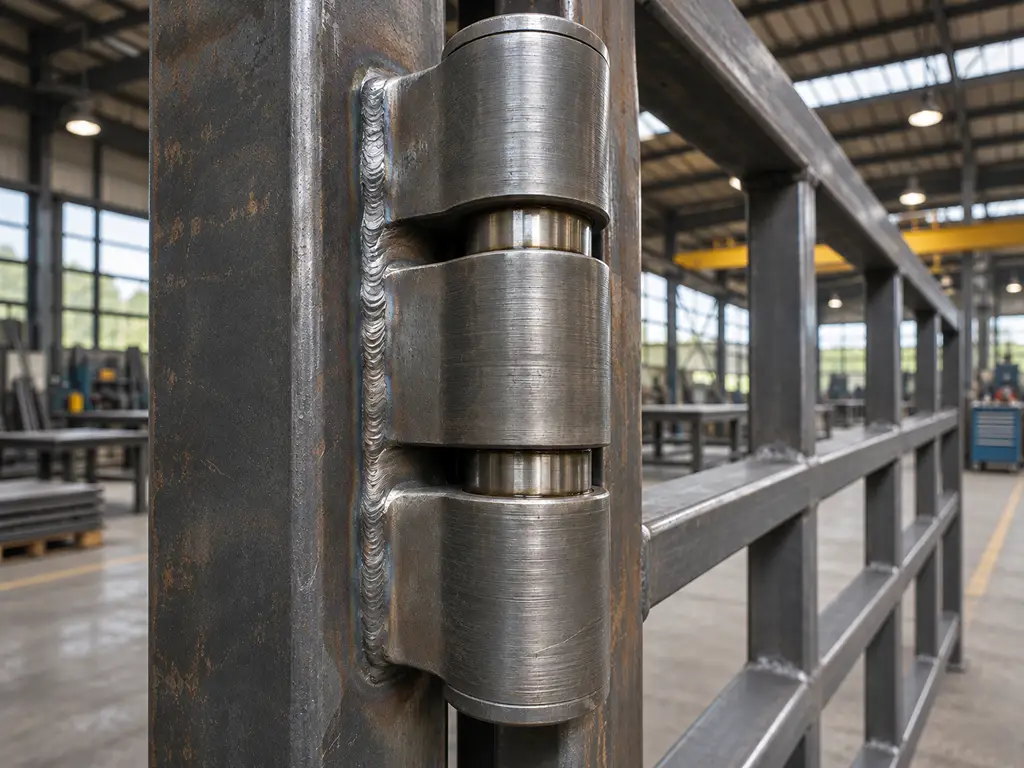
| Weld-on barrel hinges | per pair: about 150 lbs (self-closing sets) up to 3,000 lbs and above; industrial versions rate up to 20,000 lbs door weight and 8,800 lbs radial load on large models | driveway gates, security doors, heavy industrial doors | weld quality and post strength below the hinge rating, or rating applied per pair read as per hinge |
| T-hinges and strap hinges | residential-gate class, commonly within the 50-150 lbs per pair band depending on gauge and fixings | shed doors, barn doors, gates | thin strap gauge or screw pull-out in wood posts |
| Continuous (piano) hinges | load spreads along the full length, ratings often quoted per foot or per meter of length | long panels, equipment covers, doors needing even support | deflection over long spans, or per-foot rating misread as a whole-door rating |
| Concealed hinges | low profile, moderate loads, 180-degree opening typical | appearance-critical panels and doors | loads beyond the low-profile structure, or mounting inside thin board |
| Detachable (lift-off) hinges | moderate loads with vertical lift-off for door removal | equipment doors needing maintenance access | lift-off variants must stay aligned, and capacity drops if the door is often removed and re-hung misaligned |
| Torque (friction) hinges | rated in torque (N·m), not door weight; opening angles of 245-270 degrees with adjustable damping are typical | position-holding lids, panels, displays | treating a torque value as a weight rating, which it is not |
| Offset hinges | moderate loads | swing clear of seals and obstructions | doors where the offset geometry is needed for seal clearance, capacity secondary |
Sources: Gate Openers Unlimited (2025); Kiesler Machine (2025); Weber Knapp (2026); Sugatsune (2026)
Three quick answers to the questions buyers most often ask. A 12-inch T-hinge in typical shed-and-gate sizes lives in the residential-gate class, where most hinges support between 50 and 150 pounds per pair (GForce Hinge, 2025). The deciding variable is strap gauge and what the screws thread into, not the label. A piano hinge carries weight differently from every other family: the load spreads along its full length, which reduces local stress. It still carries a bending moment set by door width and center of gravity, and ratings are quoted per unit of length. And the family that holds the most weight is not subtle: bearing-equipped weld-on barrel hinges for industrial use. Large models publish maximum door weights of 20,000 lbs and radial loads of 8,800 lbs.
One more boundary line. If you source architectural hinges in the UK or EU, you will meet the BS EN 1935 grade system. In that system, Grade 10 covers doors to about 60 kg, Grade 12 to about 100 kg, and Grade 13 to about 120 kg. The system belongs to building door hardware. Industrial weld-on and equipment-door hinges are not graded in it, and using a building grade table to specify a chamber door hinge is a category error.
From Door Weight to Hinge Load: The Calculation That Comes First
Capacity selection starts with a calculation, not with a catalog. The sequence below takes ten minutes on real door geometry, and it catches the mistakes that show up later as sagging, binding, and worn fasteners.
- 1
Weigh the total assembly.
Include insulation, glazing, hardware, reinforcement plates, and anything mounted off-center. If the door weighs 200 kg in service, that is the number the hinge sees.
- 2
Locate the true center of gravity.
On irregular assemblies it rarely sits at the visual midpoint. Suspend the panel from two points and mark vertical lines, calculate it in CAD with verified material properties, or measure force at angles to find the balance point.
- 3
Compute the moment at the hinge line.
Moment = door weight × distance from pivot to center of gravity. A 200 lb door with its center of gravity 20 inches from the hinge line puts 4,000 inch-pounds on the hinge system.
- 4
Check the width effect.
The same 200 lb door at 48 inches wide produces far more hinge moment than at 24 inches. Width multiplies leverage.
- 5
Add a safety factor that matches duty.
Building-door practice adds about 10% for heavy use, 20% for a door closer, and 75% more where the closer has backcheck. High-cycle industrial doors should carry a larger margin and demand cycle-life data from the supplier.
The moment calculation is the step most selections skip. Moment equals force multiplied by distance, so the farther the center of gravity sits from the pivot, the higher the bending load on the knuckles and pin. A hinge picked on total door weight alone can look fine on paper and still deflect in service, because the moment from width was never calculated.

Doors on horizontal or tilted axes follow a second, separate rule: torque hinges are selected by torque, not by door weight. The working formula is torque = ½ × D × W. D is the panel depth measured perpendicular to the hinge axis, and W is the door weight. Keep the two tracks apart: a torque rating holds a lid at position, it does not certify a carrying capacity.
Two selection tracks
Weight track: hinges rated in door weight.
Torque track: hinges rated in N·m, torque = ½ × D × W.
One boundary on the numbers above. The +10% / +20% / +75% adjustments come from building-door practice. Equipment doors in chambers, ovens, and cold rooms cycle harder and run at temperature extremes. Treat those figures as a floor, not a target, and require cycle-life data at your actual duty instead of assuming the building-door margin carries over.
Selecting for Capacity: Structure, Hinge Count, and the Fine Print on Ratings
Structure Parameters That Rewrite the Same Number
Two hinges with the same footprint do not have the same capacity. Leaf thickness, pin diameter, knuckle length, and bearing construction all move the real limit. Bearing construction spans plain bearings, bushings, and rolling elements, and a size chart alone does not define capacity. Bearing type matters most over time. A plain bearing hinge can hold its rated load under static conditions and still wear quickly under high cycle counts. Bushed and rolling-element designs distribute contact stress and hold their rating for more cycles. When two catalogs quote the same maximum door weight, the one that publishes leaf thickness, pin diameter, and bearing construction is the one you can actually evaluate.
Hinge Count and Spacing: Why Three Does Not Divide by Three
The arithmetic most buyers run, total weight divided by hinge count, is not how the load distributes. Three hinges do not automatically split the load into three. The top and bottom hinges on a tall door carry more moment load because they resist rotation. Adding a third hinge does not raise safe capacity by 50% either, unless the manufacturer explicitly permits that multiplication (Gate Openers Unlimited, 2025). Alignment dominates: in theory two hinges share the load equally, in practice, if mounting surfaces are not coplanar within 0.1 mm, one hinge carries 60-70% of the torque.
The Fine Print That Fails Doors
0.1 mm
of mounting out-of-plane is enough to overload one hinge
60-70%
of the total torque can land on a single hinge
Capacity selection that ignores mounting flatness is not a selection, it is a guess.
Spacing works the other lever. Widening the vertical distance between upper and lower hinges reduces the horizontal reaction each attachment must resist (Gate Openers Unlimited, 2025). Closely spaced hinges on a tall or wide leaf concentrate load into the hinge bodies, welds, and post.
Reading the Fine Print on Ratings
The same catalog line can carry two different numbers, and they are not synonyms. A structural load rating describes what the hinge assembly survived in testing. The maximum door weight is the manufacturer’s working limit for a hanging door in a stated configuration. A hinge set with a 3,000-pound load rating may limit the actual gate leaf to 1,500 pounds (Gate Openers Unlimited, 2025). The 3,000 figure is not permission to hang a 3,000-pound door. Check whether the rating applies to one hinge, one matched pair, or a complete pivot set, because 1,000 pounds per pair does not approve each hinge for a 1,000-pound gate.
The honest boundary: if a hinge lists no load rating with defined test conditions, you are relying on assumption rather than data. It is worth asking the manufacturer’s engineering team for the conditions behind the number.
The Load Path Beyond the Hinge
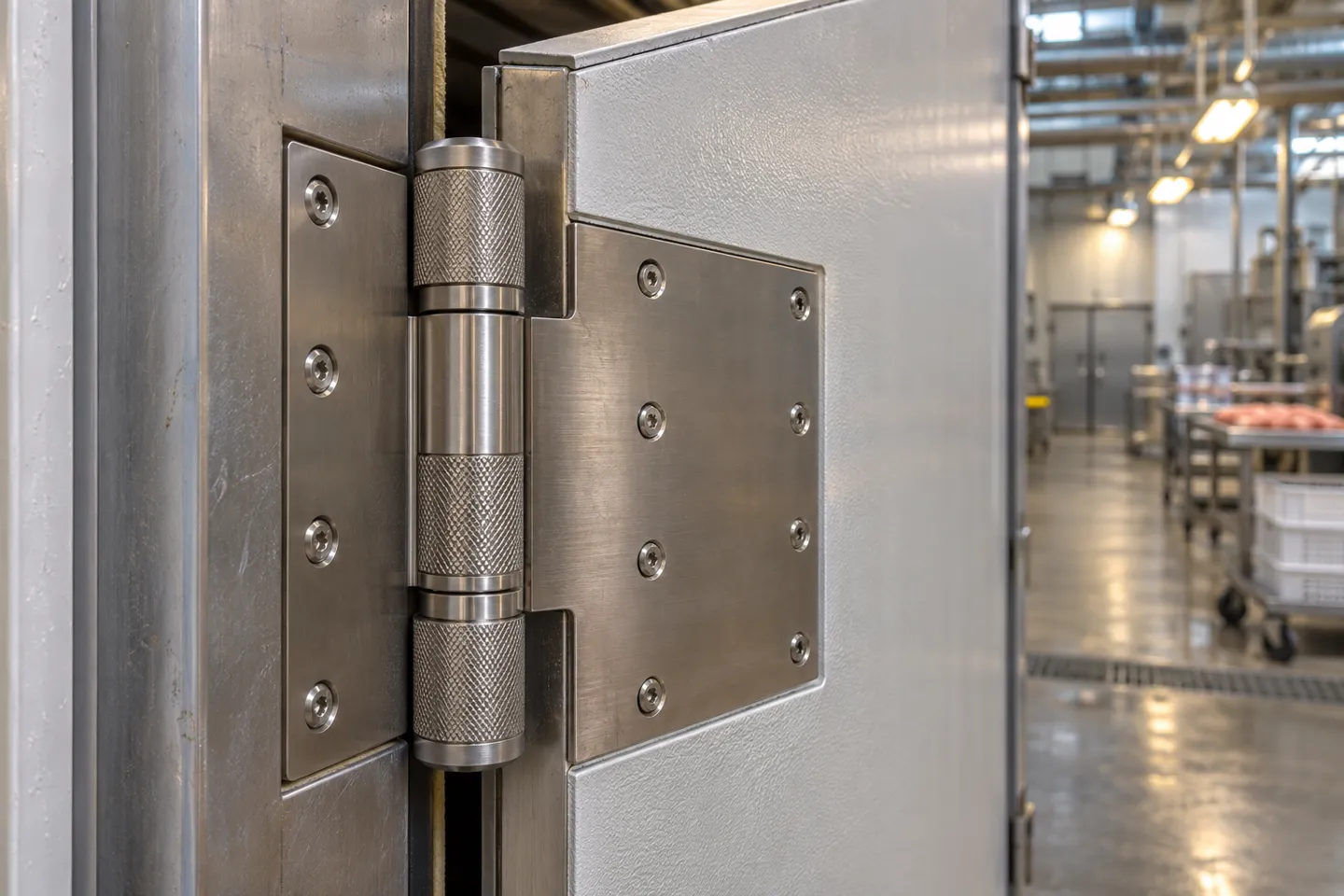
Hinges do not fail in isolation. Load transfers through screws, welds, and structure, and the weakest link in that path sets the real capacity. A rated hinge mounted to thin sheet metal with short self-tapping screws will elongate its fastener holes under repeated cycling. The hinge shifts out of alignment, and a smooth door becomes a binding one. Fastener shear and pull-out strength need to match the hinge rating, not just the door weight. So do weld size and base-metal thickness for weld-on types, and the stiffness of the door frame and post.
Putting the layers together for common equipment doors:
Application x Hinge Family x Failure Boundary
| Application scenario | Suitable hinge families | The boundary that fails first |
|---|---|---|
| Interior household doors | butt hinges within building weight grades | screw fixing into weak substrate |
| Garden and driveway gates | weld-on barrel hinges, sized per pair | post strength and weld below the hinge rating |
| Control cabinets and panels | butt or concealed hinges | thin board mounting and hinge grade mismatch |
| Test chamber and oven doors | heavy-duty barrel hinges rated with temperature and cycle conditions | room-temperature rating applied to a -70 to +260 Celsius duty, or sealing compression ignored |
| Cold storage doors | refrigerator-duty and lift-off heavy hinges | low-temperature embrittlement and ice loading unaddressed |
| Appearance-critical equipment panels | concealed hinges | load beyond the low-profile structure |
Sources: Gate Openers Unlimited (2025); Weber Knapp (2026)
Before you sign off a selection, confirm the mounting surface flatness and fastener pull-out strength, not just the catalog number. That single check separates a selection from a guess.
When Ratings Meet the Field: Heat, Corrosion, Cycles, and Sag
Temperature Moves the Limit
Ratings are established at room temperature, and equipment doors do not live there. At low temperatures steel transitions toward brittleness and polymer components stiffen. At high temperatures strength and surface hardness drop. A door cycling between deep negative temperatures and baking heat, as test chamber and oven doors do, needs a rating that holds across its service temperature range. Put that question to the supplier with the actual range attached.
Four Field Conditions That Rewrite the Number
- Temperature
Ratings are established at room temperature; steel embrittles in deep cold and softens in baking heat.
- Corrosion
Salt spray shrinks the load-bearing section even when the door weight never changed.
- Cycle count
Static capacity and cycle life are different limits; high-frequency cycling wears bearings out in months.
- Seal compression
Gasket pushback adds a squeezing load every cycle on chamber and oven doors.
Corrosion Shrinks the Working Section
Salt spray and industrial atmospheres corrode pins and bearing surfaces. Corrosion shrinks the effective load-bearing section even when the door weight never changed. Material and finish choice is the countermeasure: stainless construction for corrosive and washdown duty, appropriate plating and sealing elsewhere. This is a derating issue, not an appearance issue.
Cycle Count Is a Separate Curve
Static capacity and cycle life are different limits. A hinge can hold a heavy door closed for years and still wear out in months of high-frequency cycling. Bearing structure and lubrication decide how fast the rating decays in use. For doors opened dozens of times a day, the number to demand is a tested cycle count at load, not a static maximum. Cycle-test data in the tens of thousands of openings exists and should be a line item in the specification.
Sealed Doors Push Back
Equipment doors close against gaskets. Seal compression adds a squeezing load every cycle, and some chamber and oven doors use pressure-relief or lift-off hinge geometry specifically so the hinge line does not fight the seal. A gate-style selection that ignores seal reaction will feel right in the showroom and drag within weeks.
When a door sags anyway, work the diagnosis in this order before blaming hinge capacity:
- 1
Door leaf bracing and frame stiffness. Installers keep finding that new, stronger hinges still sag when the real fault is a brace or frame that never carries the load to the hinges, as gate owners report repeatedly after upgrades.
- 2
Fasteners and base material. Elongated screw holes in thin sheet metal or soft wood mimic hinge failure.
- 3
Mounting surface coplanarity. Out-of-plane mounts overload one hinge, see the 0.1 mm figure above.
- 4
Hinge wear itself. Check pin and bearing play last, once the path is proven sound.
How to Vet a Heavy Duty Hinge Supplier
Everything above reduces to one purchasing question: what evidence stands behind the number? A supplier worth specifying can answer all six checks below without improvisation.
Ratings with test conditions: maximum door load stated together with door width, hinge spacing, and mounting assumptions.
Temperature and cycle data: rating validity across your service temperature range, and tested cycle counts at load.
Structure specs in the open: leaf thickness, pin diameter, bearing construction, material grade.
Finished-product test battery: load, life, high and low temperature, salt spray and similar tests run on the product, not just the material certificate.
Certifications and documents: ISO quality system, third-party material reports, ROHS and REACH as your market requires.
Engineering support: downloadable 3D models and drawings so your team verifies fit before ordering, and selection engineers who answer condition questions.
That checklist is not hypothetical. It describes how a specification-grade hinge line presents itself. Our heavy-duty hinge series, KUNLONG, publishes the numbers with their conditions. The ratings read: door loads above 100 kg, durability past 24,000 opening and closing cycles, and service temperatures from -70 to +260 degrees Celsius (Kunlong, 2026). A battery of 15 finished-product tests covers load, life, high and low temperature, and salt spray (Kunlong, 2026). We hold those figures in SUS304 stainless construction with low-profile 180-degree geometry, and in lift-off and pressure-relief variants for sealed doors. The 3D models and test documentation are available before you commit a design, which keeps the numbers verifiable. The point is not that we passed the checklist. The point is that any supplier you trust should be able to fill in every line above with specifics, and if one cannot, you have your answer.
What This Means for Your Purchasing Spec and Inventory
The chain we just walked changes how the buying documents should read. Because “heavy duty” carries no standard weight, catalog numbers cannot be compared between suppliers until conditions are attached. Ratings also hide per-pair and per-set semantics, and structural ratings differ from working limits. A specification that says only “heavy duty hinge, 500 lbs” lets every vendor answer with a different number. And because heat, corrosion, and cycles derate the printed rating in the field, the spec has to bind the number to the duty.
For procurement teams, the move is concrete. Write temperature range, cycle count, maximum door weight at stated width and spacing, required test items, and material grade into the BOM line itself. With those five fields in the spec, quotes become comparable and sample testing becomes meaningful. For distributors, the same logic applies to inventory. Stock and segment by structure (bearing construction, material, lift-off capability) rather than by the words on the box. The words are unregulated; the structures are what actually carry the door.
The stance is simple. A specification without conditions hands the decision to the supplier’s marketing department, and that is the most expensive place to leave it. And when you are ready to verify fit before you buy, our 3D models library puts over 6,000 CAD models and full technical documents behind the numbers (Kunlong, 2026). The checklist above can be completed before the first quote.
Verify the Number Before You Commit the Door
Get the KUNLONG rating sheets, cycle-test data, and 3D models for your door geometry before the first quote.
Get Rating Sheets & 3D ModelsReferences
- Gate Openers Unlimited. “Heavy-Duty Gate Hinge Weight Capacity Guide.” 2025. https://www.gateopenersunlimited.com/heavy-duty-gate-hinge-weight-capacity.html
- GForce Hinge. “How Much Weight Can a Gate Hinge Hold?” 2025. https://gforcehinge.com/how-much-weight-can-a-gate-hinge-hold/