


Ask anyone who has ever stood in a hardware aisle holding two hinges that look identical and wondered which one is actually right, and you will hear the same frustration: the size markings make sense only after you already know how to read them. Add the fact that the same hinge family is quoted in inches in North America and in millimeters everywhere else, and a simple purchase turns into a research project.
This guide fixes that. It covers how butt hinge sizes are stated, the standard size ranges in both inch and metric terms, how to match a size to door weight and height, the metric track used for industrial cabinets and enclosures, and how to measure an existing hinge for an exact replacement.
How Butt Hinge Sizes Are Stated (What the Numbers Mean)
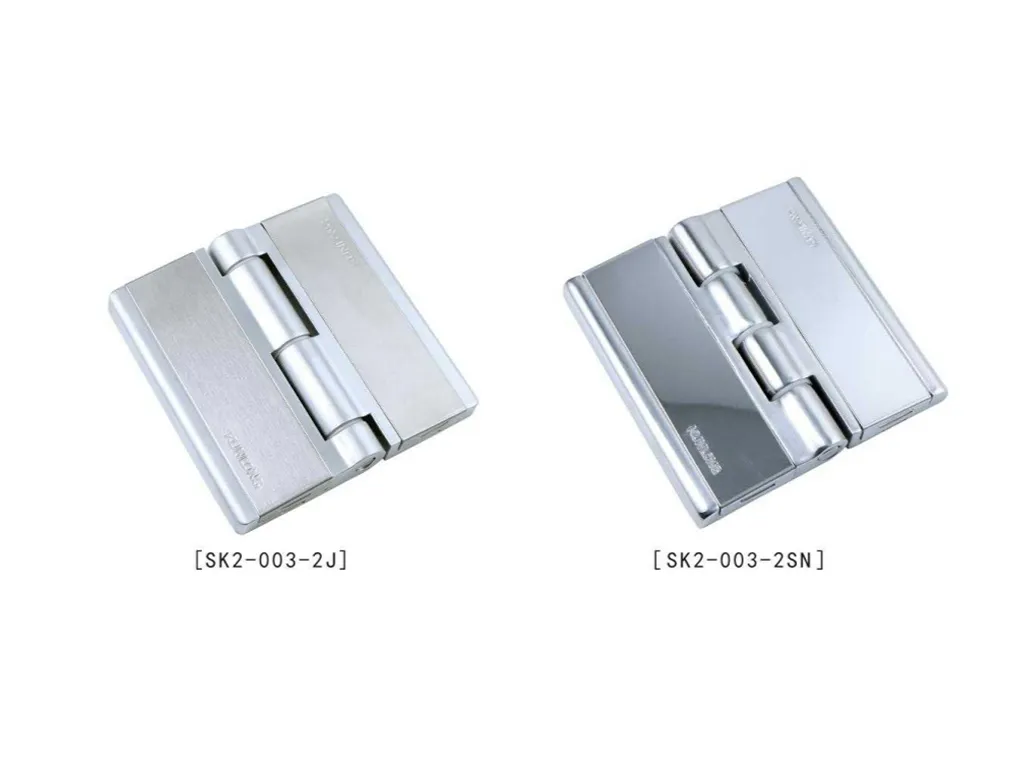
A butt hinge size is always given as two numbers: the height first, then the open width. A hinge listed as 4″ × 4″ stands 4 inches tall along the pin and measures 4 inches across both leaves when opened flat. The convention of height before width is an industry rule, not a preference. Mixing up the two is the most common sizing mistake in hinge orders.
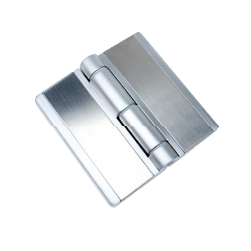
The numbers refer to three physical parts. The leaves are the two flat plates screwed to the door edge and frame. The knuckle is the interlocking barrel along the center, and the pin runs through it. Leaf width is measured from the center of the pin to the outer edge of a leaf, half of the open width. Leaf thickness, called the gauge, is what separates a light residential hinge (around 0.150″) from a heavy commercial one (0.180″ to 0.203″). All of these terms appear on spec sheets, and they all change with size.
Standard Butt Hinge Sizes: An Inch and Millimeter Reference
The standard butt hinge size range runs from 3″ to 6″ in half-inch steps, and each size has a well-defined job. The commercial workhorse is 4.5″ × 4.5″. It is the default specification for hollow metal doors and the minimum required by NFPA 80 for fire-rated assemblies, which also mandate ball-bearing construction and steel or stainless steel material (iDigHardware, 2016). Grade levels and cycle-test requirements for each size are set by the ANSI/BHMA A156.1 Butts and Hinges standard (BHMA, 2025).
| Nominal Size (in) | Metric Equivalent (mm) | Typical Application |
|---|---|---|
| 3″ × 3″ | 76.2 × 76.2 | Light interior doors, small cabinet doors |
| 3.5″ × 3.5″ | 88.9 × 88.9 | Standard interior doors up to 1-3/8″ thick |
| 4″ × 4″ | 101.6 × 101.6 | Entry doors, solid-core interior doors |
| 4.5″ × 4.5″ | 114.3 × 114.3 | Commercial standard; fire-rated doors |
| 5″ × 5″ | 127 × 127 | Heavy commercial, oversized doors |
| 6″ × 6″ | 152.4 × 152.4 | Industrial doors, high-traffic entrances |
Here is the part most size charts skip: outside North American door framing, industrial hinges do not circulate as converted inch values. They circulate as clean metric series, 30, 40, 50, and 60 mm, used for cabinets, enclosures, and equipment panels. That track deserves its own section, and it gets one below.
Matching Hinge Size to Door Weight, Thickness, and Height
Size is not a status symbol. A hinge too large for a thin door needs a deeper mortise and can split the edge; a hinge too small for a heavy door sags within a year. The right size is the one that matches three variables at once: door thickness, door weight, and door height.
Door Thickness and Width: The Base Size Rule
Start with the door slab. The rule professionals use: a 1-3/8″ interior door takes a 3.5″ hinge, a 1-3/4″ door takes 4″ to 4.5″, and doors 2″ or thicker take 5″ to 6″. The setback, the distance from the door edge to the hinge barrel, stays at 1/4″ regardless of thickness.
| Door Thickness | Door Width | Hinge Size |
|---|---|---|
| 1-3/8″ | up to 32″ | 3.5″ × 3.5″ |
| 1-3/8″ | 32″–36″ | 4″ × 4″ |
| 1-3/4″ | 32″–36″ | 4.5″ × 4.5″ |
| 1-3/4″ | 36″–42″ | 5″ × 5″ |
| 2″+ | over 42″ | 6″ × 5″ or 6″ × 6″ |
One exception worth knowing: wide-throw hinges. When a door must swing 180° and clear thick casing or trim, the hinge width deliberately exceeds the height (a 4.5″ × 6″ wide-throw hinge is common), because the extra leaf width pushes the pivot point farther from the face of the door.
Door Weight and Use Frequency: When to Step Up to Ball Bearing
The second variable decides the bearing, and it matters as much as the size itself. Plain bearing hinges, with metal riding directly on metal, are fine for light doors with low traffic. Above roughly 50 pounds of door weight, or beyond about 50 open-close cycles a day, ball bearing hinges become the correct specification; commercial Grade 1 hardware under ANSI/BHMA A156.1 requires them, and they carry a rated life 2.5 million cycles (BHMA, 2025).
| Door Weight | Use Frequency | Hinge Size | Bearing Type |
|---|---|---|---|
| up to 50 lb | low | 3.5″ × 3.5″ | plain bearing |
| 50–75 lb | medium | 4″ × 4″ | ball bearing |
| 76–125 lb | high | 4.5″ × 4.5″ | ball bearing |
| 126–175 lb | medium | 5″ × 5″ | ball bearing |
| 176–300 lb | high | 6″ × 5″ | heavy-duty ball bearing |
The frequency column explains why two hinges of identical size can last a decade in a home and fail in eighteen months on a storefront door. The difference is cycles, not craftsmanship.
Hinge Count and Placement: The Per-30-Inch Rule
Top hinge 5″ from door top, bottom hinge 10″ from door bottom
On fire-rated doors, NFPA 80 requires two hinges for doors up to 60″ in height, and adds one per 30″ of additional height. (iDigHardware, 2016). An 80″ door hung on two hinges fails at the middle span. The unsupported gap between the hinges is where a door corner drops.
Cabinet and Enclosure Hinge Sizes: The Metric Track Most Guides Skip
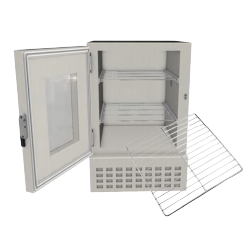
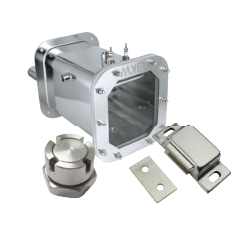
Everything above assumes a building door. But a huge share of butt hinges never touches a door frame. They carry the doors of test chambers, control cabinets, electrical enclosures, and industrial ovens. That world sizes hinges in millimeters and buys them differently, and almost no sizing guide covers it. The buyers are equipment OEMs, not door installers: environmental test chamber and industrial oven builders, telecom and power cabinet makers, and cold-chain and refrigeration equipment manufacturers. The same group includes medical and laboratory device builders and battery and new-energy equipment makers.
Industrial cabinet and enclosure hinges balance four variables: the metric size series, the mounting style, the opening angle, and the load of the door panel plus its environment.
Metric Size Series for Cabinets and Enclosures
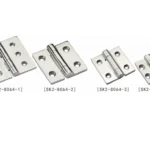
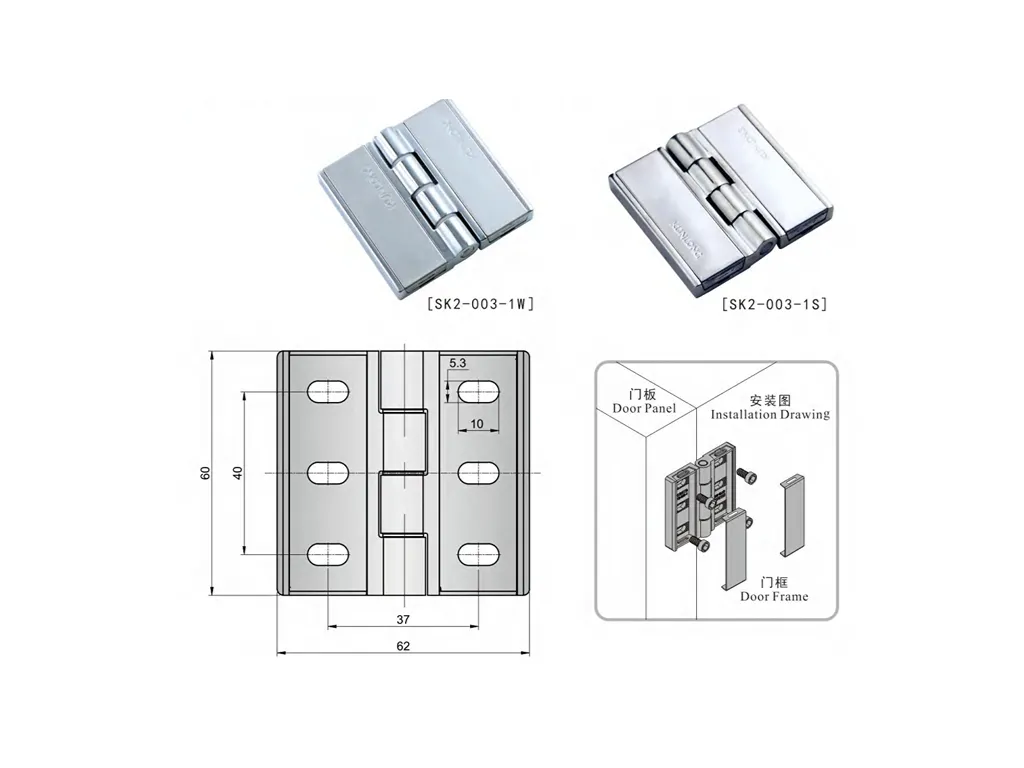
Industrial hinge catalogs quote clean metric sizes rather than converted inches: 30 mm for small access doors and instrument covers, 40 mm for medium cabinet doors, 50 mm for standard enclosure doors, and 60 mm for heavy panels. A common form is the 50 × 50 mm surface-mount hinge, the industrial equivalent of the commercial 4.5″ door hinge.
| Metric Size | Typical Enclosure Application | Notes |
|---|---|---|
| 30 mm | small doors, instrument covers | compact panels, light loads |
| 40 mm | medium cabinet doors | general cabinetry, control boxes |
| 50 mm | standard enclosure doors | the workhorse of machine and cabinet builds |
| 60 mm | heavy panels | equipment doors over 50 kg, ovens, test chambers |
Panel height sets the starting point (roughly 40 mm for cabinet doors under 500 mm tall), but load always gets the final vote.
Mounting Styles and Opening Angles
The second variable is how the hinge attaches. Surface-mount hinges screw flat onto the door and frame faces; they are quick to retrofit and visible when closed. Countersunk-mount hinges sit flush in machined recesses for a clean seal. Threaded-stud mounts thread into tapped holes from behind, which keeps the front face fastener-free. Choosing wrong here is a fit problem that no size correction can fix.
Then the opening angle. Standard butt hinges open 180°; enclosure work frequently needs 270° so the door folds fully back and out of the technician’s way during service. Lift-off hinges go a step further: the door lifts straight off the frame, which matters when equipment must move through the opening. For panels that must hold position at any angle, torque hinges with adjustable friction replace the free-swinging design entirely.
How to Write a Spec That Gets Quoted Right
The most avoidable delay in enclosure hardware procurement is an underspecified RFQ. A line that reads “50 hinges, cabinet” gets five follow-up questions before any pricing. A line that reads like this gets a quote in one round:
- Size: 50 × 50 mm
- Mounting: surface mount (or countersunk / threaded stud)
- Opening angle: 180° standard (or 270°)
- Material and finish: SUS304, salt-spray rated (or zinc alloy, powder-coated)
- Quantity: per-cabinet count plus annual usage
This format is written for an industrial hardware manufacturer. Send it to a door-hardware distributor and three of the five fields mean nothing.
That last field matters more than buyers expect. Standard metric sizes are typically stock items that ship within a week. Non-standard dimensions move to a custom track measured in weeks, with minimum order quantities around 100 pieces. That is worth knowing before you design around a size nobody keeps in inventory.
Measuring an Existing Hinge for an Exact Replacement
Replacement jobs have their own failure mode: buying a hinge that is almost the same. Almost is what makes a door bind, a paint line chip, or a corner radius sit proud of the mortise.
If all three fields match nothing on the shelf, do not settle for “close.” Size, corner, and finish form a triple match. When the combination is rare, the practical route is a custom-size hinge, not a modified door.
One more diagnostic worth making while the old hinge is off: if the knuckle shows visible wear and the door was dragging at the latch side, the original hinge was undersized for its load. The replacement should go up one size or one bearing class, not match the old one exactly.
What Sizing Tells You About How Hinges Are Bought
The replacement problem above is not a coincidence of retail assortment. It is a window into how this category actually trades. The same facts read differently depending on which side of the counter you stand on.
Think about what the earlier sections established. Buyers hunting a 4″ × 4″ hinge with a 5/8″ radius in polished brass routinely find that no shelf stocks that exact combination, because replacement demand is a three-field exact-match demand, not a price-sensitive one. Yet most retail shelves are stocked by size alone, which is precisely why the mismatch exists. Add the second fact: knuckle wear grinds a hinge down by half an inch before most owners notice the door dragging, which means the load information that would have prevented the failure never reached the buyer at decision time. And the third: the sizing rules professionals rely on (3.5″ on a 1-3/8″ door, setback at 1/4″) circulate as verbal rules passed between tradespeople, because structured size references are thin. None of this is a complaint about any retailer; it is the structure of the market: exact-match demand, invisible load data, and knowledge carried by word of mouth.
That structure produces a specific supply-side lesson. A catalog that publishes load ratings next to sizes, not just dimensions, removes the single biggest cause of silent hinge failure. Depth of stock across the size-by-radius-by-finish grid, not raw width of range, is what converts replacement buyers. And because the knowledge gap is real, the supplier that makes sizing explicit outsells the one that lists parts.
Now run the same facts through a production lens, and the market splits again. On a building door, sizes are standardized and the buyer is an installer making a one-off choice. On an equipment line, the buyer is an engineer or purchaser ordering by spec. The verticals are specific: environmental test chambers and industrial ovens whose doors routinely pass 100 kg, telecom and power cabinets, cold-chain and medical equipment, and battery and new-energy systems. For them the size question has a different shape: standard metric series that ship from stock versus non-standard dimensions that are negotiated — a stocking business on one side and a project business on the other, with minimum order quantities around 100 pieces, decisions gated by drawings or 3D model approval plus a sample stage, and the failure cost of an undersized hinge landing on the equipment builder whose door weighs more than a hundred kilograms.
That split is exactly what suppliers built for industrial volume are organized around: 3,000+ standard models held in stock that ship within a week, and a customization track that runs from 3D design in seven days to mass production within 45 days at an MOQ of just 100 pieces. That is the operational shape behind KUNLONG’s published delivery terms: standard models ship within a week, custom orders within 45 days, and behind the sizing logic of their butt hinge catalog. What their catalog does not cover is the building-door track above: the range starts where door distributors stop, at the metric sizes and load-rated designs equipment OEMs actually specify.
For equipment builders from test chambers to telecom cabinets, the full size range spans eight hinge types, including heavy-duty, torque, and stainless-steel butt hinges backed by a 20,000-cycle warranty. Explore KUNLONG’s full hinge range or contact our engineers for a sizing chart and 3D models.
Get a Spec-Ready Hinge Quote
Tell us your door weight, panel size, and quantity — get a quote-ready hinge spec with 3D models.
Send Your SpecMOQ 100 pcs, 3,000+ standard models in stock
References
- Builders Hardware Manufacturers Association. “ANSI/BHMA A156.1 – 2025 Butts and Hinges.” 2025. https://buildershardware.com/ANSI-BHMA-Standards/Hardware-Highlights/A1561-2025-Butts-and-Hinges
- iDigHardware. “Decoded: NFPA 80 Requirements for Hinges, Pivots, and Continuous Hinges.” 2016. https://idighardware.com/2016/07/decoded-nfpa-80-requirements-for-hinges/
- KUNLONG. “Hinges.” https://www.kunlonghardware.com/hinges/
- KUNLONG. “Reliable Package & Delivery.” https://www.kunlonghardware.com/reliable-package-delivery/
- KUNLONG. “Contact Us.” https://www.kunlonghardware.com/contact-us/
- KUNLONG. “Home.” https://www.kunlonghardware.com/