


A cabin door that latches fine at the dock and slams every time the boat comes off a wave. A pontoon gate held shut by a bent aluminum rod. A console door that has not closed flush since the season started. The panel gets the blame, and the panel is rarely the problem.
This article uses “boat door” the way owners use it: any door mounted on a boat, including cabin entry doors (the companionway door), walk-through windblock doors, console doors, transom doors, and pontoon fence gates. If you landed here from a block game, this is not that kind of boat door. Everyone else, read on.
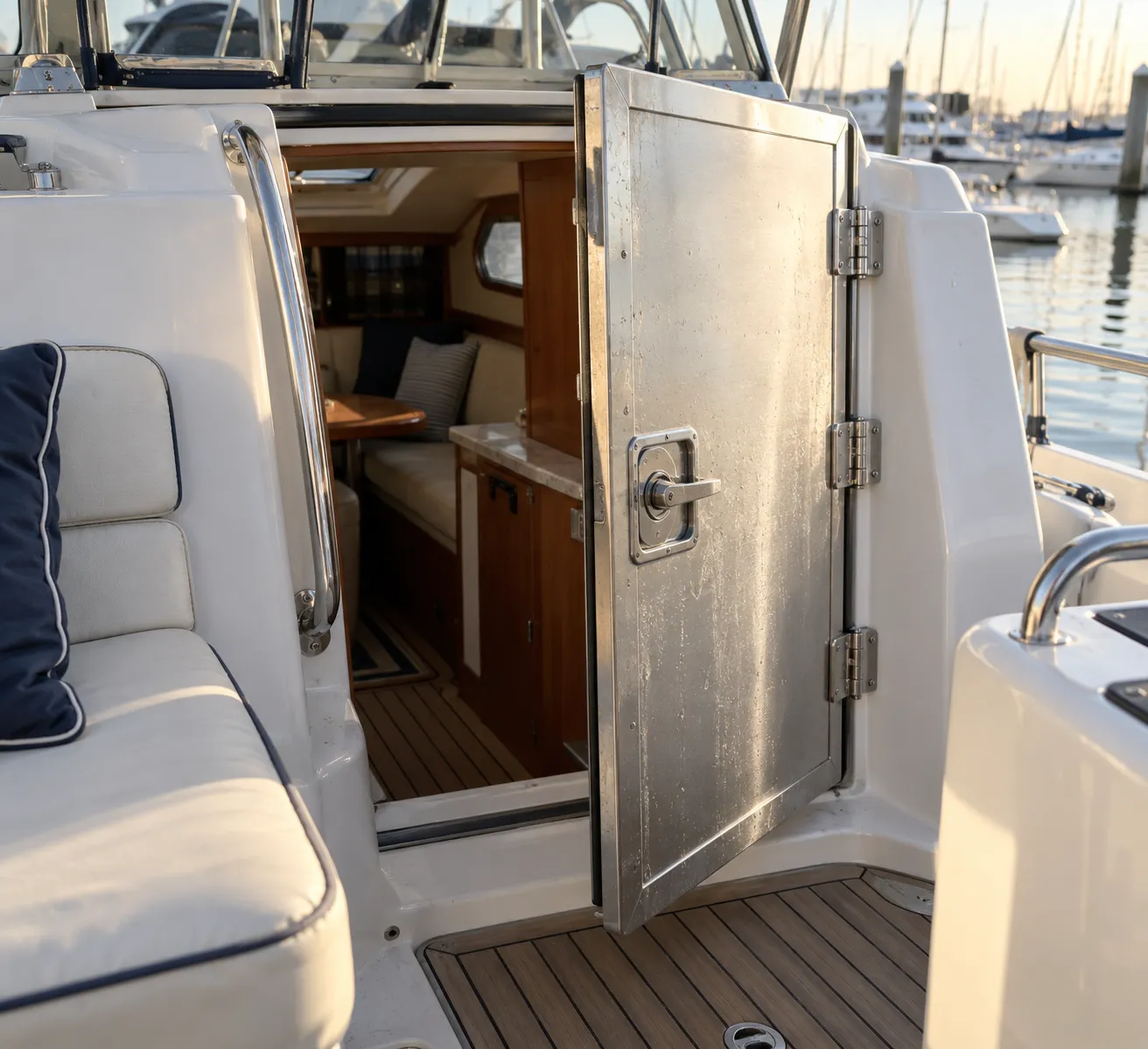
Here is the claim this whole guide stands on: most boat door trouble that recurs season after season starts in the hardware, not the panel. Hinges wear and the door drops a few millimeters, which is enough for the latch to miss its keeper. Latches wear and the door works loose underway. Seals age and the rattle you hear is water finding a path. Owners on the Ranger Tugs forum have documented exactly this chain, a cabin door sagging until the latch sat too low to catch its keeper (Tugnuts, 2018). The panel was fine. The hinge pins were worn.
Most boat door trouble that recurs season after season starts in the hardware, not the panel.
Before diagnosing anything, it helps to know what kind of door you are actually standing in front of. The map is short.
| Door type | Where you see it | Common panel material | Hardware that matters most |
|---|---|---|---|
| Cabin entry (companionway) | Cockpit to cabin | Teak, Starboard, aluminum frame | Hinges, latch or hasp, keeper |
| Sliding cabin door | Motor yachts, houseboats | Starboard, acrylic, aluminum | Rollers, tracks, surface latch |
| Walk-through windblock | Dual console, catamaran | Acrylic in aluminum frame | Compression latch, hinges |
| Console door | Center console electronics | Starboard, acrylic | Slam or compression latch, small hinges |
| Transom door | Fishing boats, stern | Starboard, fiberglass | Heavy hinges, quick-release latch |
| Pontoon fence gate | Pontoon entry | Aluminum fence panel | Gate latch sized to 1″ to 1¼” rail |
Material choice drives how much grief the panel gives you. King Starboard, a marine HDPE, shrugs off salt and UV without varnish. Acrylic looks sharp in colors but fades faster under sun. Teak looks classic and demands varnish on a schedule (Boat Outfitters, n.d.). None of that changes the hardware story. A perfect panel on worn hinges still slams.
Symptoms First: What Your Door Is Telling You
Doors fail in patterns. Four of them cover nearly every complaint you will find in owner forums, and each pattern points at one subsystem before you touch a screwdriver.
Door won’t stay latched
Likely: hinge wear has let the door sag, so the latch misses its keeper.
30-second checkLift the free edge of the door; if it moves up and down noticeably, the hinges are worn.
Slams underway
Likely: the latch is worn or underspecified for a moving boat.
30-second checkLook at the latch tongue for polished wear marks and play in the mechanism.
Sticks or grinds
Likely: corrosion in the mechanism or a bent hinge.
30-second checkWork the latch slowly; grit, stiffness, or a seized feel means corrosion inside.
Leaks or rattles
Likely: the gasket has aged hard.
30-second checkPress the seal; if it feels stiff and keeps no imprint, it has lost its rebound.
The pontoon gate deserves its own line here because its hardware is primitive by design. Owners replacing the factory setup describe a plain aluminum rod on the gate that drops into a tab on the fence, and nothing else (iBoats, 2012). When that arrangement wears, replacement kits built for 1″ to 1¼” fence tubing snap on without drilling, which is why they sell in volume (RestorePontoon, n.d.).
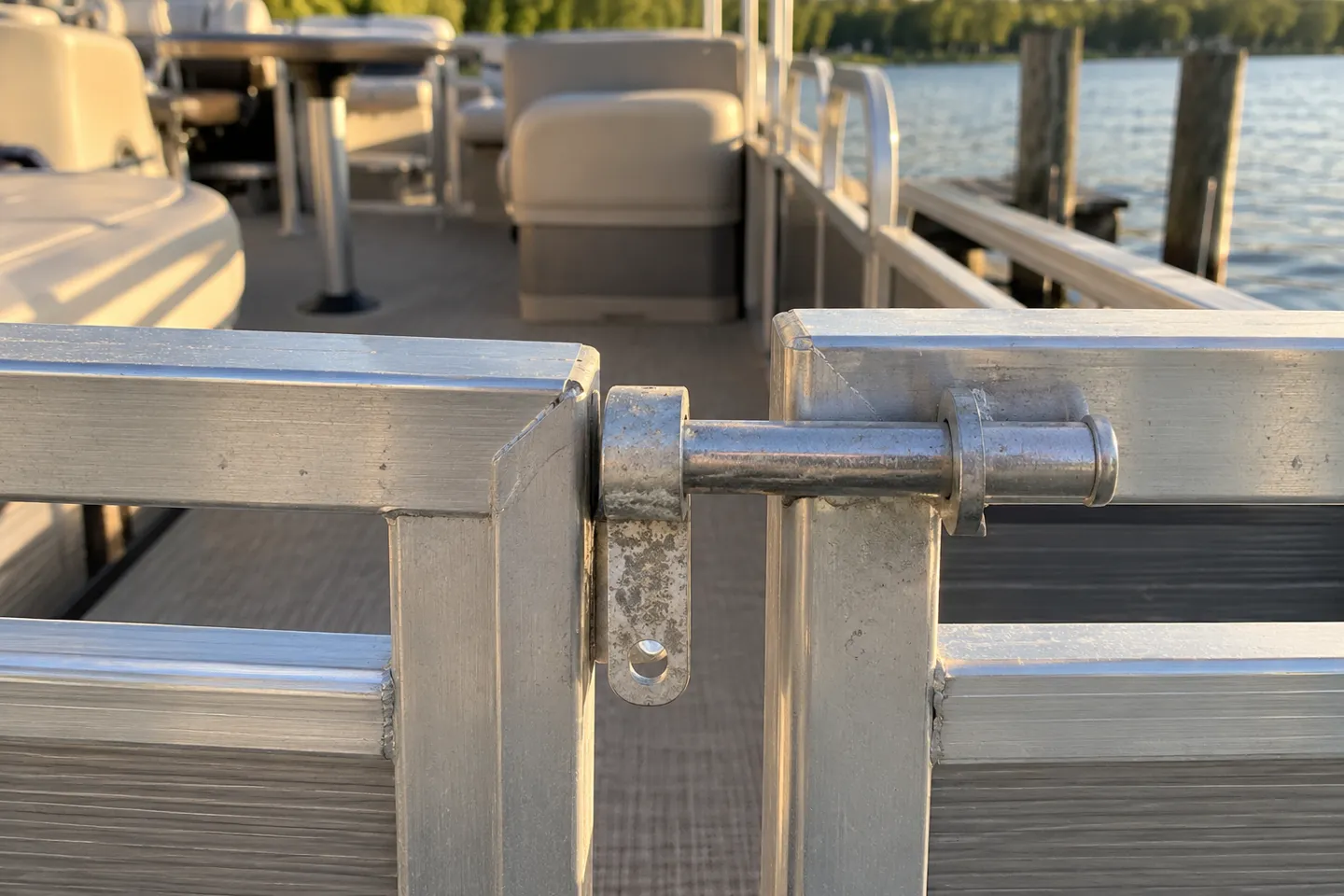
A door that won’t latch might have a worn hinge, a bent striker, or both. The thirty-second checks above tell you where to look first. The next section explains why each subsystem fails the way it does, so you can tell a worn part from a wrong part.
Before you order parts
A symptom names a suspect, not a verdict. Thirty-second checks locate the likely subsystem; they do not replace a teardown inspection.
The Hardware Layer by Layer: Hinges, Latches, Keepers, Seals
Every door on a boat runs on four subsystems. Learn what each one does and failure stops being mysterious.
Hinges: The Reason Doors Sag
A hinge has one job, holding the door’s weight in the same position for years, and it fails by wearing thin. As the pin and knuckle erode, the free edge of the door drops. Drop it far enough and the latch, which was aligned on installation day, now sits a few millimeters below its keeper. That is the “won’t stay latched” complaint from the symptom table, and it usually traces back to hinge wear rather than a bad latch.
The wear chain behind a door that won’t stay latched
Pin and knuckle wear
Free edge drops a few mm
Latch sits below the keeper
Door rattles or pops open
The chain starts at the hinges, not the panel.
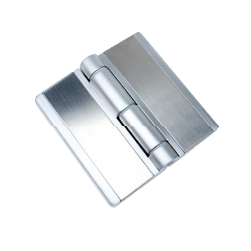
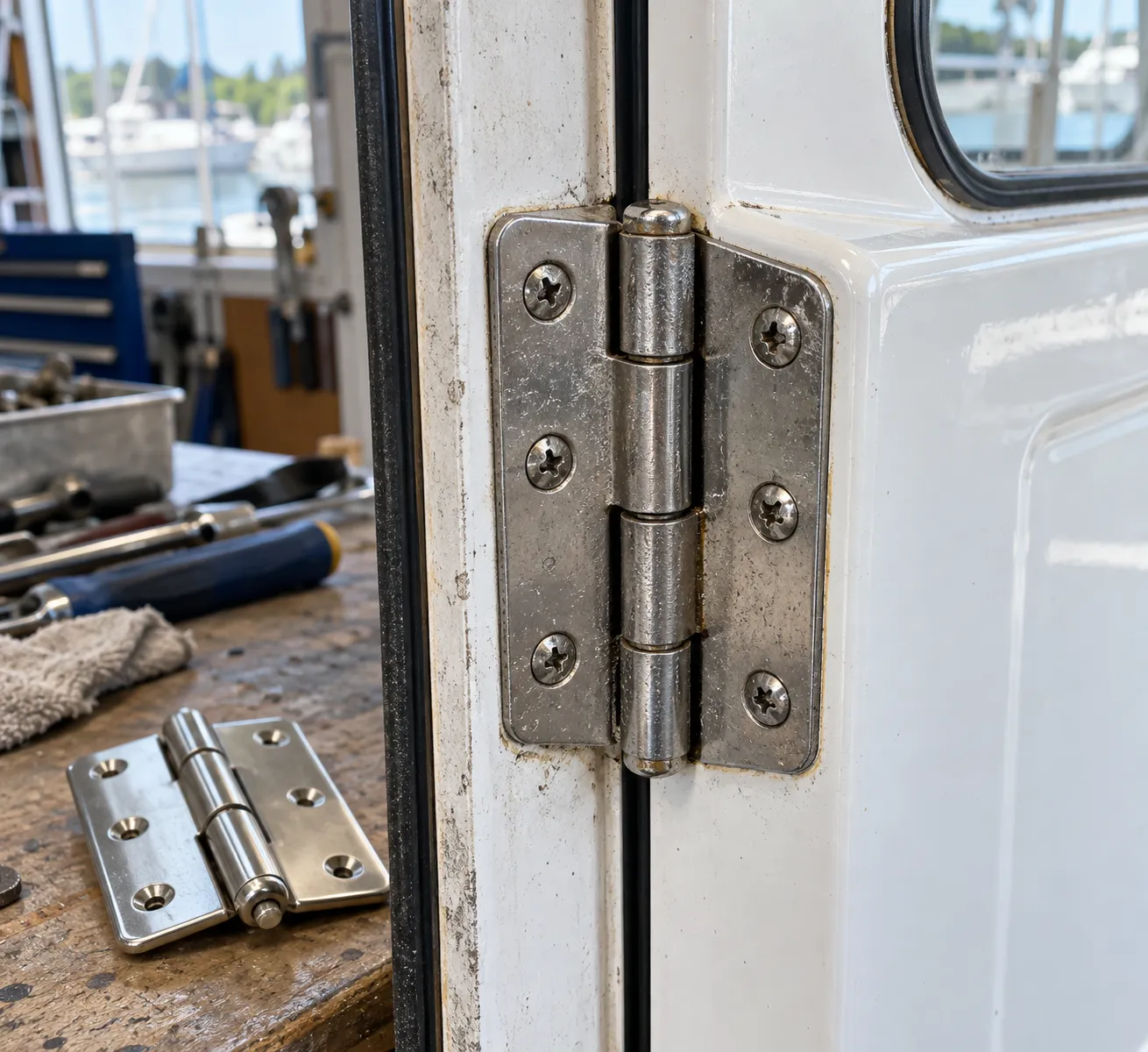
Butt hinges are the default for cabin doors. Piano hinges run the full door edge and spread the load on heavier leaves. Concealed hinges mount inside the panel for a clean look. Lift-off hinges let you pull the door without unscrewing anything, which matters on hatches and doors you remove often.
Profile height is the specification people forget until it bites. One Grady-White owner hunted for a cabin door hinge and kept finding candidates that were “not low of enough profile to allow the glass to fold properly” (GreatGrady, 2020). The hinge has to fit the door’s geometry, clear the fold of the glass, and match the closed-door reveal. Measure that before brand or finish.
Latches: Matching the Mechanism to the Duty
The latch decides whether the door stays shut in a sea. Round and square slam latches, the push-to-close kind, are the default on console and transom doors, and many are cut for a standard 2-inch opening, which is why one retailer’s catalog groups dozens of them around that single dimension (Marine Depot Direct, n.d.). Draw latches pull the door tight with an over-center toggle and suit hatches and boxes you open constantly. T-handles suit shed-style doors where you want grip and a lock point.
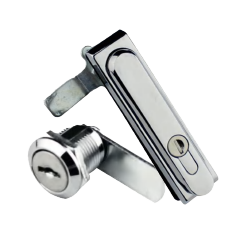
A compression latch does one thing the others do not: it pulls the door toward the gasket and holds it there under preload. That preload is what a windblock door needs, because a door that only touches its keeper will chatter against the frame as the hull works. Doors that live underway, transom doors and walk-throughs, are the ones that punish a worn or underspecified latch. When owners describe a door that flings wide in rough water, the mechanism has usually worn past its ability to hold preload.
Keepers and Stays: The Parts Nobody Replaces Until They Bend
The keeper receives the latch. The stay or catch holds a door open against a rolling deck. Neither part is complicated, and both drift out of alignment when a hinge wears, which is why they get blamed for problems that start elsewhere. If you find a bent striker, fix the hinge first and check whether the striker still bends. Struts that hold hatches open are the one common door-related part outside this set, and the same alignment logic applies to them.
Send one door’s measurements and duty, and a marine hardware supplier can match a current-production part with verifiable cycle and salt-spray data.
Send Your SpecificationsSeals and the Salt Environment: Where Corrosion Picks Its Targets
The gasket is a wear item with a shelf life. UV and heat cure the rubber hard, the door stops compressing it, and you get rattle followed by water. Replacing the seal when you replace anything else on the door is cheap insurance (Boat Outfitters, n.d.).
Metal choice is where marketing and metallurgy part ways. Retail shelves sell plenty of 304 stainless cabinet hardware, and 304 is honest steel in a dry cabin. Grade 316 adds 2 to 3 percent molybdenum, and that is the element that resists pitting in chloride exposure (Kloeckner Metals, 2021). It is the grade that survives a life of spray (Rolled Alloys, 2026). Nylon and polypropylene latches sidestep corrosion entirely, which is why pontoon suppliers favor them, but they trade strength and stiffness for it. Plated zinc sits at the bottom: fine inside, quick to bloom rust once the plating scratches through at the sea air line.
The quiet killer is mixed metals. A stainless screw in an aluminum frame corrodes the aluminum around itself as moisture cycles. Isolate the pair with sealant or isolating washers on any through-metal fastener near the waterline of the door.
Put together, the four layers make a selection grid you can hold against any door:
Door hardware: duty match and failure edge
| Hardware | Best-fit duty | Fails when |
|---|---|---|
| Butt hinge | Cabin and console doors, moderate weight | Pin wears, door sags past the keeper |
| Piano hinge | Heavy or long-leaf doors needing spread load | End brackets loosen, edge sags at the free corner |
| Concealed hinge | Clean-interior doors, light to medium leaf | Hidden wear goes unseen until sag appears |
| Lift-off hinge | Doors and hatches removed often | Rising wear lets the leaf drop on re-mount |
| Slam latch | Console and transom doors, push-to-close | Tongue wear removes engagement, door pops open |
| Compression latch | Windblock and underway doors needing preload | Lost preload, door chatters and gasket unseats |
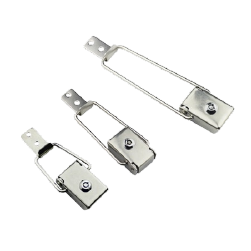
| Draw latch | Hatches and access boxes needing constant re-closure | Over-center wears loose, tension drops |
| Pontoon gate latch | Fence gates on 1″ to 1¼” rail | UV embrittles nylon, rod-and-tab wears out |
Where This Logic Ends
Everything above applies to recreational access doors. Two boundaries contain it.
The first boundary is certification. Commercial vessel doors are a regulated world of their own: ISO 6042:2015 specifies dimensions, materials, and manufacture quality for weathertight single-leaf steel doors on ships (ISO, 2015). On a classed vessel, the door and its hardware are part of a certified assembly. Swapping components by owner preference is not a maintenance decision there, it is a survey finding. Before replacing hardware on any commercial or classed door, confirm the door’s certification requirements, then source within them.
If the door is on a classed or commercial vessel, or the label says “weathertight” or “watertight,” stop. The DIY substitution logic in this guide does not apply to certified door assemblies. Confirm certification requirements first, then buy within them.
The second boundary is structural. A cracked frame, a corroded hinge seat, a Starboard panel that has creeped around its fasteners: these are door problems no latch can fix. If the mounting surface itself has failed, replacing hardware only resets the clock on the same failure. Check the frame and mounting points first; if the structure is sound, proceed with hardware. If it is not, the panel or frame is the repair.
Buying and Replacing: Four Paths and What to Measure
Once you know which subsystem failed and the structure is sound, the buying decision has four paths. Each one has a condition under which it stops making sense.
Adjust or repair
Alignment drift with sound hardware often needs a striker bend and hinge pin check, not parts. Ends when pins or latch tongues show real wear.
Replace the worn part
The default path for a confirmed hinge or latch failure. Ends when the original part is discontinued.
Retrofit a standard part
When the OEM fitting is unavailable, measure the footprint and find a current part that covers it. Ends when the cutout or hole pattern is damaged.
Replace the whole door
For a failed frame, seat, or panel, or when a custom-fabricated door costs less than chasing dead parts.
The repair-versus-replace call comes down to structure. Forum threads full of adjustment advice and retailer pages full of whole-door offers are both right, in different cases. If the hinge holes are clean and the frame is solid, repair. If the holes are wallowed out or the seat is corroded, repair only delays replacement. A corroded forty-year-old latch that no domestic supplier stocks is the classic retrofit case. One owner hunting a corroded Perko piece found it for sale only in Australia (ClassicParker, 2020). That is the situation where a current-production equivalent beats the treasure hunt.
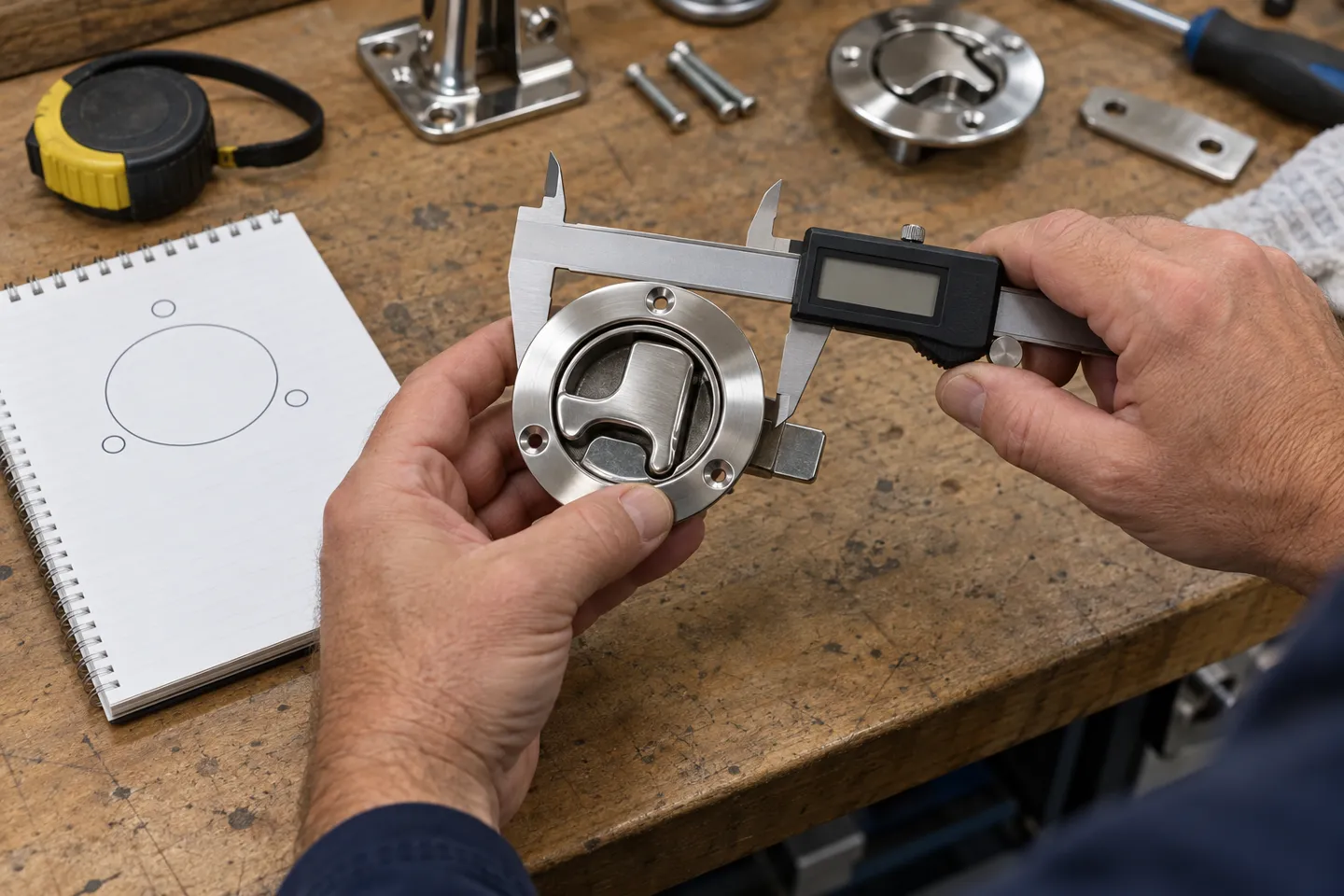
Whatever path you take, the measurement list is the same, and it is what stands between a one-trip fix and a second order:
- Cutout diameter or footprint (slam latches commonly use a 2-inch cutout)
- Screw hole pattern, center to center
- Door thickness
- Hinge profile height and open clearance for folding hardware
- Rail diameter for pontoon gates, typically 1″ to 1¼”
- Hand of door, left or right open
- Gasket section and compression range
Then match specifications to duty, and demand numbers where they exist. Material grade by position: 304 is honest inside a dry cabin, 316 earns its premium on exposed and spray-zone hardware. Latch type by duty, per the table above. For anything billed as marine-grade, ask the supplier for cycle-test life and salt-spray exposure data you can verify. A supplier who cannot produce test data is telling you something.
What Boat-Door Manufacturers Should Take From Owner Complaints
If you build boats or marine doors, the pattern in those forum threads deserves a closer read than any single repair. Run back through them: the sagging door with the misaligned latch, the gate held by a worn rod, the windblock door that chatters loose, the seal that let water in. The panel is almost never the accused. The hardware is.
That maps directly onto warranty economics. A door that reaches a customer with marginal hinge fit or an underspecified latch will generate field complaints, and each complaint costs a service loop. The same risk addressed at specification time costs a drawing note. The complaints cluster on four hardware decisions: material grade for the door’s position, hinge profile matched to the door’s actual geometry, latch type matched to the door’s duty, and seal quality. Specify those four in the drawing package and you have specified away most of the category’s warranty history.
It also changes what to ask of a hardware supplier. Verifiable cycle-life and salt-spray data, in-house control of surface treatment, and the flexibility to support low-volume custom fittings against your drawings are the three capabilities that keep a door program out of the service loop. A supplier who quotes those in writing is offering more than parts; they are offering your warranty back.
KUNLONG has supplied industrial and marine door hardware, from compression latches to hinges, catches, and stays, to equipment builders since 2005, and we develop custom fittings against customer drawings with no minimum order request on standard catalog items. If you are comparing sources for a door program, our custom door hardware page is a reasonable place to start.
Source Marine Door Hardware With Verifiable Test Data
Compression latches, hinges, catches, and stays for equipment builders since 2005. Custom fittings developed against customer drawings, with no minimum order on standard catalog items.
References
- ISO. “ISO 6042:2015 Ships and marine technology: Weathertight single-leaf steel doors.” 2015. https://www.iso.org/standard/63771.html
- Kloeckner Metals. “304 Stainless Steel vs 316: Know the Differences.” 2021. https://www.kloecknermetals.com/blog/304-stainless-steel-vs-316/
- Rolled Alloys. “304 vs 316 Stainless Steel: Corrosion Resistance, Properties, Applications.” 2026. https://www.rolledalloys.com/articles/304-vs-316-stainless-steel-corrosion-resistance-properties-applications/
- Tugnuts (Ranger Tugs Owners Forum). “Cabin door alignment problem.” 2018. https://www.tugnuts.com/threads/cabin-door-alignment-problem.10737/
- GreatGrady (Grady-White Owners Forum). “Help Finding Cabin Door Hatch Hinge.” 2020. https://www.greatgrady.com/threads/help-finding-cabin-door-hatch-hinge.30300/
- iBoats Forum. “1993 Lowe 185 Pontoon – Replace/repair door latch ideas?” 2012. https://forums.iboats.com/threads/1993-lowe-185-pontoon-replace-repair-door-latch-ideas.533546/