


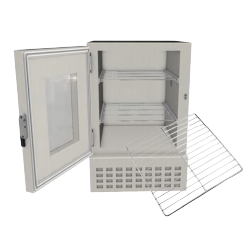
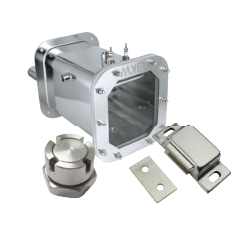
What a Temperature Test Chamber Actually Does
At 6 a.m. a battery lab starts a certification run: five hundred cycles between -40°C and +85°C, one ramp every few hours, for the next three months. The schedule never mentions the door. Yet the door will live through every one of those thermal swings, plus several thousand openings by technicians checking cells. That double life is where this article ends up. First, the machine itself.
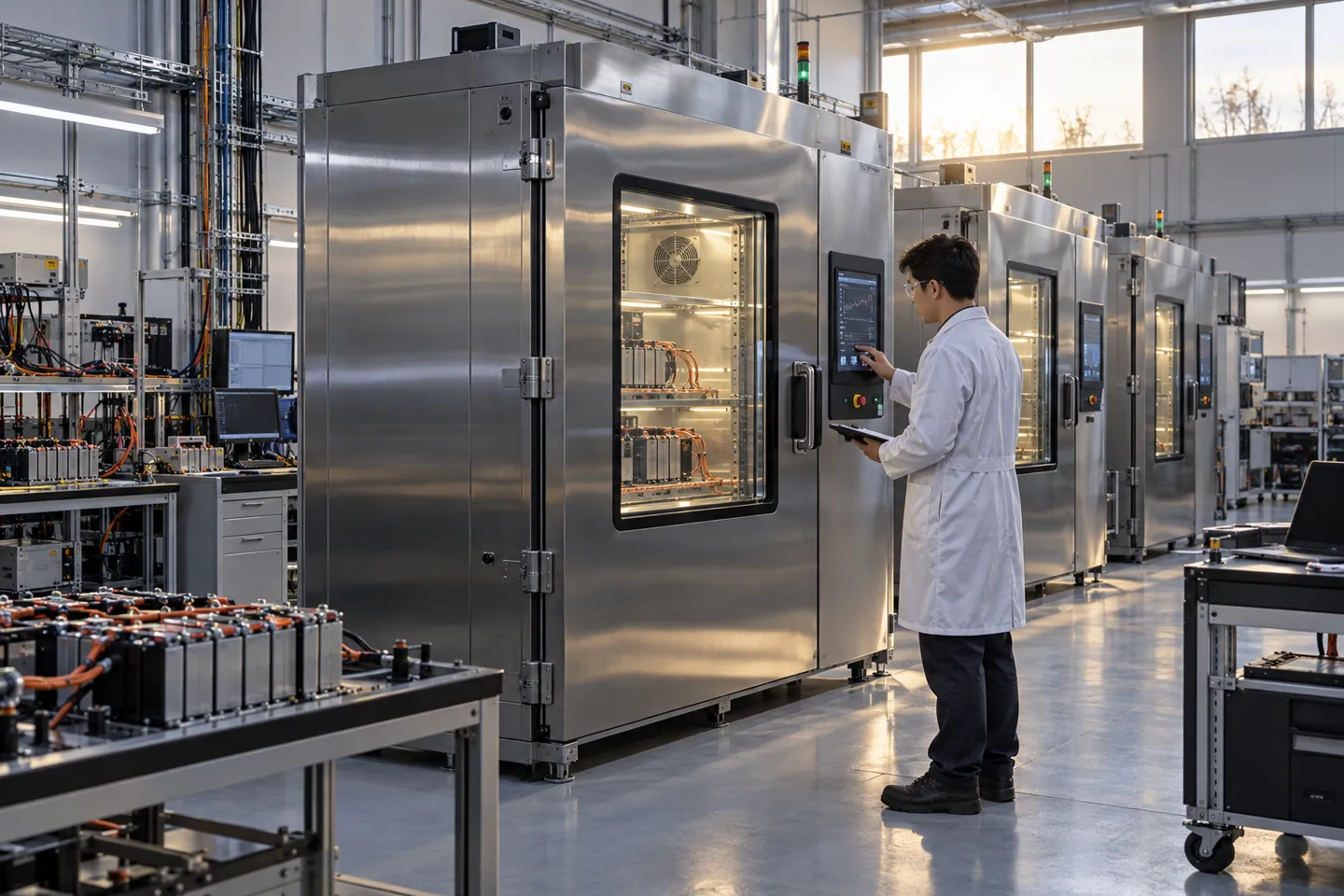
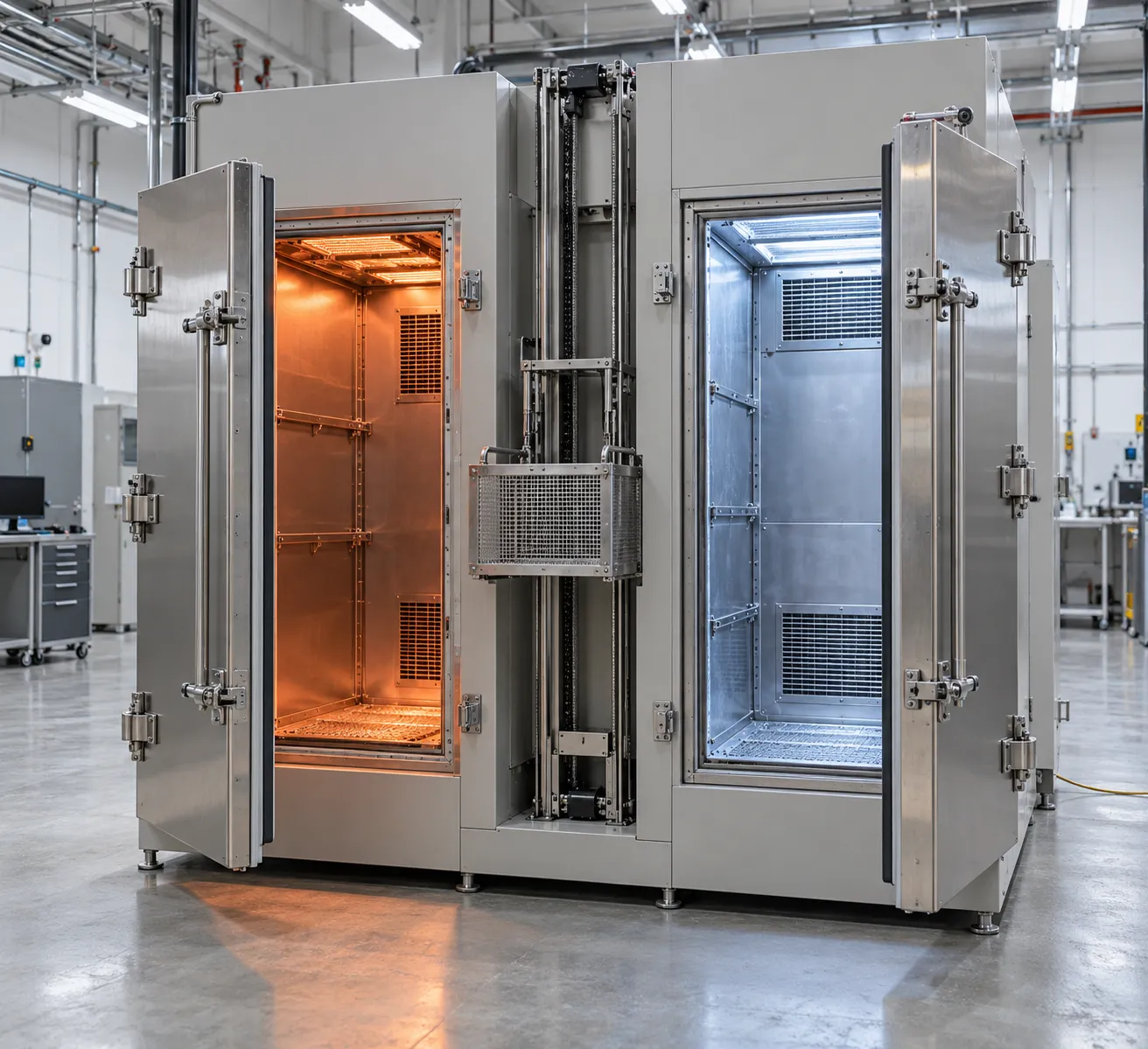
A temperature test chamber is an insulated cabinet that holds a defined temperature, or walks between defined temperatures, on a programmed schedule (Wikipedia, 2025). Three systems do the work. Resistive heaters raise the air temperature. A refrigeration circuit pulls it down, and cascade machines reach the -70°C to -80°C region that most test plans treat as the practical floor. Liquid-nitrogen boost exists for colder work where the operating cost makes sense. A controller with circulating fans holds the setpoint and keeps air uniform across the workspace, which is what turns raw heating and cooling into a repeatable test condition.
The range ladder runs from hot-only industrial ovens at one end, through standard chambers spanning roughly -70°C to +180°C, to specialty low-temperature machines at the other. Electronics, automotive, aerospace, battery and pharmaceutical labs all shop this ladder. The applications differ; the machine categories barely change.
Two boundaries keep the category tidy. A humidity chamber adds a moisture system and becomes a different machine with different failure modes, so if your testing involves moisture, that is the sibling topic. The phrase also gets borrowed loosely. A 3D printer’s heated build chamber, a plant grow cabinet, and the environmental box clamped to a materials testing machine are different products entirely. This article is about the industrial cabinet that qualifies products against temperature.
Four Form Factors, Four Different Working Days
Form factor decides the working day long before any spec sheet does.
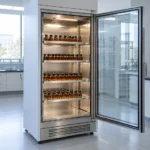
A benchtop chamber sits on a bench, holds a few dozen liters, and gets its door opened dozens of times a day by someone probing a single board or a handful of parts. A reach-in chamber, the workhorse of the category, stands on the floor, takes racks of product, and is opened continuously by technicians loading and unloading samples. A walk-in chamber is a room. Product goes in on carts, or the test article is simply too big to move. Its door may be a pallet-wide slab rather than a panel. Drive-in chambers exist for whole vehicles; dry-ice cooling shows up as a temporary low-cost hack where a real refrigeration system has not been justified yet.
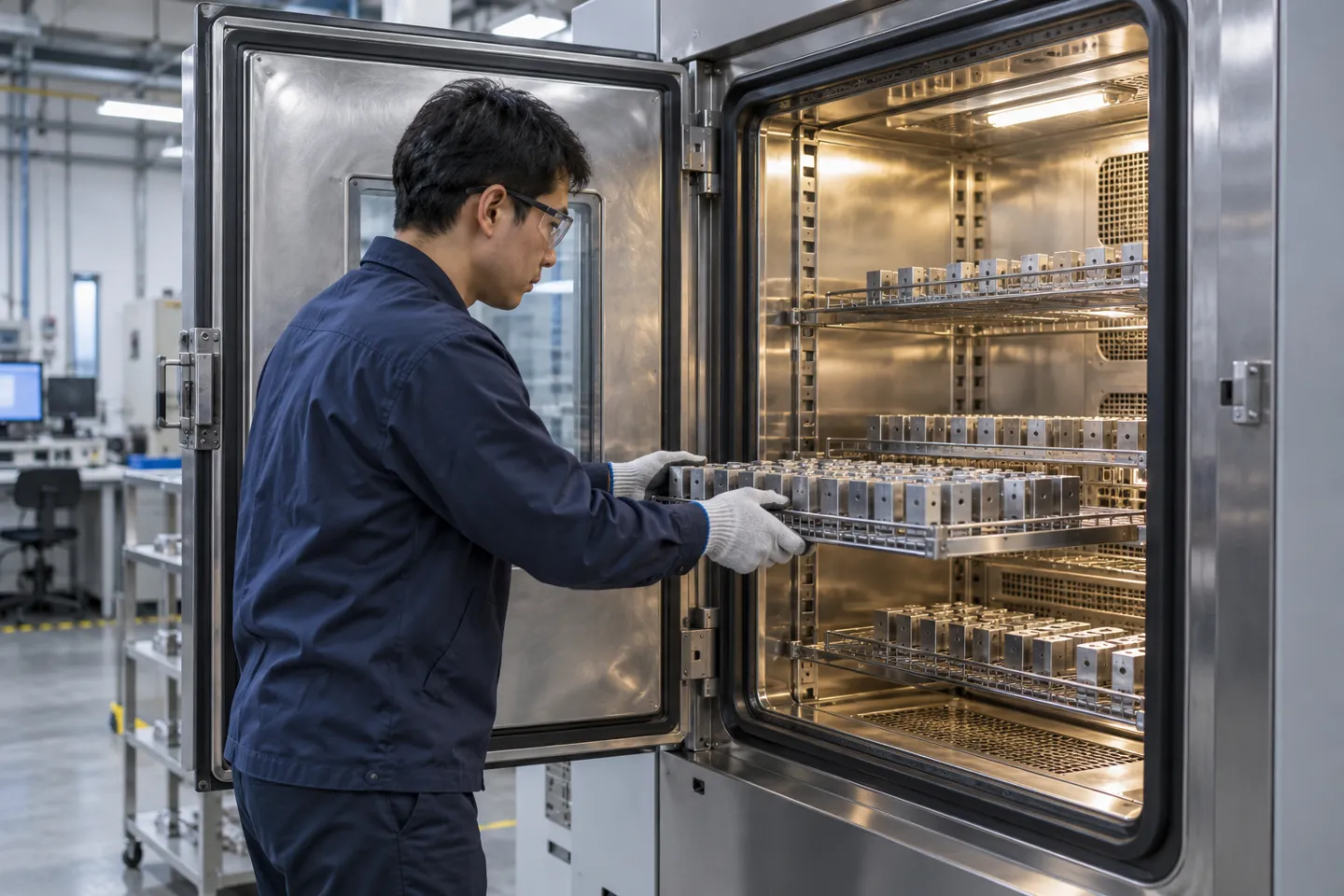
What changes across these forms is less the refrigeration plant than the door economics. A benchtop door is light and cheap to cycle. A reach-in door swings open hundreds of times a day under meaningful weight. A walk-in door might open twice a day but seals a perimeter ten times longer. The working components stay the same across all four: an insulated workspace, a fan-driven airflow system, the refrigeration and heating plant, and the controller running the program.
Operators live with the consequences first. Frost on the evaporator usually traces back to door openings pushing humid air inside. A chamber that “won’t reach setpoint” deserves a check of the door seal and the load inside it before anyone blames the compressor. Keep that door thread in mind. It gets heavier later.
Form factors and the working days they create
| Form factor | Typical volume | Door reality | Best fit |
|---|---|---|---|
| Benchtop | tens of liters | light door, frequent opening | single boards, small batches |
| Reach-in | 100 L to 1 m³ | heavy door, opened all day | rack-level production and lab testing |
| Walk-in | room-scale | pallet-wide door, long perimeter seal | large DUTs, cart-loaded batches |
| Drive-in | vehicle-scale | vehicle-sized opening | complete vehicles and large assemblies |
Temperature Cycling, Ramp Rates, and Thermal Shock
Every chamber in the category holds temperature. What separates them into different machines, and different price classes, is how violently they change it. Buyers ask this question in four words or forty, and public answers rarely settle it. Here is the ladder.
The Four Rungs of Thermal Severity
The first rung is a static soak. The chamber holds an extreme for hours, and the stress on the specimen comes from the extreme itself: a hot storage test, a cold start check, a burn-in.
The second rung is temperature cycling, the default of reliability testing. The chamber ramps between two extremes with dwells at each end, and the stress is mechanical: parts expand and contract at different rates until solder joints, connectors and housings fatigue. IEC 60068-2-14, Test N, is the generic “change of temperature” test most industries borrow from (ANSI, 2023). JEDEC JESD22-A104 defines how the semiconductor world runs its cycling (JEDEC, 2023).
The third rung is the rapid-rate class. Standard cabinets change temperature at a few degrees per minute; dedicated high-rate machines are built around change rate as the headline number, in the 5°C/min class and beyond (ESPEC, 2025). Fast cycling compresses test time and reaches some failure mechanisms a slow ramp never triggers.
The fourth rung is thermal shock, and it is a different machine philosophy, not just a faster one. Two-zone shock chambers keep a hot zone and a cold zone at temperature permanently and move the specimen between them on a shuttle, so the transition takes seconds instead of minutes. JEDEC’s cycling standard explicitly distinguishes this dual-chamber shuttling from single-cabinet ramping (JEDEC, 2023). Shock targets specific failure mechanisms, brittle fracture in solder and ceramic or damage in potted assemblies, that gradual cycling treats too gently.
The boundary matters more than the ladder’s top rung. Most life and reliability questions are answered at rung two. Shock testing is for products whose failure physics demand it, and paying for rung four when your standard asks for rung two buys the wrong machine at a higher price.
The thermal severity ladder
| Rung | What the machine does | Stress mechanism | Typical use |
|---|---|---|---|
| Static soak | holds one extreme for hours | the extreme itself | storage, burn-in |
| Temperature cycling | ramps between extremes with dwells | differential expansion fatigue | reliability and life testing |
| Rapid-rate cycling | high change rate, 5°C/min class and up | compressed-time fatigue | accelerated screening, fast iteration |
| Thermal shock | shuttle between two ready zones in seconds | shock fracture in brittle materials | solder joints, ceramics, potted assemblies |
How to Read a Ramp Rate Specification
Ramp rate is the most misread number on a chamber datasheet, and the misreading runs in the vendor’s favor every time.
Start with linear versus average. A linear rate means the chamber controls a constant slope across the whole span. An average rate is total span divided by total time, which flatters any machine. It can race through the middle of the ramp where the compression system has margin, then crawl near the extremes, and still quote an impressive average. The same chamber can honestly carry both numbers, several degrees per minute apart.
Then the load question. Ratings are measured empty. A dense specimen with real thermal mass drags the achievable rate down, sometimes by half, and service technicians list oversized test loads among the standard reasons a chamber “can’t keep up” with its own program. Vendors rarely publish a derating curve, so the number on the datasheet is a best case by construction.
Finally, “rapid” itself has no industry-wide definition. One vendor’s rapid-rate line starts at 5°C/min (ESPEC, 2025); marketing copy elsewhere attaches the word to machines that would fail the same spec. There is no committee that polices the adjective.
Three questions pin down any ramp rate quote: Is that figure linear or average? Was it measured empty or with a representative load? Over what temperature span? A vendor who answers all three in writing has just out-qualified half the market.
The Standards Behind the Programs
Test standards choose the machine class for you, which is why the smartest buying move is reading the standard before the datasheet.
IEC 60068-2-14:2023, Test N, covers change of temperature for components and is the reference most industrial test plans cite (ANSI, 2023). MIL-STD-810H Method 503.7 governs temperature shock for defense equipment and prescribes transition severity that only two-zone hardware delivers cleanly (Keystone Compliance, 2025). JEDEC JESD22-A104, currently at F.01, defines temperature cycling conditions for semiconductor packages and spells out the single, dual and triple-chamber methods by name (JEDEC, 2023).
Map your program to its clause, then shop the machine class that clause assumes. The datasheet conversation gets short and honest in a hurry.
What Buying One Really Involves
The spec sheet settles perhaps half of a purchase. The other half is contractual, and the failure stories there are remarkably consistent.
Lead time is the first trap. Even standard models from top-tier makers have stretched to nearly a year in documented buyer accounts. One engineer describes an ordered chamber that arrived “almost a year” late (Reddit, r/MechanicalEngineering, 2024). A delivery date without a remedy clause is a hope, not a term.
Service is the second. In the same account, repair visits without a service contract stretched to months of waiting. Response time belongs in the purchase order: hours to acknowledge, days to arrive, and a named escalation path. Buyers comparing brands swap exactly this kind of warning alongside their shortlists (Reddit, r/engineering, 2025), and the vendor who will not discuss service terms in writing is telling you something.
Spares are the third, and cheapest, protection. Door gaskets and filters are consumables; stocking a spare gasket set at delivery costs a rounding error against a chamber sitting idle for want of a fifty-dollar seal. The distinction to hold onto is consumable money versus design money. A worn gasket is maintenance, but a chamber that cannot hold setpoint with a fresh gasket and a normal load is a factory problem. The warranty conversation should treat it that way. Used and refurbished machines compress this whole section into one rule: the deal is only as good as the service ecosystem behind it.
Before signing for a temperature test chamber
- Delivery date with a remedy clause, not just a date.
- Service response terms in writing.
- Spare door gasket set ordered with the machine.
- Ramp rate quoted linear, with your load, over your span.
- Door hardware specification on file: hinge load rating, gasket material and compression geometry.
The Door System: Where Cycling Stress Lands
The Two-Cycle Rule
The door system is the only subsystem in a temperature test chamber that takes two cycles at once. The thermal cycle is set by the test program. The opening cycle is set by the operator. Spec every door component against the harsher of the two.
That sentence is the whole argument of this section, and it is worth dwelling on why. Seal failure sits at the top of every published chamber fault list, right next to control and refrigeration problems. A leaking seal lets conditioned air escape and humid air in. The controller chases a drifting setpoint, frost builds, and the test data quietly stops meaning what it claims. None of that shows up as a dramatic breakdown. It shows up as a number that is slightly wrong for weeks.
For the people who build these machines, the door system deserves to be engineered as deliberately as the refrigeration plant. Its components and their failure boundaries follow.
Hinges: Load, Sag, and Temperature-Rated Materials
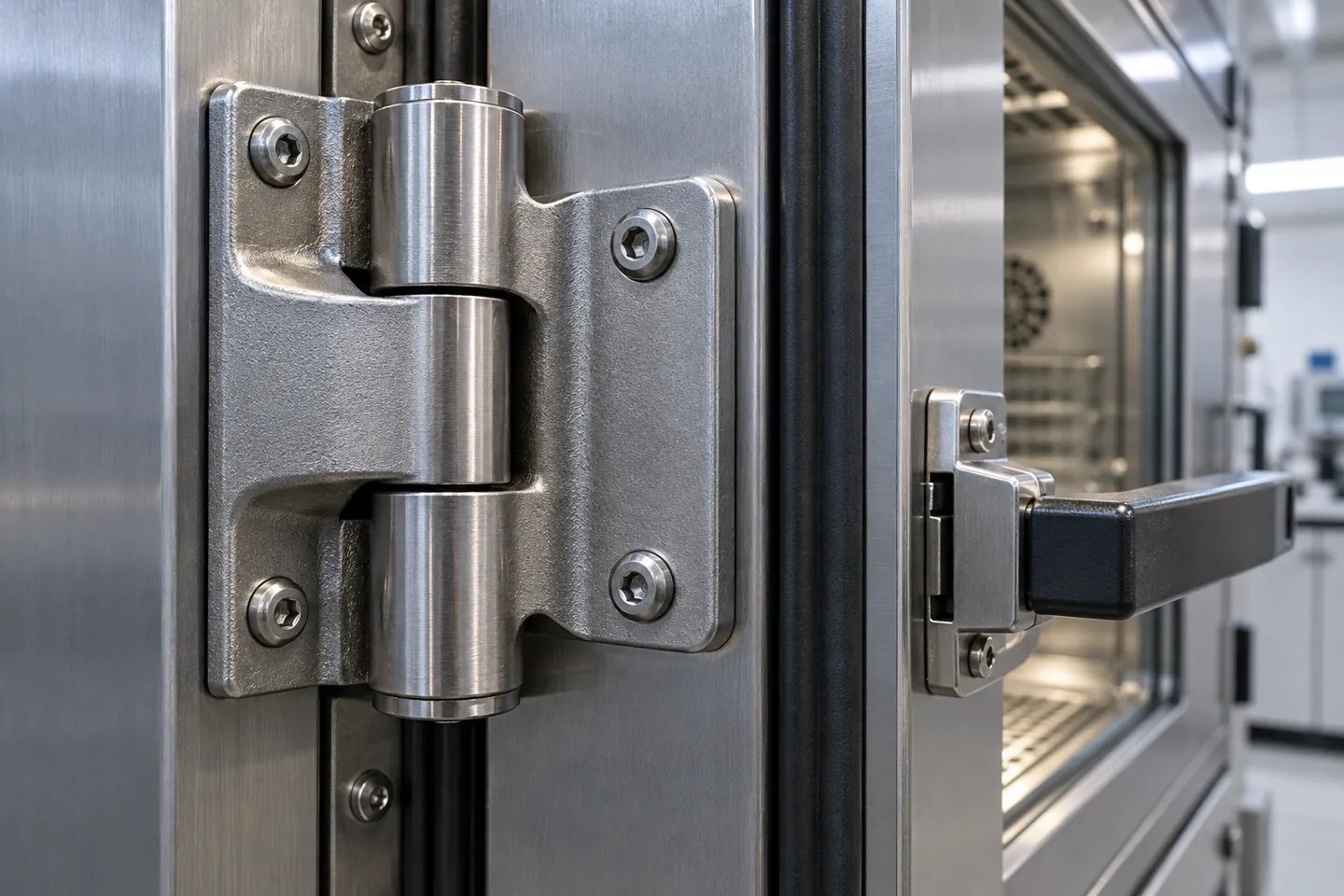
Doors on reach-in and walk-in chambers routinely weigh over a hundred kilograms. A hinge that sags under that load, by even a few millimeters, unloads the gasket at the latch corner first, and that corner becomes the leak path. Hinge selection is therefore seal design, whatever the parts catalog calls it.
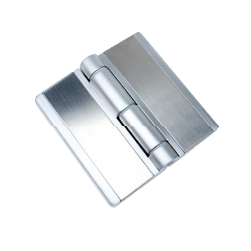
Material rating is the second axis. Zinc alloy die castings are the economic default and serve well inside milder envelopes. Stainless steel solid castings keep their strength across the full chamber range, from -70°C soaks to bakes above +250°C, and shrug off the condensation that forms every time a -40°C door meets room air. Then there is maintenance geometry worth demanding by name. Hinge mounts adjust to gasket thickness, so a worn seal can be re-tensioned without realigning the door. Lift-on-open motion raises the door slightly as it swings, so the gasket is not scrubbed across the frame several thousand times a year. Component makers in this niche publish cycle-test data for exactly this reason. Chamber door hardware is tested to 100,000 opening cycles (T3 Works, 2025), a number that exists because opening cycles are a recognized wear mechanism, not a theoretical one.
Gaskets and the Compression Budget
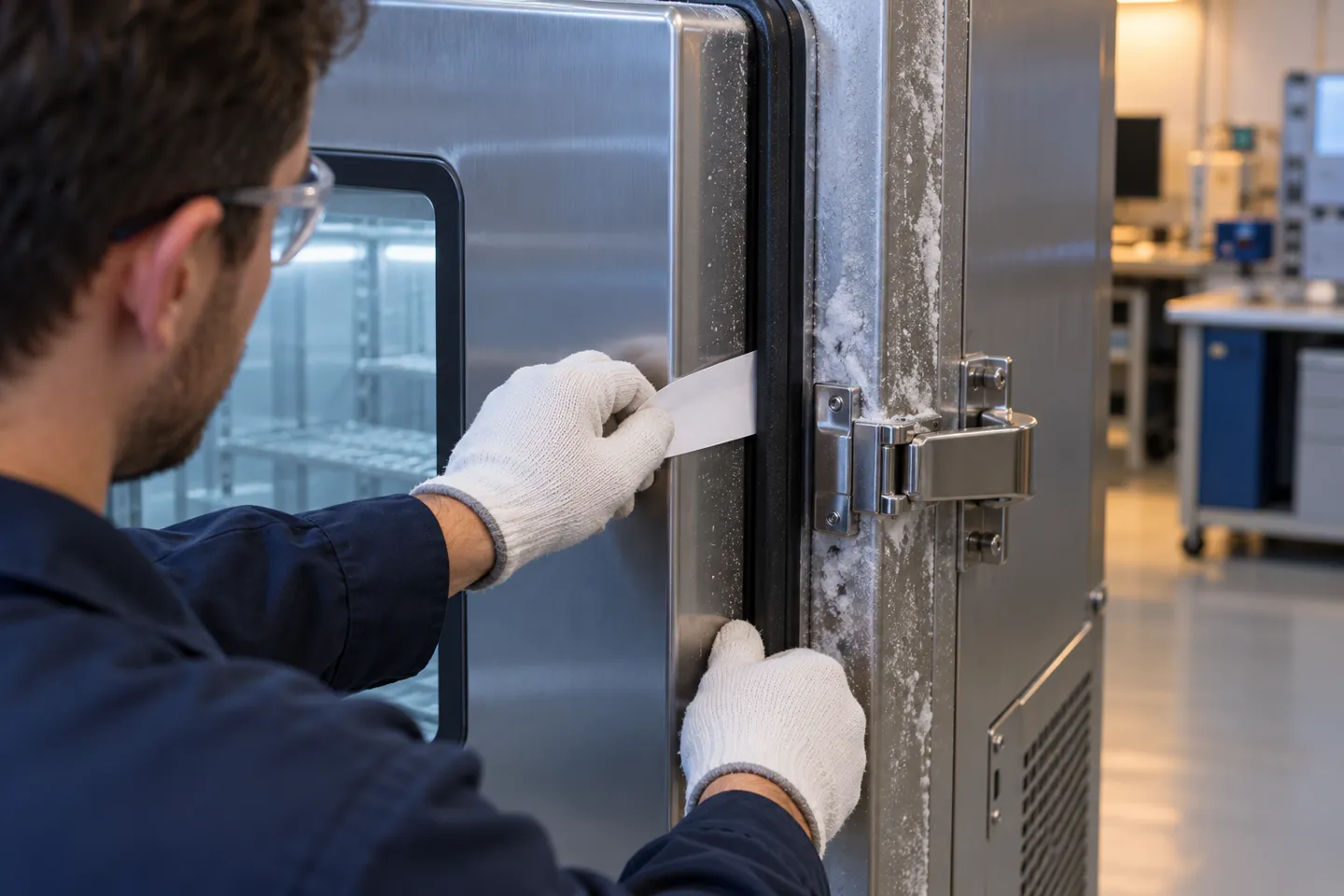
A gasket dies of compression set. Held compressed against a warm frame for months, the elastomer takes a permanent flatten and stops pushing back. The seal gap opens, and the dollar-bill test, pulling a sheet of paper from a closed door, starts succeeding long before anyone notices (MarathonLS, 2025). Field checks are unglamorous and effective: run the bill test around the perimeter, shine a flashlight through the closed door in a dark room, inspect the gasket folds and the hinge side for dirt and flattening.
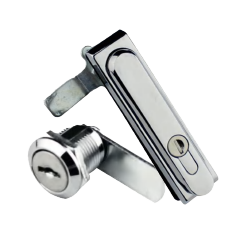
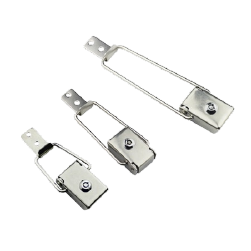
The compression has to come from somewhere, and that somewhere is the latch. Compression-style latches and handles convert handle motion into gasket travel. A compression handle with roughly 15 mm of travel, adjustable at the base, sets how hard the door pulls the seal and how recoverable that setting is as the gasket ages. Even pressure around the perimeter is the design goal, because a gasket compressed hard at the handle and lightly at the far corner seals exactly where it is not needed. And just as a gasket swap alone can leave two freezer doors popping each other open when the strike alignment is ignored (Reddit, r/refrigeration, 2025), seal maintenance is a system adjustment. It is not a part number.
Latches, Multi-Point Locking, and the Thermal Break
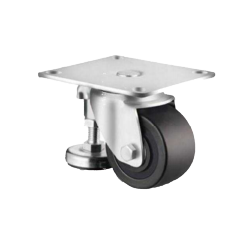
Tall doors need pressure at more than one point. Over-center draw latches pull the door into the frame and hold it there mechanically. Multi-point latching distributes compression across the top, middle and bottom of a walk-in slab, where a single latch would hinge the seal open at both ends. For top-opening chambers, stays and catches belong to the same family, and anti-vibration leveling feet quietly keep the cabinet square so the door geometry stays true; they are the last line of the parts map, rarely discussed and occasionally decisive.
The quieter upgrade is in the door leaf itself. A thermal break interrupts the conduction path from inner to outer frame skin, keeping the outer face above the dew point so it stops sweating and icing. When Cincinnati Sub-Zero redesigned its ZP chamber line, the announcement led with exactly two door features: a continuous gasket and an upgraded door design with thermal break (CSZ, 2025). When a first-tier manufacturer spends its engineering budget on the door, that is a professional opinion about where reliability is won.
Door system boundary matrix: what fails, and what to demand
| Component | Failure boundary under dual cycling | Confirm with the hardware supplier |
|---|---|---|
| Hinges | sag under door weight; corrosion at condensation points | material rating across your full envelope, load rating with margin, cycle-test data, gasket-gap adjustment |
| Gaskets | compression set at sustained heat; frost damage at cold | elastomer service range, compression set figure, tool-free replacement design |
| Latches and locks | lost compression from wear; uneven perimeter pressure | compression travel in mm, over-center holding force, multi-point option for tall doors |
| Door leaf and frame | thermal bridging; frame condensation and icing | thermal break construction, continuous gasket geometry |
One boundary on all of this: a benchtop door weighs ten kilograms and opens twenty times a day. The dual-cycling logic holds, but the spec tier scales with door weight times opening frequency. Over-specifying small doors is its own cost error.
Rereading the Chamber Business Through Its Doors
Set the established facts side by side. Seal failure heads the chamber fault list. A leaking seal corrupts test data weeks before anyone calls it a failure. Consumable money and design money are different budgets, and the door is where they meet. A first-tier manufacturer just spent a product revision on gasket continuity and a thermal break. The conclusion is not subtle: in the chamber business, field reliability surfaces first at the door, and warranty cost rides on some of the cheapest hardware in the machine.
The business recommendation follows directly, and it is a spec-sheet move, not a shopping move. Treat the door system as a managed subsystem. Write the temperature rating, the cycle-life evidence and the compression geometry into component requirements. Buy door hardware only from suppliers who can produce cycle-test data on request. Tier the spec by duty. A walk-in slab door opened twenty times a day at -70°C deserves the stainless solid-casting tier. A benchtop door does not, and pretending otherwise just taxes the BOM.
There is a boundary on the advice itself. Most readers of this article buy chambers rather than build them. For that reader the equivalent action is narrower: read the door hardware line on the acceptance datasheet, stock the spare gasket set, and run the dollar-bill test on a schedule. The economics are identical either way, because the door does not care which side of the transaction you stood on.
This is the conversation our own door hardware is built for. KUNLONG supplies solid-cast SUS304 hinges and compression latches engineered for oven and test chamber doors. Our SK2-8065 hinge is a solid stainless casting rated for test chamber and oven service. The heavy-duty hinge SK2-728 adjusts to gasket thickness and lifts the door on opening, and the SK1-606R compression handle delivers about 15 mm of controlled travel to pull a gasket evenly tight. We back the range with a 20,000+ cycle lifespan guarantee, and the full test chamber and industrial oven hardware line is online if you are drafting a door-system spec.
Door Hardware With Cycle-Test Receipts
Hinges, latches, and gasket hardware engineered for test chamber and oven doors, with cycle-test data available for your spec sheet.
Request a QuoteReferences
- Wikipedia. “Environmental chamber.” 2025. https://en.wikipedia.org/wiki/Environmental_chamber
- ANSI. “IEC 60068-2-14 Ed. 7.0 b:2023: Temperature Testing.” 2023. https://blog.ansi.org/ansi/iec-60068-2-14-ed-7-0-b-2023-temperature-testing/
- Keystone Compliance. “MIL-STD 810 Temperature Shock Testing.” 2025. https://keystonecompliance.com/mil-std-810/temperature-shock/
- JEDEC. “JESD22-A104: Temperature Cycling.” 2023. https://www.jedec.org/standards-documents/docs/jesd-22-a104e
- JEDEC. “JESD22-A104F.01: Temperature Cycling (dual-chamber shuttle method).” 2023. https://file.globalso.com/file_manage/3034/20250321/jedec-jesd22-a104f-01-2023-temperature-cycling-1.pdf
- ESPEC. “High-Rate Thermal Cycle Chamber.” 2025. https://www.espec.co.jp/english/products/env-test/hr/
- MarathonLS. “How to Spot Early Signs of Seal or Gasket Failure in Lab Equipment.” 2025. https://www.marathonls.com/spot-early-signs-of-seal-or-gasket-failure-in-lab-equipment/
- T3 Works. “Environmental Chamber Door Design: Safety, Seals, Viewing Options.” 2025. https://t3test.com/environmental-chamber-door-design-safety-seals-viewing-options/
- CSZ. “New Upgrades to ZP Test Chambers with Customer Focus.” 2025. https://www.cszindustrial.com/Resources/News-Detail.aspx?newsid=80
- Reddit, r/MechanicalEngineering. “Environmental test chamber recommendations?” 2024. https://www.reddit.com/r/MechanicalEngineering/comments/1c6p2au/environmental_test_chamber_recommendations/
- Reddit, r/engineering. “Thermal chamber companies.” 2025. https://www.reddit.com/r/engineering/comments/1lpayxa/thermal_chamber_companies/
- Reddit, r/refrigeration. “What am I doing wrong when I replace gaskets?” 2025. https://www.reddit.com/r/refrigeration/comments/1nguapu/what_am_i_doing_wrong_when_i_replace_gaskets/