


What Makes a Battery Test Chamber Different from a Standard Environmental Chamber
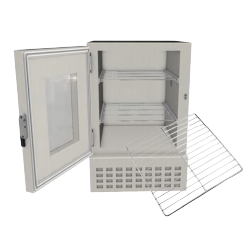
If you’re looking for advice on testing a car battery at the parts store, this isn’t that article. A battery test chamber is laboratory equipment: an environmental chamber that holds a battery at controlled temperature and humidity while it is charged, discharged, aged, or deliberately abused. Unlike a standard environmental chamber, it is built to survive what the battery does back.
That difference exists for one reason: thermal runaway. Overcharge, internal short, nail penetration, or external heating can push a lithium cell past its thermal stability limit. The electrolyte decomposes, releases flammable gas, and the cell vents, catches fire, or, worst case, explodes. What starts as lab routine can end as a facility loss, depending on the box around it.
These are not hypotheticals. In 2009, a lithium-ion battery under test detonated inside an enclosed steel locker in a NASA bunker (NASA Lessons Learned, 2009); in 2012, gases from A123 cells triggered an explosion in GM’s battery laboratory (Green Car Reports, 2012). In both cases, the testing was routine and the containment was not.
A lithium cell under abuse can vent gas, ignite, or disintegrate — EUCAR level 7. The chamber is the only thing between that event and your lab; that is why battery test chambers carry a safety layer ordinary chambers do not.
So the first decision is not which chamber to buy; it is what you plan to do inside it. A standard environmental chamber can host low-risk battery testing: low-energy cells, no abuse testing, staff present. The moment you charge, discharge, or abuse at meaningful energy, the safety layer stops being optional.
Battery Test Chamber Types: Two Axes That Sort Every Chamber
Search “battery test chamber” and you’ll see temperature ranges that appear to contradict each other: 5-70°C on one page, -70 to 180°C on another. Both are correct: they are different machines for different purposes. Two axes sort the entire category.
Axis one is what you are testing. The device format decides the chamber’s size and the load its structure must carry:
- Cells (coin, cylindrical, pouch). Benchtop or stacked chambers of roughly 80-400 L, like the Landt LBI series for long-duration constant-temperature cycling (Landt Instruments, 2026)
- Modules. Reach-in chambers sized to a module tray, often several per unit
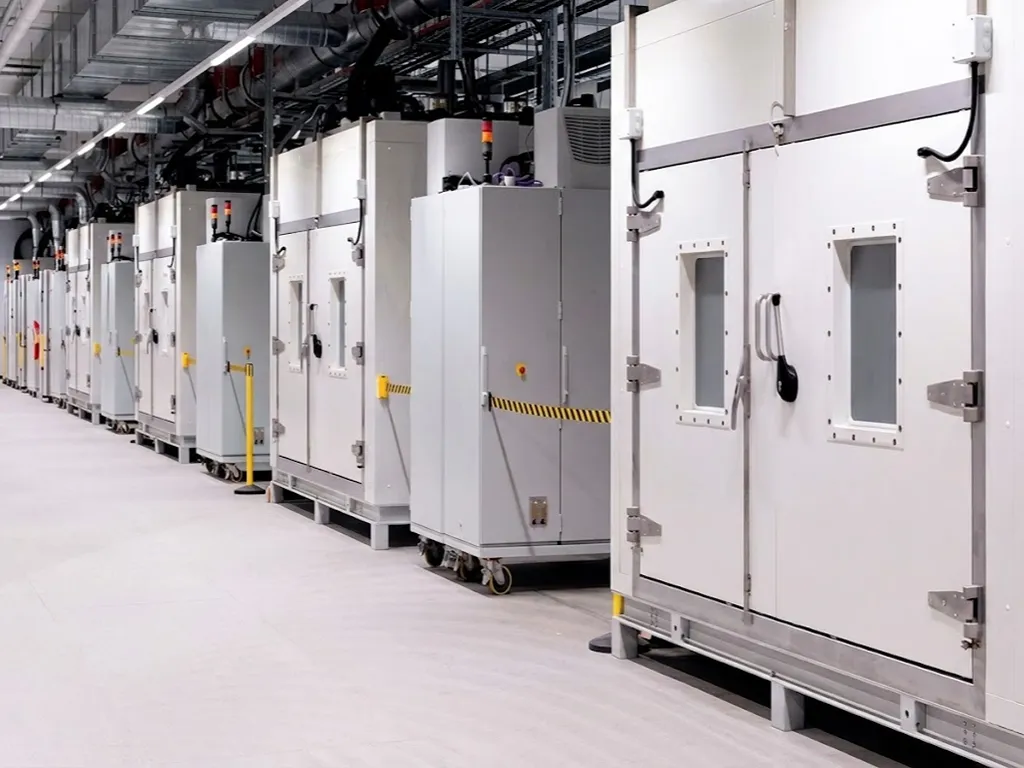
- Packs and vehicles. Walk-in (and drive-in) chambers, room-sized, built for EV packs or whole vehicles
Axis two is temperature. Constant-temperature cycling chambers hold a narrow band (5-70°C typical) around charge/discharge stations. The battery’s own heat is the load, and the chamber keeps it from drifting (Landt holds ±0.5°C across 80-400 L with frost-free control). Thermal abuse and high/low-temperature chambers cover -70 to 180°C, with ramp rate and cooling power as the headline specs. Thermotron cites -70 to 180°C at 20-95% RH (Thermotron, 2026); Tenney’s walk-in battery chamber spans -68 to 180°C (Tenney, 2026). Thermal shock chambers transition in seconds; a separate machine for separate standards.
A third axis is the test function: charge/discharge cycling, environmental reliability, and safety abuse testing (nail penetration, overcharge, external short). That last one is where “battery safety test chamber” and “explosion proof battery test chamber” searches live, and where the safety layer becomes the whole point.
| DUT format | Typical chamber | Typical test | Representative spec |
|---|---|---|---|
| Cell (coin/cylindrical/pouch) | Benchtop / stacked 80-400 L | Long-duration constant-temperature cycling | 5-70°C, ±0.5°C (Landt LBI) |
| Module | Reach-in | Cycle + reliability | -70 to 180°C, 20-95% RH |
| Pack / vehicle | Walk-in / drive-in | Thermal abuse, climatic + safety | -68 to 180°C (Tenney); -70 to 180°C (Thermotron) |
The boundaries matter as much as the boxes. A constant-temperature cycling chamber cannot reach abuse conditions; a thermal abuse chamber costs more to run for plain cycling; and nobody builds a walk-in to test coin cells, because airflow uniformity and instrumentation cost are wasted at that scale. Match the axis to the test, and the contradiction resolves itself.
Which Safety Level Does Your Battery Testing Need
Once test type and DUT format are fixed, one question remains: how much containment does this test demand? Three steps answer it.
First, classify the test. Cycling and climatic tests of healthy cells stay at the low end of consequence; abuse tests push cells past failure on purpose. They assume the battery will fail; the question is how violently.
Second, size the energy. A coin cell releases a fraction of the energy of a 60-kWh pack. Cell-level abuse fits compact explosion-proof enclosures; pack-level abuse requires rooms with blast relief and fire protection. Energy multiplies everything else.
Third, set a target EUCAR hazard level. The automotive industry classifies battery test outcomes on the EUCAR scale, 0 to 7 (EUCAR hazard levels, 2022). Levels 0-2 (no effect to irreversible damage) sit inside ordinary environmental chambers; levels 3-4 (electrolyte leakage, venting) demand gas handling; level 5 is fire; level 6 is rupture with flying parts; level 7 is explosion, disintegration of the cell, a pressure event the chamber must contain.
Three-step safety-level check
- Test type: cycling / climatic / abuse? — abuse tests assume failure.
- Energy: cell / module / pack — energy is the consequence multiplier.
- Target EUCAR level: 0-4 needs gas handling; 5-7 needs full containment — doors, restraint, relief, suppression.
Here is the trend: the safety ladder is moving up. Weiss, Tenney, AES, CSZ, ESPEC and Thermotron all list explosion-resistant or explosion-proof battery chambers as standard products where they used to be specials. Battery testing has moved from “simulate the environment” to “survive the failure,” and the equipment market followed.
The standards you’ll be asked to name sit alongside this: UN 38.3 covers transport safety, IEC 62660 cell performance, UL 1642/1973 battery safety. Those say what to test; EUCAR says how much the box around it must take. Do not let a sales sheet mix the two.
Battery Test Chamber Safety Features: What Actually Defines the Grade
How Pressure Relief and Door Restraint Work
An explosion-proof battery test chamber contains a pressure event not by sealing it in, but by giving it a controlled way out: pressure relief panels or blast windows open at a set overpressure and direct hot gas away from occupied areas. A relief port aimed at a walkway is a design fault, not a feature.
The door is the hard problem. In an EUCAR level 5-7 event, the door is the largest object that can become a projectile. The frame, hinges, and latch train are all that hold it closed against internal pressure. That is why explosion-resistant doors get reinforcement, observation windows get meshed lamination, and “door restraint” is listed as a feature on its own.
It also explains the terminology mess across product pages: “explosion-proof” (rated to contain an internal blast), “explosion-resistant” (survives with controlled pressure release), and “fire-proof” (rated against fire) are different engineering targets, not synonyms.
Three names, three engineering targets
Explosion-proof
Rated to contain an internal blast — the pressure event stays inside.
Explosion-resistant
Survives with controlled pressure release, not full containment.
Fire-proof
Rated against fire and heat, not necessarily blast pressure.
If the datasheet says “explosion-proof”, ask for the venting and restraint spec — the nameplate word is marketing.
Gas Detection, Inerting, and Fire Suppression: The Response Layer
The second line of defense buys time. Hydrogen is the first gas a failing cell releases, so battery chambers commonly integrate detection for H₂ alongside CO, CO₂, and O₂. A rise in H₂ or a drop in O₂ is the earliest signal that a cell has opened (Thermotron, 2026).
Nitrogen purging or a fully inert atmosphere removes the oxygen a fire needs. It is effective and expensive, since every purge interrupts testing and takes time to restore. Fire suppression (CO₂ or LN₂) sits further down the chain. And discharge testing generates heat and condensation risk: the frost-free control on constant-temperature chambers exists because a wet cycling station is a corrosion generator.
These systems have honest limits. Gas detection has response time; detection is not prevention. Inerting is not infinite abuse capacity. The matrix below is the decision tool for the whole layer.
| Test type | Realistic EUCAR target | Required features | Fails when |
|---|---|---|---|
| Cycling / climatic, cell | 0-3 | Temperature control only; condensation protection | Thermal cycling beyond spec range |
| Abuse, cell | 4-5 | Pressure relief + gas detection; compact blast enclosure | Relief vent blocked or misdirected |
| Abuse, module | 5-6 | Relief + detection + inerting; door restraint; multi-point locking | Detection latency exceeds event window |
| Abuse, pack / vehicle | 6-7 | Full containment: blast relief, structural door, restraint locks, suppression; walk-in room | Single-point manual lock left unengaged |
One boundary deserves its own paragraph: IECEx and ATEX certify equipment for use inside explosive atmospheres (a gas detector mounted in a chamber, for example). They do not certify a chamber’s ability to contain an explosion from within; that is judged by EUCAR-style containment design. If a supplier answers “how do you validate EUCAR 5-7 containment?” with an IECEx certificate, ask again.
Where the Grade Is Won or Lost: Battery Test Chamber Doors and Hardware
Door Weight and Hinge Load
A standard reach-in chamber door weighs tens of kilograms; a walk-in battery pack door (reinforced for blast, glazed with meshed observation windows) regularly passes 100 kg. At that mass it is a structural design problem, not a hardware selection problem.
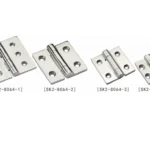
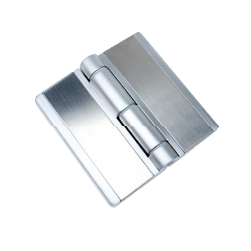
The hinges carry that mass through tens of thousands of open-close cycles at temperature extremes. Three requirements follow: load rating for full door weight plus dynamic slam loads, not leaf weight; creep resistance, because a hinge that sags on a 100 kg door becomes a seal failure; and low-temperature toughness, since materials fine at room temperature embrittle at -70°C.
Multi-Point Locking and Pressure-Event Restraint
If EUCAR level 5-7 is in scope, a single-point manual latch is not a door closure; it is a liability. Pressure events demand multi-point locking: three or more engagement points along the door edge, so the seal compresses evenly and the frame carries the load as a system rather than at one hinge. Electrically actuated variants tie into the safety interlock logic, so a test cannot start until every point is verified engaged. And a walk-in door handled in thermal gloves is not served by a thumb-turn lock.
EUCAR 5-7 DOOR RESTRAINT
The instant pressure releases inside a battery chamber, the door becomes the room’s largest projectile — only the multi-point locking and restraint system keeps it attached to the frame.
The frame, hinges, and latch train are all that hold it closed.
Every grade above EUCAR 4 is won or lost at that door.
Seals That Survive -70°C and 180°C
The seal layer is where most long-term chamber failures start. At -70°C, elastomer seals stiffen and lose seating force; at 180°C they age and harden. A leaking seal turns a “controlled environment” test into a measurement artifact: humidity drifts, cold seeps in, results stop being comparable.
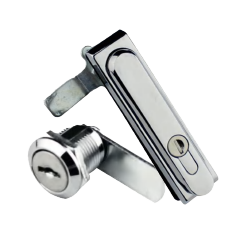
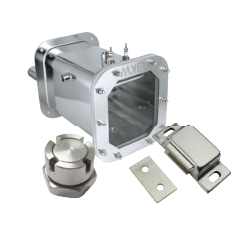
Compression-style sealing hardware (a handle or latch that mechanically squeezes the door against the gasket) holds seal force predictably across the temperature range, where a plain mechanical latch relies on its own elasticity. Surface treatment is the quiet third factor. Corrosion degrades a seal before inspection finds it, so salt-spray endurance is the honest specification to ask for: hardware rated for hundreds of hours versus over a thousand is the difference between surviving a coastal lab’s lifetime and replacement inside three years. Our stainless hinge and compression latch lines are built to this standard, and we’ll send the salt-spray and low-temperature test data for your door spec. It is the same data we use when a chamber builder asks us to engineer hardware for a -109°C biomedical cold-chain door; the low end of the range forces the design discipline for everything above it (KUNLONG hinges, compression latches, 2026).
Door hardware numbers that matter
100+ kg
Door mass: reach-in tens of kg; walk-in 100+ kg
-70 to 180°C
Temperature envelope across battery chamber classes
24,000 cycles
Hinge service life rating
400-1000 h
Salt-spray class for coastal / corrosive labs
Those three numbers (door mass, temperature envelope, cycle life) are exactly the parameters that should appear in your hardware request-for-quote, because they are what separate a component from an engineered system.
Three parameters to demand from a hardware supplier
- Target EUCAR level and door restraint class — does the lock train match the blast load?
- Door mass and size — hinge load rating must cover dynamic slam, not leaf weight.
- Temperature envelope and salt-spray hours — seal material, hinge finish, and test data, in writing.
One note on honesty, because this matters in safety equipment: the mechanical layer is necessary, not sufficient. The best door in the industry does not compensate for a misdirected relief port or a slow detection system. Grade design is a system; the door is its most visible component, not its only one.
How Battery Test Chambers Fail: Lessons from Real Lab Incidents
Failure reports cluster around a small set of mechanisms, all mechanical or procedural rather than exotic:
- Relief path failures. A blocked or misdirected relief port turns a contained event into a pressure failure.
- Seal and condensation failures. After extreme-temperature cycling, seals lose seating force and condensate finds power connections. The NASA 2009 incident ended with a battery detonating inside an enclosed steel locker; the locker became a pressure vessel instead of vented containment (NASA Lessons Learned, 2009).
- Inerting drift. A nitrogen system below rated pressure or a drifted O₂ sensor means the test runs in “believed inert” conditions. The GM 2012 explosion was attributed to gas accumulation in a confined space (Green Car Reports, 2012).
- Left-behind samples. In one documented facility fire, a technician left a battery in explosion test equipment over a weekend (ScienceDirect, 2024). No test was running; the battery failed on its own.
Relief blocked
Venting misdirected — check direction and trip test.
Seal aged
Gasket loses seating force after cycling — inspect on schedule.
Inerting drifted
O₂ sensor drifts — test runs “believed inert”.
Sample abandoned
Battery left in chamber unattended — it does not need a test to fail.
Factory validation is therefore straightforward: cycle the door and re-check the seal, trip the relief mechanism on purpose, run to both temperature extremes and measure condensation, and put lock-train engagement into the pre-shipment checklist. If a chamber cannot pass these, no control software makes up for it.
What the Battery Safety Arms Race Means for Test Chamber Manufacturers
Step back from the specifications and the market makes a clear statement: safety capability has moved from differentiator to entry ticket. The same manufacturers who sold environmental chambers a decade ago now ship battery safety lines as standard products. The electrical layer of that capability is purchasable off the shelf from component vendors; that part of the value chain is commoditizing.
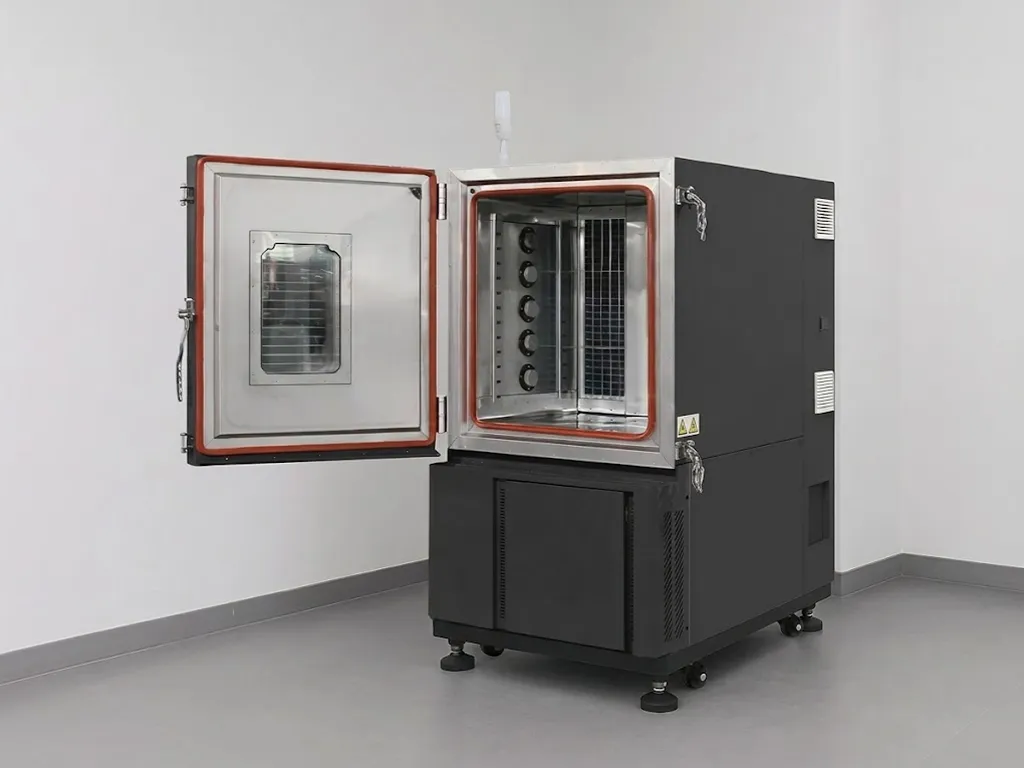
The mechanical layer is not. Door systems, restraint locks, seals that hold -70°C to 180°C, hardware that survives salt air and 100 kg doors: all of it is designed per chamber, per door spec, and the responsibility cannot be delegated to a component catalog. It is simultaneously your differentiation and your liability. An electrical layer failure is a service event; a mechanical layer failure during a level-6 event is a safety incident.
The implication for chamber builders is direct: treat the mechanical layer as a first-class engineering discipline, and hold hardware suppliers to the same standard as your sensors. Demand the EUCAR level, door mass, and temperature envelope up front, and require test data rather than catalog adjectives. The grade on your nameplate is decided by what the door does when it matters.
When you need that data, the fastest path is a supplier who already manufactures door hardware for extreme environments. We build chamber hardware in stainless and compression-sealing variants for equipment makers across twelve industries. Standard products ship within 7 days with 3,000+ models stocked; custom hardware follows a project-specific schedule (KUNLONG delivery, 2026).
Spec the Door That Survives the Event
Chamber hinges, multi-point locks, and compression seals rated for your door mass, temperature window, and EUCAR target — with salt-spray and cycle-life test data. MOQ 100, standard items out in a week.
Request chamber-hardware specificationsReferences
- [NASA]. “Lithium-Ion Battery Fire (Lesson 3516).” 2009. https://llis.nasa.gov/lesson/3516
- [Green Car Reports]. “GM Battery Lab Explosion Attributed To Gases From A123 Cells.” 2012. https://www.greencarreports.com/news/1075296_gm-battery-lab-explosion-attributed-to-gases-from-a123-cells
- [Battery Design]. “EUCAR Hazard Levels.” 2022. https://www.batterydesign.net/eucar-hazard-levels/
- [Landt Instruments]. “Battery Test Chambers (5°C~60°C).” 2026. https://landtinst.com/battery-test-chambers/
- [Thermotron]. “Introduction to a Thermotron Battery Test Chamber.” 2026. https://thermotron.com/thermotron-chambers-perform-a-battery-of-tests/
- [Tenney]. “Tenney Walk-In Battery Test Chamber.” 2026. https://www.tenney.com/products/battery-test-chambers/tenney-walk-in-battery-test-chamber
- [ScienceDirect]. “Exposure Assessment Study on Lithium-Ion Battery Fire.” 2024. https://www.sciencedirect.com/science/article/pii/S2093791123000793
- [KUNLONG]. “High-Performance Hinges.” 2026. https://www.kunlonghardware.com/hinges/
- [KUNLONG]. “Compression Latch/Handle.” 2026. https://www.kunlonghardware.com/compression-latch/
- [KUNLONG]. “Reliable Package & Delivery.” 2026. https://www.kunlonghardware.com/reliable-package-delivery/
- [KUNLONG]. “Homepage.” 2026. https://kunlonghardware.com/