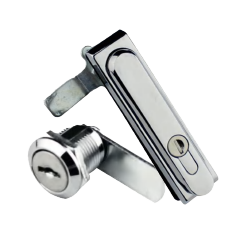



If you searched for “types of cam locks” expecting a breakdown of cabinet and enclosure locks and instead found page after page of hose fittings, you are not alone. You are not wrong, either. That collision of two unrelated industries sharing one name is exactly where every good cam lock conversation has to start. This guide clears it up in one section. Then it walks through every real category of cabinet cam locks: how they are operated, what sits inside the cylinder, which materials survive which environments, and which industrial types equipment builders actually specify. You will also learn how to order one without buying the wrong size, and what nobody tells you about replacing one.
“Cam Lock” vs. “Camlock Fitting”: Why Your Search Results Look Wrong
Two completely different products are called “cam lock,” and search engines have largely sided with the fluid-handling industry.
A cabinet cam lock is a compact cylindrical lock that secures doors, drawers, and access panels on enclosures. A camlock fitting, also written as cam lock or cam-and-groove coupling, is a quick-connect coupling used to join hoses and pipes. It is identified by a letter system of Type A, B, C, D, E, F, DC, and DP. Same name, two unrelated industries:
| Name | Industry | What it does |
|---|---|---|
| Cam lock (cabinet lock) | Industrial hardware & enclosures | Secures a door or panel with a rotating pawl behind the door |
| Camlock fitting (cam & groove) | Fluid transfer | Quick-connects hoses and pipes for liquids and powders |
From here on, every “cam lock” in this article means the one that locks cabinets.
How a Cam Lock Works: The Cam-and-Pawl Basics
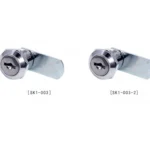
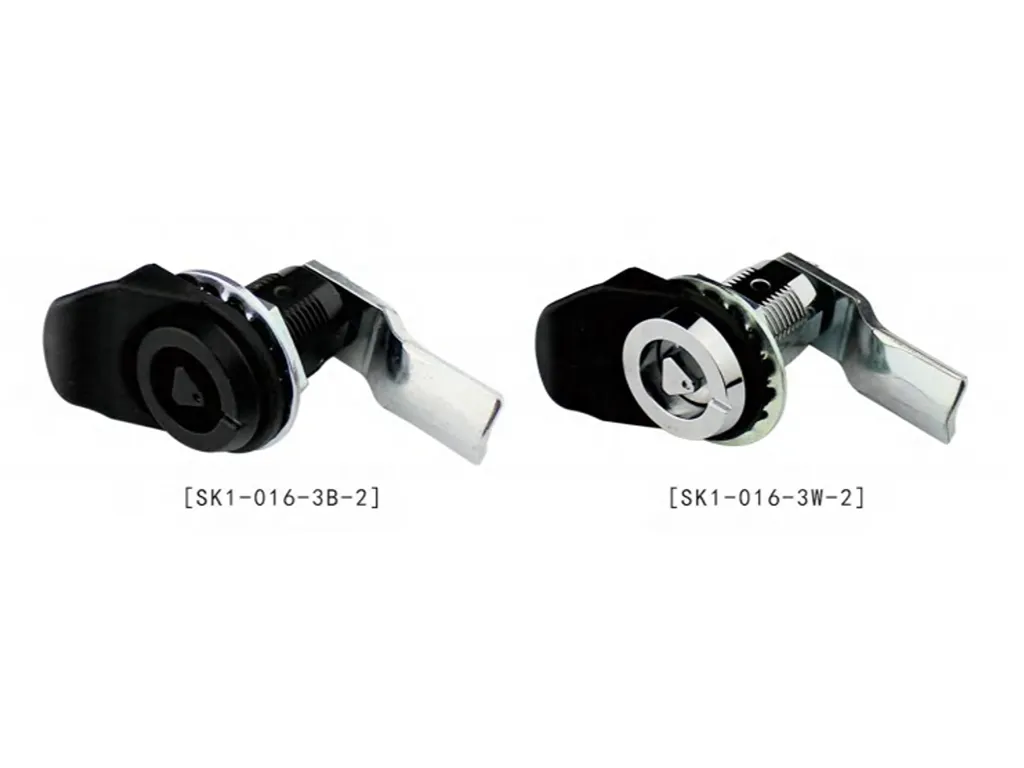
Every cam lock is built from four parts. The cylinder is the body you see on the door face. The cam is a flat stamped pawl attached to the back of the cylinder. The mounting nut clamps the lock into the panel. And a removable stop washer controls how far the cam can rotate.
The locking action itself is beautifully simple. Turn the key or tool, and the cam swings behind the door until its tip interferes with the frame lip, or with a metal keeper mounted for exactly that purpose. Unlock, and the cam rotates clear so the door opens. That interference is the entire mechanism: a cam lock does not shoot a bolt. It parks a rotating bar in the way.
Two details matter more than they look. First, the stop washer sets rotation at a standard 90° or 180°, which must match your door’s opening geometry. Second, how far the cam reaches, its length and offset, decides whether it actually catches the frame. We return to both in the selection section, because these two details are where most ordering mistakes happen.
One honest positioning note before the catalog begins: a cam lock manages who is expected to open the cabinet. It is not, by itself, a forced-entry system.
Types of Cam Locks by Operator: Keyed, Tool-Operated, and Keyless
The most useful first question is not “which lock is best” but two simpler ones: who should be able to open it, and how much key management are you willing to live with? The five operator families below answer both questions at once.
Keyed Cam Locks: The Default Choice for Managed Access
Keyed cam locks are the mainstream: one key, one authorized user group. They appear on industrial cabinets, test chambers, control boxes, vending machines, anywhere the rule is “whoever holds the key may enter.” You will recognize two key forms in the field: the familiar flat, toothed key and the round tubular key used on many vending machines and mailboxes.
What the catalog photo will not tell you is a quiet industry reality. Most stock cam locks shipped with OEM equipment use low-complexity cylinders, and professional locksmiths routinely open them in seconds to under half a minute. “Original equipment” is not the same thing as “secure.” A keyed cam lock is an access-management device first and a theft barrier second; the rest of the cabinet structure does the heavy lifting against forced entry.
Tool-Operated Cam Locks: Security Without a Key Inventory
Tool-operated locks replace the personal key with a dedicated tool: tri-head, square-head, Allen, or double-barbed drivers, or even a coin slot. The screening question changes from “who has a key?” to “who has the tool?”. That is why they dominate public and semi-public hardware, from restroom dispensers and medical furniture to telecom cabinets and service panels. The common thread is simple: keep casual hands out without running a key register.
Two sub-families are worth knowing by name. Slam locks lock automatically when the door closes and require the tool to reopen, the standard answer for metal lockers and mailboxes. Plunger locks push a bolt sideways and are typically side-mounted on sliding doors and filing cabinets. No key inventory, no lost-key crisis; the trade-off is that tools, like keys, can be copied.
Combination Cam Locks: The “No Key to Lose” Option
Combination cam locks put a numbered dial where the keyway used to be. They are beloved in two communities for the same reason: RV owners and toolbox owners who have been locked out once never want to depend on a key again.
Be honest about the trade-off before choosing one. Codes can be shared, shoulder-surfed, or simply left at the factory default, so the security level is modest: right for keeping honest people out, wrong for protecting anything valuable. And if you are replacing an OEM keyed lock with a combination unit, check the drive interface on the back of the cylinder. Square, oval, and double-D shafts are not interchangeable, and this mismatch stalls more retrofits than any other single issue.
Thumb-Turn and Knob Cam Locks: Quick Access, Zero Security
Thumb-turn cam locks are the keyless family’s convenience end: twist the knob on the door face, and the cam rotates, no key, no tool, no code. Their job is keeping a door from swinging open, not keeping people out, since anyone can operate them.
That makes them perfect for display cases, utility cupboards, and home storage where the goal is tidiness rather than restriction. Technically they sit at the lockless end of the cam latch family: same body, same cam, no cylinder gating it.
Electronic Cam Locks: Where Cabinets Meet Access Control
The newest branch keeps the mechanical cam but replaces the key with a keypad, card reader, or network connection. The cam mechanism is unchanged; only the driving force is electronic.
Today they cluster where access needs auditing or remote control: data-center racks, shared parcel lockers, and a growing number of environmental test chambers. Builders of those chambers are starting to ask for remote lock status and cycling logs. Adoption in general industrial cabinets is still early, mechanical locks remain the volume market, but if your product roadmap mentions IoT, this is where cabinet hardware is heading.
Inside the Cylinder: Pin, Wafer, Disc, and Tubular Tumblers
The operator decides who may turn the lock; the tumbler mechanism decides how the key is verified. These are two orthogonal dimensions, and mixing them up leads to overbuying or underbuying.
| Mechanism | Key type | Security level | Environment tolerance | Typical use |
|---|---|---|---|---|
| Pin tumbler | Flat toothed key | Moderate-high | Standard | File cabinets, lockers, cash boxes |
| Wafer tumbler | Flat key | Basic | Standard | Office furniture, utility panels, light enclosures |
| Disc tumbler | Rotating disc key | High, pick-resistant | Excellent – dirt, cold, corrosion | Outdoor enclosures, vending machines, meters |
| Tubular | Tubular key | Moderate | Standard | Vending machines, mailboxes, toolboxes |
The mechanism differences explain the table. Pin tumblers use spring-loaded pins that align at the shear line only when the correct key lifts them. Wafer tumblers use flat spring wafers, cheaper to make and lighter duty. Disc tumblers contain no springs at all: rotating discs align to let a sidebar fall into place. That design shrugs off dirt, freezing, and corrosion that would kill a pin tumbler, which is why outdoor vending and utility hardware favors it. Tubular locks use a round key with cuts around the barrel.
One caveat to carry into procurement: these security grades describe the cylinder’s resistance to skilled opening, not the cabinet’s resistance to a pry bar. The two numbers live on different scales.
Materials and Finishes: Matching the Lock Body to the Environment
Same lock type, different material, and the material decides where it dies. Indoor office furniture and a seaside EV-charger cabinet are not the same job.
| Material | Strength & life | Corrosion resistance | Typical environment |
|---|---|---|---|
| Zinc alloy (die-cast) | Good, cost-effective | Moderate | Indoor, light to medium duty |
| Brass | Good, machines well | Good | Moderate environments, polished appearance |
| Stainless steel 304 | High | High | Outdoor, humid, general industrial |
| Stainless steel 316 | High | Excellent – resists chlorides | Marine, medical, food processing |
Finishes are the second layer. Chrome and nickel plating, black powder coating, polishing, and grinding change both the look and the surface chemistry of the lock body. Industrial suppliers commonly offer ten or more surface treatments, because a lock that matches the cabinet’s finish also matches its corrosion budget. When suppliers quote salt-spray endurance to prove corrosion resistance, ratings commonly span from a few hundred hours up to a thousand; it is the number to compare between bids.
The material decides where the lock body dies. The next section decides what kind of work the lock is built to do.
Industrial Cam Lock Types: Sealing, Compression, and Engineering Variants
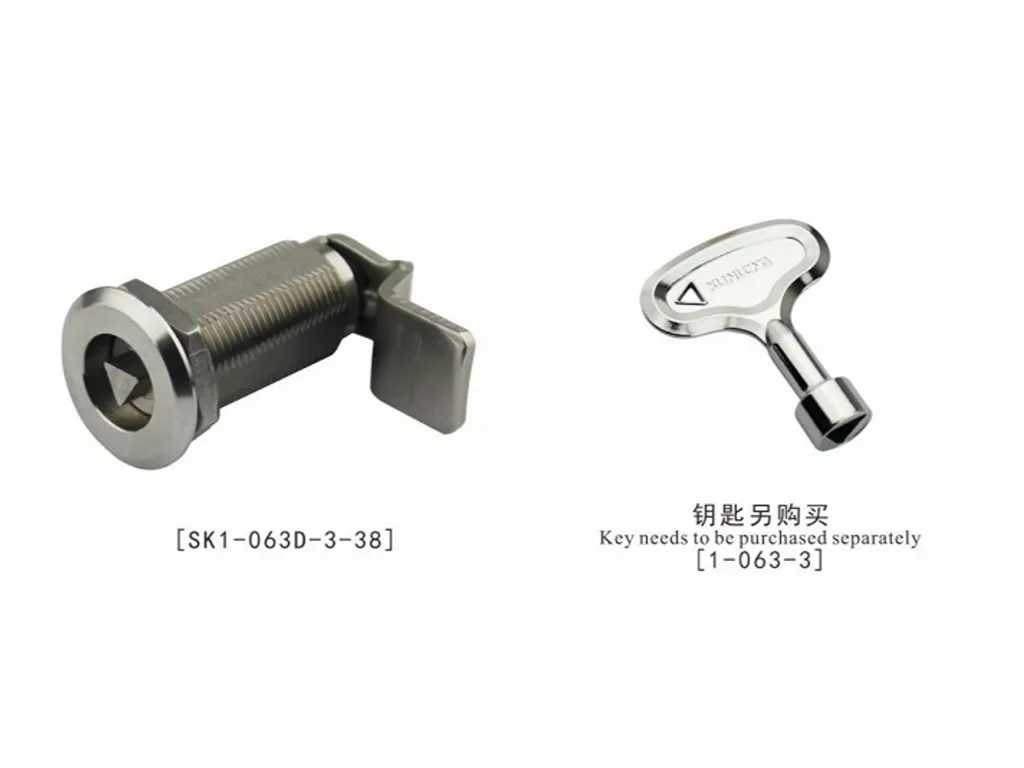
The first three type families answer “who opens it,” “how the key is verified,” and “what the body is made of.” This one answers the question equipment builders actually ask: what will this lock have to survive on my machine?
These next families come from industrial catalogs rather than everyday lock vocabulary, so three boundaries are worth drawing before the table.
The first and biggest: the industrial families are not a replacement for the three axes above. They are a fourth axis stacked on top. A keyed lock with a disc tumbler in a zinc-alloy body specifies three axes. Add an IP65 sealed housing, and the same part number now specifies four. When you see “keyed, disc-tumbler, SUS316, IP65-sealed cam lock” on a spec sheet, that is four axes in one string.
The second boundary is between the families themselves. They split by the problem each solves: one seals the lock against the environment, one pulls the door tight, one adds a second visible authority, and the last is not a family at all but a set of fit dimensions. Each gets a plain definition below before the engineering detail.
Industrial cam lock catalogs organize products around function, not around key shapes. Four families do most of the work:
| Industrial type | Key feature | Typical equipment |
|---|---|---|
| Sealing & waterproof | Face gasket, key-cylinder rings, or IP65 molded-in body | Outdoor telecom cabinets, cold chain, EV chargers |
| Compression pawl | Grooved pawl pulls the door tight against its gasket | Control boxes, power cabinets, enclosures |
| Padlock-ready | Built-in hasp for an added padlock | Equipment with two-person or cross-shift access rules |
| Engineering variants | Left/right hand opening, two pawls, multiple spigot heights, SUS304/316 | Medical devices, marine, automation, automotive |
Sealing and waterproof cam locks keep water and dust out of the lock itself. Note the boundary: they seal the lock, not the door; door-level sealing is the next family’s job. Three engineering approaches do the work. The simplest puts a compressible gasket behind the lock face. The next seals the key cylinder itself with waterproof rings, which also add a soft damping feel to the key turn. The most thorough molds the cylinder and housing in one piece and rates the whole assembly IP65. That means dust-tight and protected against low-pressure water jets, with IP ratings defined by IEC 60529 (IEC). These are the locks that live on outdoor telecom cabinets, cold-chain equipment, and EV charger doors.
Compression cam locks take over where sealing locks stop: at the door. A standard cam merely blocks the door from opening; a compression pawl grips it. Their pawl carries a groove that catches the door panel as the lock closes, pulling the door tight against its gasket. Control boxes and power cabinets that must stay sealed against dust and stray airflow rely on this type.
Padlock-ready cam locks add a second, visible authority on top of the key. The built-in hasp does not replace the lock’s own key; it lets a padlock join it. Equipment maintained under two-person rules or cross-shift handover protocols uses this extra layer so that operating the lock leaves a visible trace.
Engineering variants are the honest label for a group that is not really a family. These are fit dimensions that every family above ships in, and treating them as a fourth security type is the most common spec mistake. Left- and right-hand opening versions suit doors that hinge on either side. Two pawls mean two latching points instead of one. Spigot height, the length of the threaded stud that carries the pawl, comes in several steps so one lock body fits several door thicknesses. Material options step up from zinc alloy to SUS304 and SUS316 for medical devices, marine gear, and automation equipment. Two procurement habits come with this territory: keys are often purchased separately by key code, and every SKU ships with its own specification sheet and drawings.
Where do these types actually land? Test chamber and industrial oven doors, which cycle through deep-freeze and bake temperatures and carry real weight. 5G telecom cabinets and power control boxes that sit outdoors for a decade. Medical equipment, cold-chain units, lithium battery production lines, food and pharma packaging machines, shielded and soundproofed enclosures, and EV charging and power distribution cabinets. If your equipment has a door with an enclosure behind it, one of these four families is almost certainly already on a competitor’s machine, and your spec should know why.
How to Choose a Cam Lock: Panel Fit, Cam Geometry, and Keying Plans
Selection reduces to two legs, and a lock is only right when both stand: the lock must physically fit the panel, and the keying plan must match how people actually work.
Physical Fit: Cutout, Body Length, and Cam Offset
Four checks, in order:
Each check has a failure mode. Too short a body and the nut never bites; too short a cam and the door “locks” without actually catching anything; the wrong rotation and the cam stops in the wrong position. If you are replacing an existing lock, measure the old one before shopping, and keep those measurements when you order.
Keying Plans: Keyed Alike, Keyed Different, and Master Key
The keying plan is an organizational decision dressed as a product option:
- Keyed alike: one key opens every lock in the group. Right for one team servicing many identical cabinets. The catch: one lost key compromises the whole group.
- Keyed different: every lock has its own key. Right for separated permissions, at the cost of a bigger key register.
- Master key: each lock has its own key, plus a supervisor key opens them all. Right for hierarchical sites, and not supported by every lock family; confirm before ordering.
For bulk orders, treat the key code, sometimes called the cylinder code, as the lock’s identity. Specify how many locks, how many operating keys, and the spare-key policy. Add one clause that is easy to forget: future replenishment orders must carry the same code. Skip it, and your five-year-old keyed-alike fleet slowly turns into a mixed-key nightmare. Documenting the plan matters as much as choosing it.
Replacing a Cam Lock: The Compatibility Checklist Nobody Publishes
Everything below is about reading those three photos.
Cam Drive Interfaces: Why “Same Size” Is Not “Same Fit”
The cylinder’s rear shaft is where replacements go wrong. Drive shafts come in square, oval, and double-D profiles, and they are not interchangeable; a lock can be the same diameter, same body length, and still refuse to accept your cam. Check the shaft profile against your old lock’s. Note whether the cam exits straight from the key axis or at an offset. And if the old cam is still sound, check whether it can be reused on the new shaft.
The stakes are higher than most people price in. In one well-documented Garage Journal thread, a toolbox owner was quoted $280 by a local machine shop. Two matching cams, after his combination-lock retrofit stalled on a square-versus-oval shaft. Ten minutes of interface checking before the purchase would have cost nothing.
Linkage, Keepers, and Repairs: What Else Moves When the Lock Turns
The lock is never the whole story. Drawer cabinets and multi-door boxes route the lock through a rod or linkage system. When you replace the lock, the linkage must be re-checked for travel and timing, or the drawers will not behave. Behind the door, the keeper or strike, the metal lip the cam actually catches, wears with use. A worn keeper on a heavy door makes even a brand-new lock feel broken. Professional locksmiths routinely specify a proper metal keeper for double-door medical cabinets rather than relying on the frame alone.
Two structural notes finish the picture. A cam lock is a single-point closure. On very heavy doors or wide panels, evaluate a multi-point or rod-based closure instead of asking one small lock to hold a hundred kilograms. And if the old mounting hole is scarred from a previous removal, a trim ring or washer often covers the damage. Just check the remaining hole diameter against the new lock’s face before you buy.
What Cam Lock Selection Actually Means for Equipment Builders and Buyers
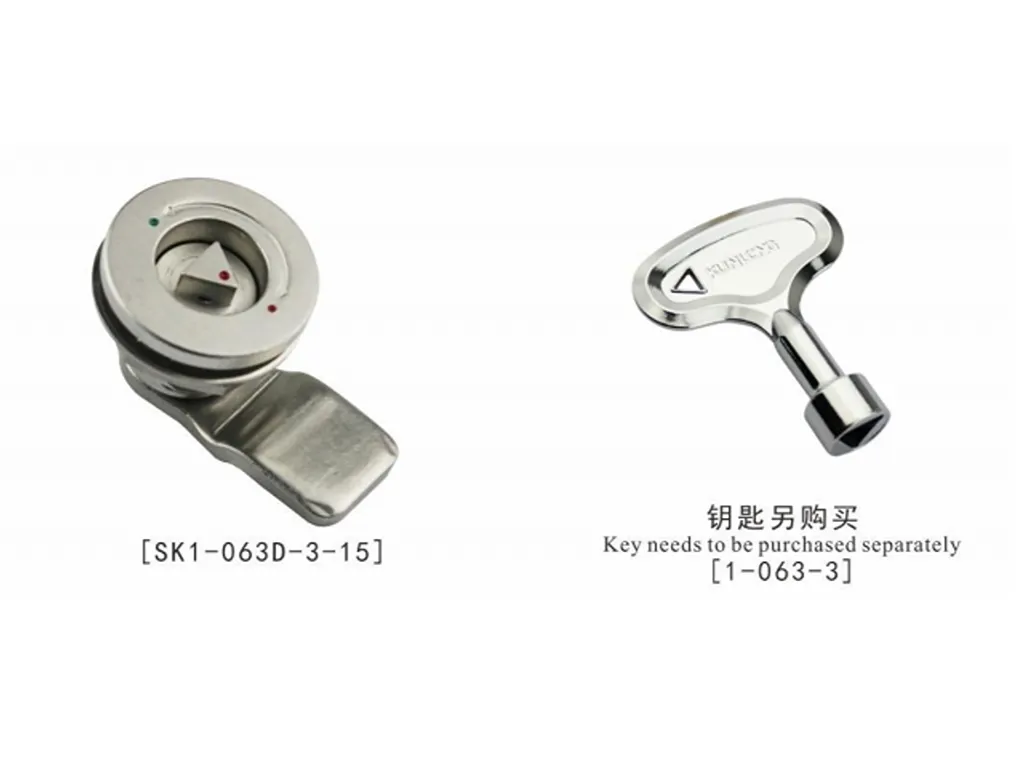
Everything above looks like a catalog of parts. Turn the same facts sideways and they become a map of a market, and the map explains why buying cheap locks and buying locks cheaply are two different mistakes.
Start with what end users actually report. The dominant complaint in every toolbox and machine-shop forum is the same: budget locks that “bind, fall apart and seize in about a year.” Notice what is not mentioned: nobody complains that their lock was picked. The end user’s real requirement is not security theater but reliability: buy once, ignore for a decade, and have it work the one time it matters. That is why the market’s disappointment concentrates in cheap zinc-alloy imports rather than in any particular lock type. And it is the first market rule: perceived durability, not headline security, drives satisfaction.
The second rule concerns decision-making. End buyers choose on price, reviews, and fit. The fact that OEM stock locks can be picked in seconds barely moves their behavior: technical opening resistance is a blind spot at the terminal end of the market. The third rule sits in after-sales: the moment a lock needs replacing, interface compatibility becomes the whole experience. As the $280-cam story shows, a mismatch turns a $15 part into a machining project, and the failure lands on whoever sold the original cabinet.
For anyone on the supply side, these three rules convert into specific actions. Invest visibly in cycle-life and corrosion testing, because durability is the feature the market actually feels. Offer keyed-alike groups and same-code replenishment, because “one key, forever, even five years later” is the promise bulk buyers are quietly paying for. And publish your interface specifications and drawings openly, because the buyer’s deepest fear is buying a part that will not fit. Remove the fear and the order follows.
The same facts, seen from the equipment-builder side, tell a different story. Industrial cam lock demand is a mixed stock-and-project market. Standard SKUs leave the warehouse in about a week with no hard minimum order. OEM programs move through drawing approval and sampling, scaling from pilot lots to six-figure production runs. The buyers are design and procurement engineers at equipment makers, enclosure builders, maintenance teams, and distributors. Their decision gates are concrete: the cutout, body length, cam geometry, IP rating, and material grade all sit in the technical specification, and the keying plan must survive internal review. And because the cost of a wrong lock falls on the equipment builder and the maintenance team, response speed and continuity of supply outweigh unit price sensitivity in nearly every repeat order. When a wrong lock ships, someone returns a cabinet or makes an angry site visit.
That is the industrial shape of this market: stock breadth with week-level lead times, per-SKU specification sheets and drawings, low order minimums, and same-code continuity across years. Suppliers built for this shape are easy to spot. KUNLONG, for example, covers the industrial type spectrum: sealing cam locks with face gaskets, waterproof key-cylinder rings, and IP65 molded-in bodies; compression-pawl types that pull doors tight; padlock-ready variants; and engineering options like left- and right-hand opening, two pawls, and multiple spigot heights. All of it in SUS304, SUS316, and zinc alloy. Every SKU ships with specifications and drawings, standard items leave the warehouse in about a week, and there is no minimum order requirement. Its industrial cam lock catalog is a practical place to check your fit against a real model.
What are the different types of cam locks?
Cam locks fall into five operator families: keyed, tool-operated, combination, thumb-turn, and electronic. Tumbler mechanisms (pin, wafer, disc, tubular) and materials (zinc alloy, brass, stainless 304/316) are separate dimensions.
What types of cam locks do industrial equipment builders use?
Industrial catalogs organize cam locks by function: sealing and waterproof types (face gaskets, key-cylinder rings, IP65 bodies), compression-pawl types that pull doors tight, padlock-ready types, and engineering variants such as left- and right-hand opening, two pawls, and multiple spigot heights for different door thicknesses.
What is the difference between a cam lock and a cam latch?
A cam latch is any mechanism that closes a panel with a rotating cam. A cam lock is the keyed or tool-restricted version: the same mechanism with access control added.
Are all cam locks the same size?
No. Mounting holes commonly come in 16 mm, 19 mm, and 22 mm, body lengths must span the panel thickness, and cam shafts come in square, oval, and double-D profiles that are not interchangeable.
What is the most common cam lock size?
For cabinet and enclosure hardware, 19 mm and 22 mm mounting diameters with a double-D cutout are the most frequently specified, but always measure the old lock before ordering.
References
- [IEC]. “Ingress Protection (IP) ratings.” https://iec.ch/ip-ratings
- Garage Journal Forum. “Hardor Freight Toolbox Lock Replacement.” 2019. https://www.garagejournal.com/forum/threads/hardor-freight-toolbox-lock-replacement-please-help.430078/
- Practical Machinist Forum. “Quality keyed cabinet cam lock.” 2025. https://www.practicalmachinist.com/forum/threads/quality-keyed-cabinet-cam-lock.444411/
- KUNLONG. “Cam Locks.” https://www.kunlonghardware.com/cam-lock/
- KUNLONG. https://www.kunlonghardware.com/