


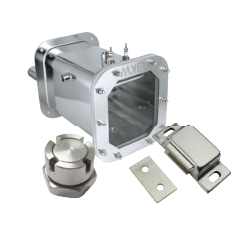
If you build or maintain marine equipment — a shipboard cabinet, a reefer container door, a marine refrigeration unit — “marine hardware suppliers” means something very different to you than it does to a weekend boater replacing a deck cleat. The same search term sends one buyer to a retail shelf and another to an OEM factory floor. Most of what ranks for it serves only the first group.
This guide covers both worlds. It explains what marine hardware actually includes and walks through the material question (304 vs. 316) that decides whether your parts survive salt water. It sorts the supplier landscape into four tiers, profiles 13 marine hardware suppliers by buyer type, and closes with a verification checklist and an application-by-application boundary matrix. Where relevant, it also covers stainless steel marine hardware suppliers and marine hardware manufacturers specifically, because those searches pull a different, more sourcing-oriented set of results.
“Marine Hardware Suppliers”: What the Term Actually Covers
Marine hardware is a broad label for the metal (and increasingly composite) parts that hold a boat together and keep its equipment working: latches, hinges, cleats, rail fittings, fasteners, gas shocks, rod holders, and the hundreds of small parts around them. When it works, you never notice it. When a latch fails, you lose access to a hatch; when a through-hull fitting fails, you are relying on the bilge pumps.
What matters more is that the term hides two different product worlds:
- Deck hardware: cleats, chocks, rail fittings, hawse pipes. These live on the hull and deck, bolted down and rarely touched. They are bought by boaters, boat builders, and chandleries.
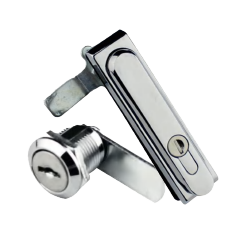
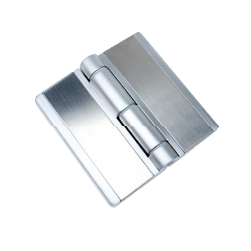
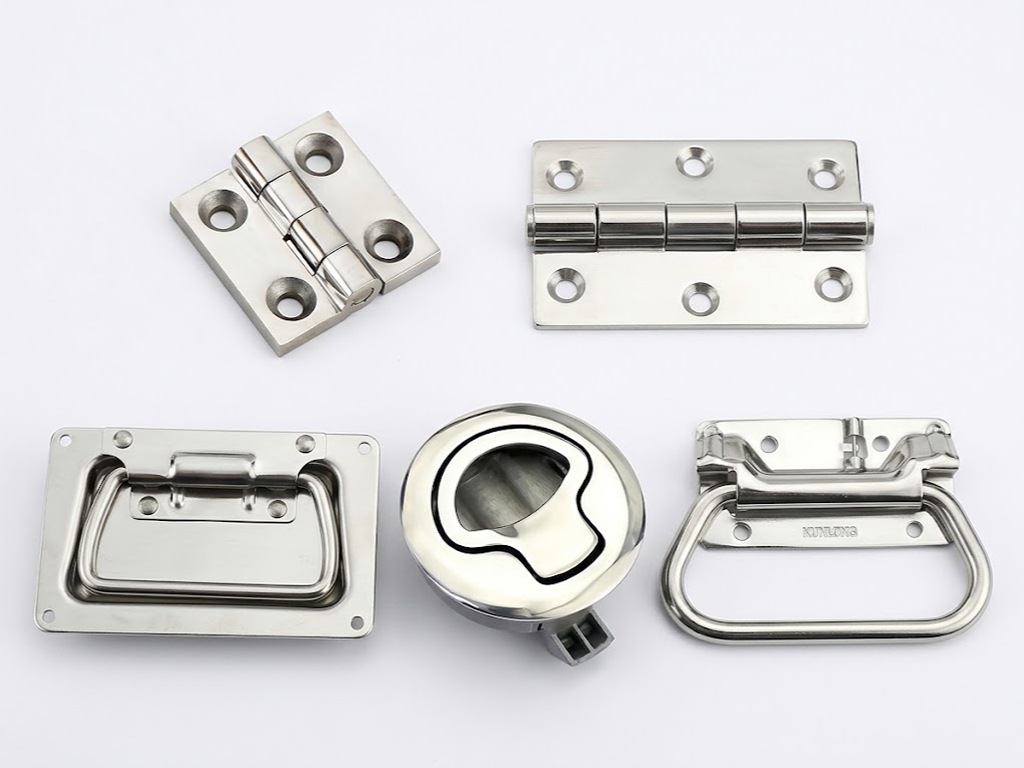
- Equipment and cabinet hardware: compression latches, butt hinges, catches, stays, and handles for shipboard cabinets, doors, and equipment enclosures. These move every day, so they are bought on material grade, cycle life, and tolerance — not just corrosion resistance.
A cleat on the gunwale sits untouched for a decade. A hinge on a cabinet door cycles open and shut dozens of times a day in salt air. Keeping this split in mind is the single most useful thing you can do before contacting any supplier, because it determines which tier of the market you should be talking to.
304 vs. 316 Stainless Steel: The Material Question Behind Marine Hardware
Most marine hardware is stainless steel, and most stainless debates come down to two grades: 304 and 316. The difference is molybdenum: 316 contains roughly 2-3% molybdenum, which 304 lacks, and that single alloying element is what gives 316 its superior resistance to pitting and crevice corrosion in chloride environments — i.e., salt water (Xometry, 2023; Lesjöfors, 2026).
| Material | What It Is | Where It Works | Where It Fails | Typical Price Position |
|---|---|---|---|---|
| 304 stainless | 18-8 chrome-nickel, no molybdenum | Interior cabinets, freshwater gear, above-deck dry locations | Saltwater immersion zones; shows rust spots from crevice corrosion within months in some cases | Lowest |
| 316 stainless | 2-3% molybdenum added | Decks, rails, exterior fittings, anything wetted or in salt spray | Still vulnerable to crevice corrosion if installed without sealant and marine-grade fasteners | 20-40% premium over 304 |
| Chrome-plated zinc | Plated corrodible base | Dry interior trim, light-duty hardware | Chips expose the base metal; rapid corrosion once plating breaks | Cheapest |
| Plastic / nylon | Non-corrosive polymers | Light-duty latches, vent fittings | UV embrittlement over time; load limits | Low |
Two points that rarely make it into the online comparison tables. First, stainless steel can rust. The chrome-oxide film that protects it breaks down in oxygen-starved crevices, under fastener heads and between two clamped plates. That is why proper installation means marine-grade fasteners and a real sealant bed, not household caulk. Second, if you are buying for equipment rather than for a boat deck, the material grade is only the entry ticket: you will also need documentation. Equipment buyers routinely ask for material test reports (third-party, such as SGS) and salt-spray test results to ISO 9227 (ISO, 2017), typically in the 400-1,000-hour range for industrial-grade hardware, along with RoHS compliance where the equipment ships into regulated markets.
The Four Tiers of Marine Hardware Suppliers (and Which One You Need)
Here is the framework most supplier articles skip: you are not choosing a store, you are choosing a supply-chain tier. Searches for “stainless marine hardware suppliers” and “marine hardware manufacturers” surface all four, mixed together, and each tier answers to a different buyer with different volume, documentation, and lead-time expectations.
| Tier | Who Lives Here | Typical Buyer | Order Shape | Watch For |
|---|---|---|---|---|
| Manufacturers | Gemlux, Marine Town, Schaefer Marine, Marine Hardware Inc. | Boat builders, OEMs, brand-loyal boat owners | OEM batches and direct sales | Patent and history claims; verify they actually manufacture what they sell |
| Distributors & wholesalers | Bainbridge, Whitecap, Trivantage | Chandlers, fabricators, wholesale buyers | Volume, multi-brand lines | Wholesale pricing tiers; minimums; national distributor networks |
| Retailers | West Marine, Boat Outfitters, Bosun Supplies | DIY boaters, small repair shops | Single units, fast fulfillment | Easy to overpay for premium brands; watch for unmarked knockoffs |
| Industrial & OEM-tier | Suncor Stainless, McMaster-Carr, Marsh Fasteners | Equipment manufacturers, engineering procurement | Spec-driven, documented | Must provide grade, test data, and certificates with the parts |
One company can occupy two tiers at once. Boat Outfitters, for example, is an OEM supplier to more than 200 boat builders and a retail store for DIY repairs. Suncor Stainless explicitly serves marine, industrial, architectural, government, and OEM markets from the same catalog. Judge the tier by the transaction you are making, not by the logo.
13 Marine Hardware Suppliers That Cover the Market, by Buyer Type
Before reading the profiles below, answer three questions to locate yourself: Are you outfitting one boat or a production run of equipment? Are you buying single pieces or MOQ quantities? Do you need test reports and certificates with the delivery? Your answers route you to the right section.
Manufacturers: Brand Makers You Can Buy From Directly
These companies design and build their own hardware. This is the tier to call when you want the factory behind the brand.
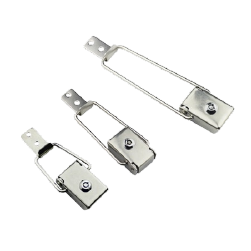
These brand manufacturers sell “marine standard products plus brand heritage” — mostly to the recreational and light-commercial market. KUNLONG, a China-based industrial hardware manufacturer, occupies a different corner of the same tier: its ship-equipment line (stainless catches, stays, compression handles) is built for equipment manufacturers, with SUS304/SUS316 material options, electro-polished finishes, and OEM customization on size, surface treatment, and batch — the kind of spec sheet a boat-builder parts counter does not carry.
Distributors & Wholesalers: Multi-Brand Channels for Volume Buying
This tier buys from many factories and resells with margin, stock, and logistics. It is where chandleries and marine fabricators buy by the case, not by the piece.
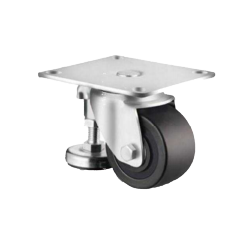
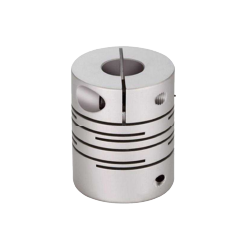
All three are resellers — their value is breadth and logistics, not manufacturing. For distributors and wholesalers themselves, the complementary question is whether you want to keep buying multi-brand at wholesale markup, or go one level up to a manufacturer that sells factory-direct: KUNLONG runs the full catalog a reseller needs (locks, hinges, handles, latches, casters, couplings, shelving) with 3,000+ SKUs in stock across all product lines shipping within a week, a 100-piece MOQ, and customization options down to logo, packaging, and 30+ color choices — a one-supplier alternative to juggling three branded lines.
Retailers: Fastest Path for DIY Repairs and Replacements
If you are replacing a broken latch on your own boat, these are the reliable channels. They are also the antidote to the “cheap Amazon part that rusts in one season” experience boating forums are full of (“buy nice rather than buy twice” is the recurring advice on The Hull Truth).
One buying tip that saves the most frustration in this tier: measure before you order — unfolded hinge length, hole pattern, panel thickness — and confirm the grade stamp (316, not just “stainless”). Replacement failures are usually measurement failures.
Industrial & OEM-Tier Suppliers: When “Marine Grade” Has to Be Proven
This is the tier most supplier lists never mention, and it is the one equipment builders actually need. Here, parts are bought on documented parameters: material grade, salt-spray hours, cycle life, tolerance.
That is the profile you should expect to see from any supplier claiming to serve this tier.
How to Qualify a Marine Hardware Supplier Before You Commit
Verifying a supplier is not a reputation audit — it is a parameter and paperwork audit. Reputation can be marketed; parameters cannot. Run any candidate through these three checks.
Verify the Material: Grade, Finish, and Test Reports
Ask three things and accept no adjectives in place of answers: What grade, exactly — AISI 304 or 316, stated on the drawing, not just “stainless”? What surface treatment, and how many stages — electro-polishing, passivation, brushed? And what documentation comes with the parts — third-party material test reports (SGS-type) and RoHS compliance where your market requires it?
The salt-spray number is the quickest sorting test. Industrial-grade hardware is commonly qualified to 400-1,000 hours of neutral salt spray (ISO 9227), while plenty of cheap circulation parts are never tested at all — which is exactly the difference between hardware that lasts on a deck and hardware that spots in a season.
Verify the Performance: Cycle Life, Load, and Tolerance
Marine equipment hardware earns its price on fatigue, not looks. Ask for cycle-life test data — a 20,000+ cycle rating is the floor for a hinge or latch on a door that opens twenty times a day for three years. Ask about load ratings for heavy doors — a single equipment door can exceed 100 kg, and the hinge is what carries it. And where mechanical interfaces matter, ask for stated machining tolerances; ±0.0005 mm is achievable by precision shops and tells you the supplier actually controls its machining, not just its assembly.
Verify the Terms: MOQ, Lead Time, Samples, and After-Sales
Finally, check whether the supplier’s commercial terms fit your purchasing shape. Friendly terms for industrial buyers look like: MOQ in the 100-piece range rather than full containers; stock items shipping within a week and custom SKUs within 7-15 days; free samples on stock items (freight collect) and sample fees on custom work — both standard practice, not red flags; and after-sales response measured in hours, with warranty terms stated in cycles (1 year or 24,000 cycles is a typical industrial commitment).
If you plan to run this checklist against real suppliers, one practical benchmark: KUNLONG publishes the full parameter set above for its marine-equipment hardware line — SUS304/SUS316, 400-1,000-hour salt-spray qualification, 24,000-cycle warranty, ±0.0005 mm tolerance, 100-piece MOQ, one-week stock shipping, and 12-hour response — which makes it a convenient reference sheet for comparing any industrial-tier supplier’s answers against, Suncor and McMaster-Carr included.
Choosing a Supplier by Application: The Boundary Matrix
No supplier covers every application, and in this market boundaries matter more than headlines. The matrix below flips the question around — instead of “who is the best company,” it asks “for my application, who is actually strong, and what do I still have to confirm?”
| Application | Strong Fit | Boundary Check Before You Commit |
|---|---|---|
| Recreational deck hardware (cleats, deck fittings, rod holders) | Gemlux, Whitecap, Marine Town, West Marine | Confirm 316 grade and match hole patterns to the original equipment; watch for chrome-plated zinc posing as stainless |
| Boat interior cabinet hardware (latches, hinges, pulls) | Marine Town, Boat Outfitters, Gemlux | Confirm latch type (slam/compression/push-button) and panel thickness before ordering |
| Sailboat rigging hardware (blocks, travelers, furling) | Schaefer Marine, Bainbridge (Karver/Italwinch lines) | Size by sail area and winch load, not by price; check load ratings |
| Canvas and bimini hardware (fasteners, bows, top fittings) | Trivantage, Bosun Supplies | Confirm DOT/YKK fastener spec and case-pack pricing (100/1,000-piece packs) |
| Marine equipment cabinet hardware (industrial OEM) | Suncor Stainless, KUNLONG, Marsh Fasteners | Request grade + salt-spray + cycle-life reports; confirm MOQ and OEM customization (sizes, finishes) |
| DIY replacements and small repairs | West Marine, Bosun Supplies, Boat Outfitters | Measure unfolded hinge length and hole pattern; insist on a stated grade, not just “stainless” |
Notice how the same company can appear in different rows with different strength: Gemlux is a top pick for deck hardware and appears nowhere in the industrial equipment row, while KUNLONG is strong in that equipment row and absent from the deck-hardware rows.
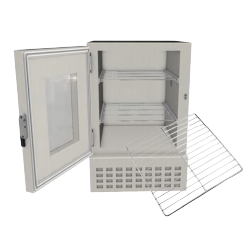
If your project falls in that equipment-hardware row (shipboard cabinets, marine refrigeration, reefer containers, special vehicles), KUNLONG’s ship-equipment line is one concrete reference point worth putting on your shortlist: SUS304/SUS316 stainless with electro-polished finishes, salt-spray and cycle-life documentation available with orders, 3,000+ stock SKUs across all product lines shipping within a week, and a 12-hour response time for technical questions. Request the marine hardware spec sheet or a stock sample to compare against the other suppliers in the row — the checklist above is designed to make that comparison fast.
References
- Xometry. “316 Stainless Steel: Composition and Density.” 2023. https://www.xometry.com/resources/materials/316-stainless-steel/
- Lesjöfors. “What is Marine Grade Stainless Steel? 304 vs 316.” 2026. https://www.lesjofors.com/lv/tehnologija/insights/what-is-marine-grade-stainless-steel/
- ISO. “ISO 9227:2017 — Corrosion tests in artificial atmospheres — Salt spray tests.” 2017. https://www.iso.org/standard/61996.html
- Boat Outfitters. “Boat Hardware.” 2026. https://www.boatoutfitters.com/hardware
- The Hull Truth. “Best place to buy marine hardware?” 2020. https://www.thehulltruth.com/boating-forum/1105758-best-place-buy-marine-hardware.html
- Marine Hardware, Inc. 2026. https://www.marinehardware.com/
- Schaefer Marine. 2026. https://www.schaefermarine.com/
- Bainbridge International. “Marine Hardware.” 2026. https://bainbridgeintusa.com/marine-hardware/
- Whitecap Industries. “Whitecap Marine Products.” 2026. https://www.whitecapmarineproducts.com/
- Trivantage. “Marine Hardware.” 2026. https://www.trivantage.com/hardware-marine
- West Marine. 2026. https://www.westmarine.com/
- Bosun Supplies. 2026. https://www.bosunsupplies.com/
- KUNLONG. “Aviation, Shipbuilding & Railway Equipment.” 2026. https://www.kunlonghardware.com/aviation-shipbuilding-railway-equipment/
- KUNLONG. “Catch SK5-017S.” 2026. https://www.kunlonghardware.com/catch-sk5-017s/
- KUNLONG. “Stainless Steel Hinges.” 2026. https://www.kunlonghardware.com/stainless-steel-hinges/