



Vacuum drying ovens remove moisture, solvents and volatiles from materials inside a sealed, heated chamber held at reduced pressure. The trick is simple physics: drop the pressure and the boiling point falls. At roughly 12 kPa absolute, water boils near 50°C instead of 100°C (Engineering ToolBox). Materials can then be dried at temperatures that barely warm them at atmospheric pressure, with oxygen largely evacuated along with the air. Low temperature and low oxidation are the entire reason this equipment exists — and the reason semiconductor wafers, lithium battery electrodes, pharmaceutical powders and electronic assemblies are dried this way.
One boundary before we go further: this article is about vacuum drying ovens — heated vacuum chambers for labs and production. Not freeze dryers, not plastic pellet dryers, and not hobbyist vacuum chambers rigged up for 3D-printing filament. Those solve different problems, and treating them as the same machine is where most confusion starts.
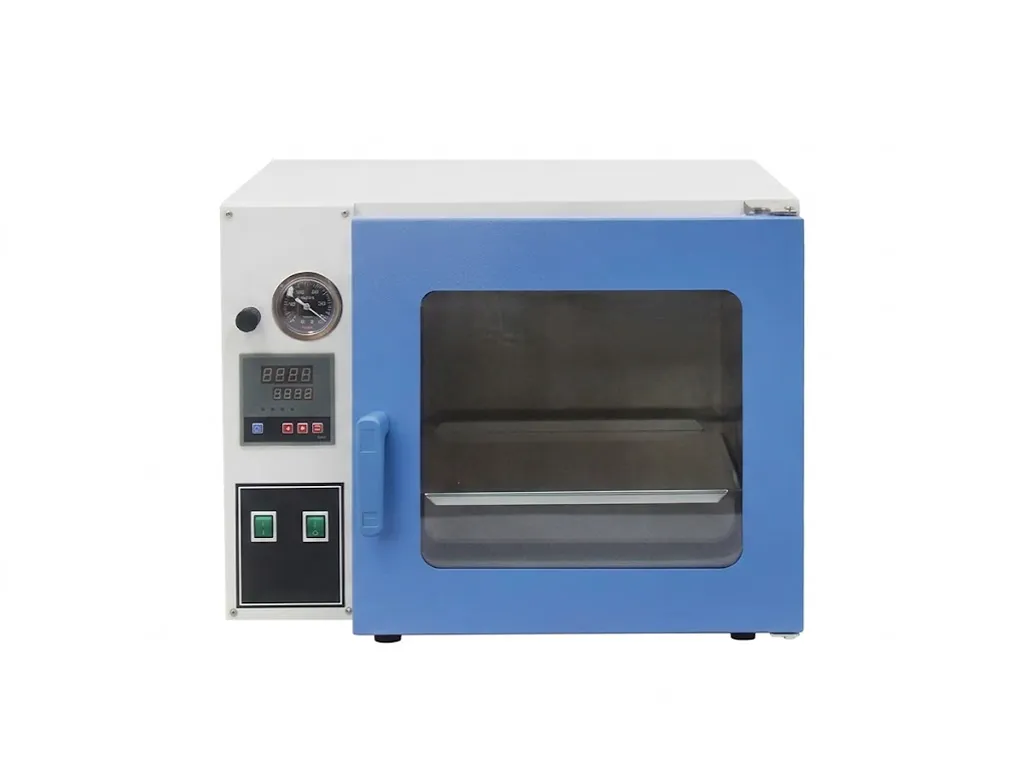
What Is a Vacuum Drying Oven — and Why Does Vacuum Speed Up Drying?
A vacuum drying oven is, at heart, a pressure vessel that heats. The pump pulls air out of the chamber; the heater drives moisture out of the material; the vacuum does two jobs at once. It lowers the temperature at which water and solvents evaporate, and it removes the evaporated vapor out of the chamber so it does not re-condense on the load.
That second job is more important than most explanations admit. In a conventional oven, drying happens at the surface where hot air meets the part. In a vacuum oven, the vapor leaving the material is continuously swept into the pump — the pressure gradient itself carries moisture out of a part’s interior, which is why vacuum drying reaches residual levels that surface-drying cannot (Busch).
So the practical consequences: shorter cycles at lower temperatures, and a dry part that was never exposed to enough heat or oxygen to degrade. That is the value proposition — and as we will see in the next section, it is not free, and it is not always what you need.
Bench-Top vs. Industrial: The Types of Vacuum Drying Ovens
Vacuum drying ovens come in two practical families: bench-top units for laboratories and R&D, and industrial floor-standing systems for production.
Bench-top chambers typically run tens to a few hundred liters, reach a moderate vacuum, and are used for drying samples, curing epoxies, degassing and moisture-sensitive storage. Industrial units are far larger, are often built for batch processing on a line, and may be integrated into the production flow — battery electrode drying being the clearest example, where ovens sit directly in the cell-production line (Weiss Technik).
The second axis is the heating structure, and it matters more than size. Under vacuum there is no air to carry heat: convection stops, so every oven heats by radiation, by conduction through heated shelves, or by both. Shelf heating dominates production units because parts load directly onto the heated plates; radiant heating suits oddly shaped or loose loads. Choose the wrong family for your scale and you overpay; choose the wrong heating structure and you get temperature differences you cannot fix later.
With the machine classified, the real question follows: should the purchase happen at all?
Should You Buy a Vacuum Drying Oven? When It’s Worth It — and When It Isn’t
Heat-sensitive pharmaceutical powders, moisture-critical battery electrodes, oxygen-reactive metal powders — these make vacuum drying close to mandatory.
Three checks before you buy
When none of those apply (an ordinary metal, polymer or ceramic part that tolerates heat, drying only surface moisture), a conventional drying oven does the job cheaper. This is the boundary most guides skip: vacuum drying is not “better drying,” it is a targeted tool, and using it on undemanding materials buys nothing but a bigger invoice.
The comparison that actually confuses buyers is vacuum drying vs. freeze drying. Freeze drying preserves structure and rehydration quality that vacuum drying cannot, which is why it rules biopharmaceuticals — but it costs more in capital and far more in energy and cycle time (Pilotech). Vacuum drying sits between: gentler than a convection oven, dramatically cheaper than a lyophilizer, and wrong only when you genuinely need freeze-dried structure.
| Method | Typical materials | Temperature sensitivity | Cost level | When NOT to choose it |
|---|---|---|---|---|
| Convection drying oven | Metals, ceramics, general parts | Low | Lowest | Heat-sensitive, oxidation-sensitive or solvent-bearing loads |
| Vacuum drying oven | Powders, electrodes, electronics, APIs | High — dries 40–80°C | Medium — oven + pump + maintenance | Only surface moisture, no thermal risk, tight budget |
| Freeze dryer | Vaccines, biologics, structure-critical foods | Extreme — below −40°C | Highest — capital + energy | Cost-sensitive, structure preservation not required |
Price reality is worth stating plainly: bench-top vacuum ovens start around $1,350 for the oven alone (Lab Depot) — the vacuum pump is almost always an additional purchase, and full lifetime cost includes pump maintenance and seal replacement.
Two trends are worth watching if you are buying for a production line. Battery and semiconductor expansion is pushing vacuum drying from a lab tool into a line-integrated process, and modern controls — programmable thermal profiles, data logging, remote monitoring — are becoming the differentiator between suppliers rather than the vacuum itself (KOMEG). Buy a controller you can export data from; you will be asked for it.
How to Choose a Vacuum Drying Oven: The Parameters That Actually Matter
Read the Vacuum Rating Before You Compare Prices
Spec sheets mix units freely: kPa, mmHg, Torr, “-0.1 MPa”. Comparing them without conversion is how two identical machines look different. The conversion is simple: 101.3 kPa = 760 mmHg = 760 Torr = one standard atmosphere. A gauge reading of −0.1 MPa is a gauge, not an absolute: it means roughly 1 kPa absolute.
| Absolute pressure | Approx. gauge vacuum | Water boils at |
|---|---|---|
| 101.3 kPa | 0 — atmosphere | 100°C |
| 50.8 kPa | −50% | ~82°C |
| 12.3 kPa | −88% | ~50°C |
| 7.4 kPa | −93% | ~40°C |
Data: Engineering ToolBox
“More vacuum” is not automatically better. Drying ovens operate in the coarse-vacuum range — the boiling-point numbers above are the ones that matter for drying, not the deep vacuum of a deposition system, which is slower and far more expensive to hold. Choose the pressure that gets your solvent’s boiling point to your safe drying temperature, and no deeper.
Temperature Range and Chamber Size
Set the upper temperature by your material’s limit, not by ambition — a 200°C-rated oven costs more and risks nothing on heat-tolerant parts. Chamber size follows batch size, with one caution: an oversized chamber on a small pump takes longer to pull down, and a pump sized for the vacuum level but not the vapor load will struggle with solvent-heavy batches.
The Vacuum Pump Is Part of the System
Pump selection is a system decision, not an accessory line item. Match the pump’s pumping speed to chamber volume, and match its construction to what you dry: organic solvents demand oil-mist recovery or dry-pump design, and corrosive vapors will destroy a pump that was not specified for them. A common point of confusion is whether the pump must run continuously. In a healthy system it does not: you pull to target vacuum, then the pump idles or cycles to hold it. If your operator reports the pump “has to run constantly,” that is a symptom of leakage, not of normal operation (IFM) — and a malfunctioning pump or wrong pressure setting directly degrades drying quality and production yield.
“The pump has to run constantly” is a leak diagnosis, not a way of life. In a healthy system the pump pulls to target vacuum and then idles or cycles to hold it. If yours never stops, find the leak before you buy a bigger pump — a malfunctioning pump or wrong pressure setting directly degrades drying quality and yield.
Temperature Uniformity: The Physics No Spec Sheet Tells You
Every product page advertises temperature uniformity. Under vacuum, achieving it is physically harder than in a convection oven, because there is no air to distribute heat — uniformity depends on shelf contact, radiation layout and load placement. So treat the ±1°C claim as a starting point and verify it yourself: load the oven as you will run it, put sensors on multiple shelves, and measure. This matters most in coating and electrode work, where temperature non-uniformity is a documented cause of quality loss (XHS Machine).
The ±1°C uniformity claim is a starting point, not a guarantee. Under vacuum there is no air to distribute heat — uniformity comes from shelf contact, radiation layout and load placement. Verify it the way you will run it: load the oven, put sensors on multiple shelves, measure.
Vacuum Leaks, Seals and Pumps: What Breaks — and How to Check
Vacuum leakage is the number-one failure mode, and its cost is concrete. Pressure never reaches target, moisture stays in the product, and yield suffers. In battery production, residual moisture above ~200 ppm in electrode coatings drives electrolyte decomposition and capacity loss (LIB Industry). The door seal is the first suspect: elastomer seals age, get nicked, and lose their grip; and a leak that “barely” misses target pressure still floods the chamber with humid air that re-wets the load.
Leakage is the number-one failure mode, and it costs yield, not just vacuum: in battery electrode production, residual moisture above ~200 ppm drives electrolyte decomposition and capacity loss. The door seal is the first suspect — an elastomer that ages, gets nicked, or loses its grip re-wets every load.
The diagnostic that settles it is a pressure-hold test: pull to target vacuum, stop the pump, close the valve, and record how fast pressure rises. A healthy system holds; a system that loses pressure quickly has a leak — check the door seal, fittings and piping in that order.
Vacuum oven troubleshooting checklist
What Goes Into a Vacuum Drying Oven That Holds Vacuum: Chamber, Door and Hardware
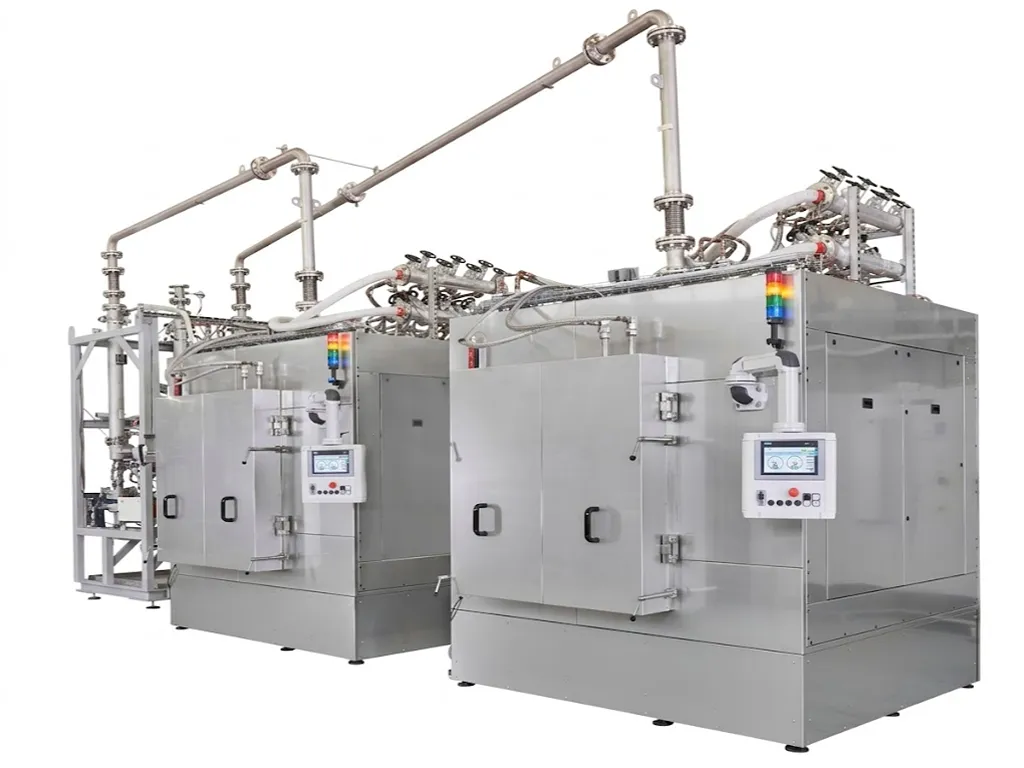
The Chamber: Vacuum Is a Force, Not an Absence
Here is the fact that changes how you look at these machines: vacuum is a force, not an absence. A chamber pulled to 1 kPa absolute carries roughly a ton of atmospheric load per square meter of wall. On large square chambers, that load has deformed oven walls in real production. Published work on lithium battery vacuum ovens explicitly cites rigid deformation of square oven walls as a known failure (Journal of Energy Storage, 2019). Designers answer with radiused corners, reinforcing ribs, thicker plate and weld quality controlled to a leak standard — and the round chamber exists precisely because it distributes that load with no corners to concentrate it. If you build or buy large square chambers, confirm the structural engineering, not just the heater.
1 t/m²
Vacuum is a force, not an absence.
At ~1 kPa absolute, every square metre of chamber wall carries a tonne of atmospheric load. On large square chambers, that load has deformed oven walls in real production.
The Door System: Seals, Hinges and Hardware
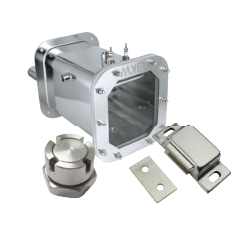
The door is the first place a vacuum oven loses its vacuum, and the last place most designs spend engineering. Think about what the door does in a shift: it is pulled shut against an elastomer seal, compressed, heated, evacuated, and reopened — dozens of times a day, for years. A heavy door panel that sags on weak hinges misaligns the seal and starts the leak cycle; a handle that fights the operator gets slammed; hardware that corrodes in a cleanroom environment becomes a recurring maintenance item.
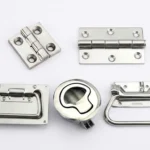
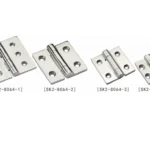
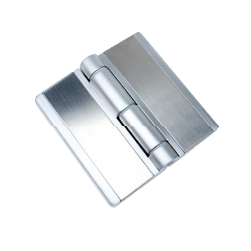
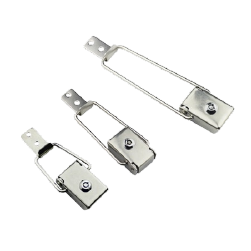
We make this hardware ourselves, for exactly this duty cycle. KUNLONG’s oven-duty door handles and heavy-duty hinges are rated for repeated cycling, carry door loads above 100 kg, and hold up across the −70°C to 260°C range these chambers cycle through; our locks and draw latches provide the clamping force a vacuum seal needs. Every batch passes our standard 15-stage inspection — covering salt spray, cycle life and torque — before it ships, and we offer 10+ surface finishes so the hardware matches your cabinet’s finish rather than fighting it. If you are speccing a door system, browse our oven-duty door handles and heavy-duty hinges rated for repeated cycling, or see the 15-stage inspection covering salt spray and cycle testing behind them.
Shelves, Casters and Finish: The Supporting Cast
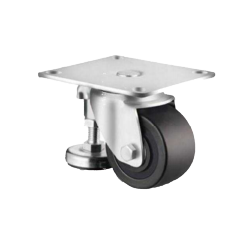
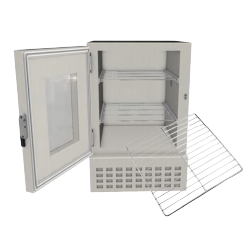
Inside the chamber, shelf design is thermal design: perforated or mesh shelves let vapor escape and dry both sides of a load, solid plates conduct heat but trap moisture underneath. For floor-standing units, the supporting cast is unglamorous but decisive: leveling feet for stable operation, casters for line reconfiguration, and corrosion-resistant finishes that survive both heat cycles and cleaning agents. These are specification items, not afterthoughts: they determine how evenly the oven dries, how long it keeps its vacuum, and how much maintenance it demands.
| Design decision | When it fits | Where it fails |
|---|---|---|
| Square chamber + ribs / radiused corners | Large batch capacity, cost-sensitive | Unreinforced large openings → wall deformation under vacuum |
| Round chamber | Long-term vacuum hold, high delta-P | Higher fabrication cost, lower volume efficiency |
| Heavy-duty hinges + high-cycle hardware | Heavy door panels, frequent opening | Standard hardware → sag, seal misalignment, leaks |
| Manual draw latch / toggle clamp | Small–medium units, low budget | Large doors → insufficient clamping force → leaks |
| Perforated / mesh shelves | Vapor-generating loads, coating lines | Solid plates → moisture trapped under load |
The Business Angle: Why Door-System Hardware Deserves a Spec
For a builder of vacuum drying ovens, the numbers that decide customer acceptance — leak rate, door-cycle life, corrosion resistance — are decided by components most RFQs treat as an afterthought. A door that sags under a heavy panel misaligns the seal. A handle that fights the operator gets slammed. Hardware that corrodes becomes a warranty line item. None of this shows up on day one; all of it shows up in the first warranty period, and all of it is preventable at design time by writing door-system hardware into the specification: rated load, cycle life, corrosion class, finish — decided alongside the chamber, not scavenged at the end.
The same reasoning that says “the seal is the first thing that fails” says the door system is the first thing to spec. If you are building a unit that has to hold vacuum for years, send us your door-system specification — we will tell you what holds up, and what does not.
Spec the Door System Before You Spec the Chamber
Rated load, cycle life, corrosion class — send us your door-system specification and we’ll confirm what holds up through vacuum and heat cycling.
Send Your Door-System SpecReferences
- Engineering ToolBox. “Water — Boiling Points at Vacuum Pressure.” https://www.engineeringtoolbox.com/water-evacuation-pressure-temperature-d_1686.html
- Busch Vacuum Solutions. “Vacuum Drying.” https://www.buschvacuum.com/us/en/applications/drying/
- Weiss Technik. “Vacuum Drying in Battery Cell Production.” https://weiss-na.com/vacuum-drying-in-battery-cell-production/
- Pilotech. “Freeze Drying vs. Vacuum Drying.” https://www.shpilotech.com/freeze-drying-vs-vacuum-drying/
- Lab Depot. “Vacuum Ovens.” https://www.labdepotinc.com/vacuum-ovens
- KOMEG. “Vacuum Drying Oven: Principles, Applications, Benefits and Industrial Testing Solutions.” https://www.komegtek.com/knowledgeblog/vacuum-drying-oven-principles-applications-benefits-and-industrial-testing-solutions/
- IFM. “Vacuum Drying of Electrode Coils.” https://www.ifm.com/us/en/shared/machine/e-mobility/battery-cell/electrode-production/vacuum-drying
- XHS Machine. “Vacuum Drying Oven Troubleshooting: Common Issues and Preventive Maintenance Tips.” https://www.xhsmachine.com/vacuum-drying-oven-troubleshooting-common-issues-and-preventive-maintenance-tips/
- LIB Industry. “Battery Electrode Drying via a High-Temp Industry Oven.” https://www.lib-chamber.com/knowledge/battery-electrode-drying-via-a-high-temp-industry-oven
- Journal of Energy Storage. “Research on vacuum drying process and internal heat conduction of Li-ion battery.” 2019. https://www.sciencedirect.com/science/article/pii/S2095034919300248
- KUNLONG. “Oven-Duty Door Handles.” https://www.kunlonghardware.com/oven-handle/
- KUNLONG. “Heavy-Duty Hinges.” https://www.kunlonghardware.com/hinges/
- KUNLONG. “Comprehensive Quality Control — 15-Stage Inspection.” https://www.kunlonghardware.com/comprehensive-quality-control/
- KUNLONG. “Contact Us.” https://www.kunlonghardware.com/contact-us/
- KUNLONG. “Home.” https://www.kunlonghardware.com/