


What “Holds Position” Actually Means
An oven door settles at 70 degrees while an operator loads a rack, and it stays there. Six months of production later, the same door creeps three degrees past where it was left, then drifts shut on its own. Nothing broke visibly. The door just stopped holding.
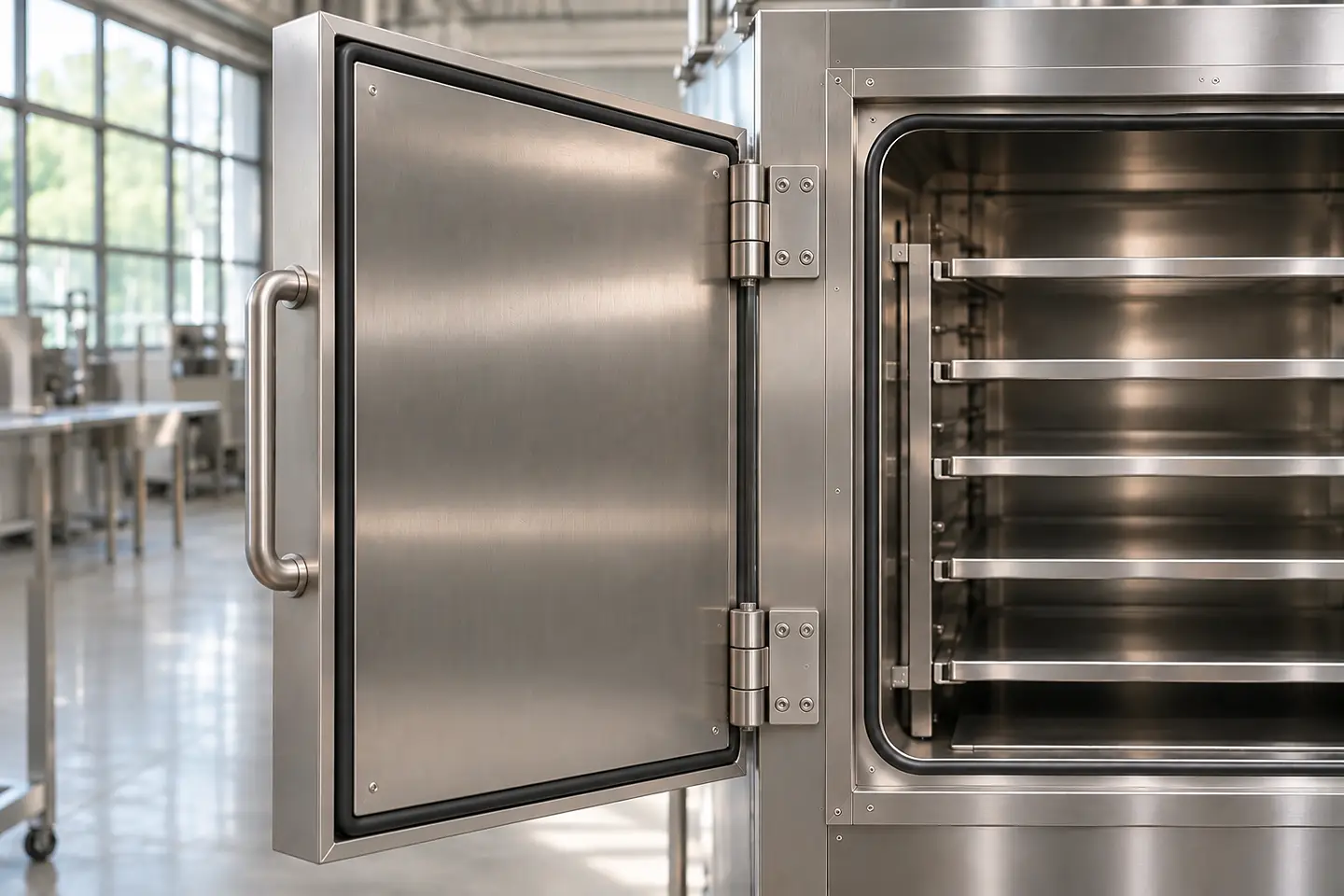
That ability, stopping at any angle and staying without a latch or a prop, is what both a torque hinge and a friction hinge are built to do. Search either term and you will land on the same product family: hinges that resist rotation internally, so a lid, panel, or screen stays exactly where the user releases it. Major manufacturers treat the two names as one category. Southco describes a torque hinge as using friction to control the movement of a door, lid, or panel. Sugatsune calls a torque hinge “also known as a friction or position control hinge”. Reell notes that friction hinges are “sometimes called torque or position hinges”.
Three neighbors get mixed into this family and none of them belongs. A soft-close hinge only decelerates the last few degrees of closing. It will not hold a door at 70 degrees. A friction stay is window hardware, the arm that holds a casement window open, a different product despite the shared word “friction”. And a plain butt hinge has no internal resistance at all, which is why an unlatched door on one swings freely.
So the useful question is not which name is correct. Both names describe contact resistance inside the barrel. What separates a hinge still holding in year five from one drifting in month six is a single question: how controlled is that resistance? To answer it, it helps to see what is actually inside.
How the Resistance Is Built
Almost every hold-in-place hinge creates resistance through contact inside its barrel. Most builds are a spring-loaded clutch pack: stacked discs pressed together so that rotating the hinge forces the discs to slip against one another. Weber Knapp describes the mechanism directly, “a spring and a clutch pack or disc in the barrel of the hinge, creating a known frictional force”.
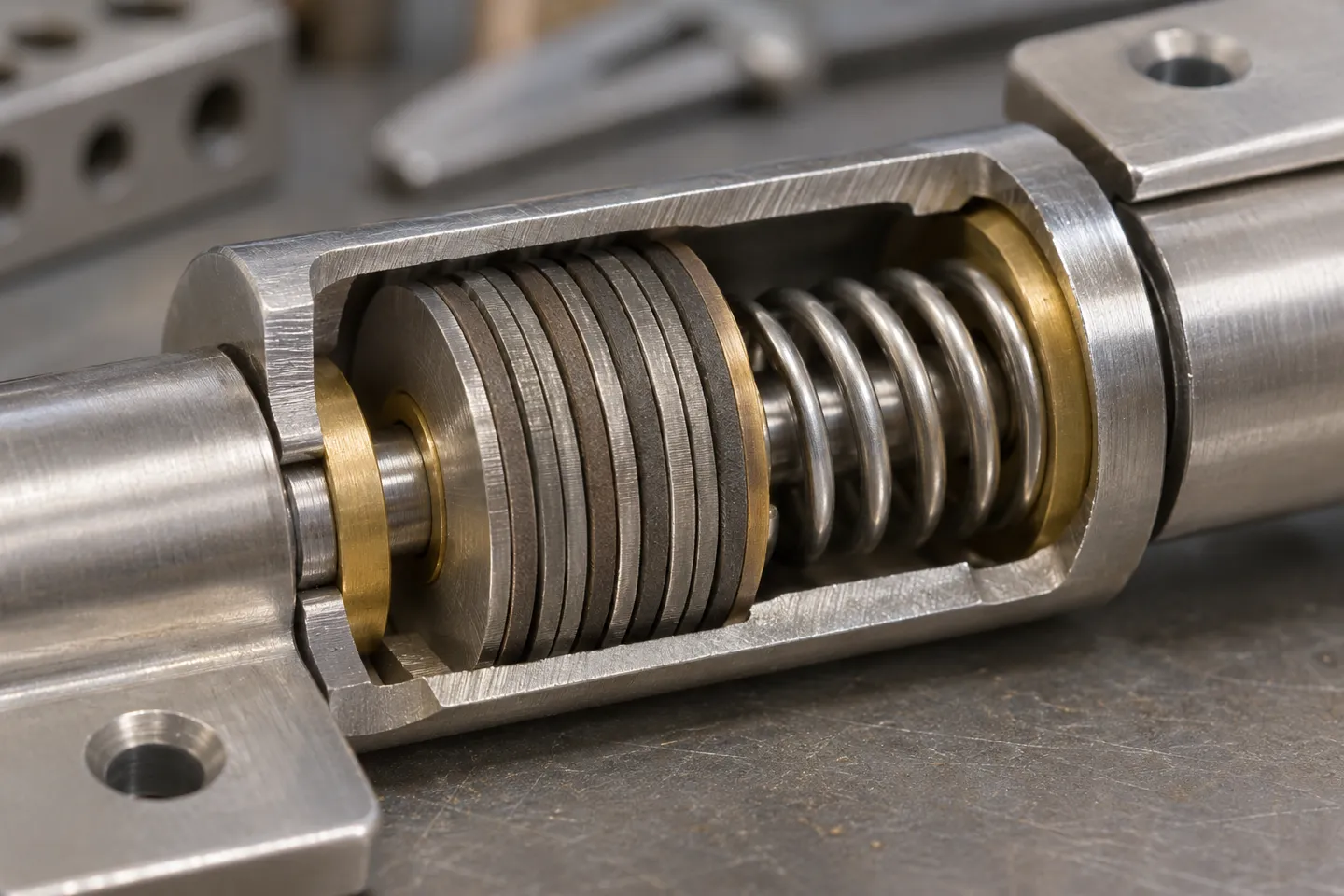
Other builds trade some of that simplicity for a different feel. Viscous dampers use silicone fluid for very smooth motion. Graphite-pad damping keeps the resistance dry without metal powder, so the hinge runs quiet across its life. Detent or cam mechanisms give a clicked, indexed feel rather than continuous resistance. The table below lines up the four builds.
Four ways hinge resistance is built
| Build | Principle in one line | Feel on the door | How it wears |
|---|---|---|---|
| Dry friction disc pack | Spring-loaded discs slip against each other | Continuous and even | Torque fades as disc surfaces polish smooth |
| Viscous damping | Silicone fluid shears between layers | Very smooth, nearly silent | Performance shifts with temperature |
| Graphite-pad damping | Graphite pads carry the load dry | Smooth and quiet, low noise | Slow decay, no metal powder residue |
| Cam or detent | A cam and ball snap between positions | Indexed with defined stops | Detent force weakens at the stops |
One feel problem comes from the physics of contact itself. Static friction is higher than sliding friction, so a joint can stick until force breaks it loose, then jump. That stick-slip is why some budget lids feel jerky rather than smooth. It shows up most where the contact surfaces are coarse and the press load is uneven.
None of these mechanisms escapes wear. Every one of them turns a defined resistance into heat and fine particles, and the resistance falls as the surfaces change. What separates products is not whether they decay but how fast, and whether anyone promised you a number. That promise, or its absence, is worth more than either name on the box.
The Real Divide: Calibrated vs Uncalibrated Resistance
Four catalogs say one thing, one guide says another
Ask whether torque hinges and friction hinges are different products and the industry splits in two. Catalogs from Southco, Essentra Components, Sugatsune, and Reell treat the names as synonyms. A second camp has appeared in buying guides from newer hinge makers. One such guide defines friction hinges as basic surface-contact parts costing $2 to $15, with noticeable torque loss within 2,000 to 5,000 cycles. That same guide rates calibrated torque hinges at 20,000 to 100,000+ cycles and prices them at $15 to $80+.
Both camps are describing the same physical mechanism: contact resistance. Its two categories actually sit at two points on a calibration gradient. Uncalibrated contact gives you a hinge that works out of the box but drifts as it wears. Calibrated contact gives you a hinge whose resistance was set, measured, and written down as a number with a tolerance. So the synonym camp is right about the mechanism but incomplete about the result. The distinction camp is right about the result and overstates it as two species. For a buyer, the fight itself is the lesson: when manufacturers cannot agree on what the words mean, the words cannot carry your specification.
The synonym camp
Who
Southco, Essentra, Sugatsune, Reell catalogs.
Claim
Torque hinge and friction hinge are two names for contact-resistance hinges.
Practical effect
Naming tells you nothing about quality.
The distinction camp
Who
Newer maker buying guides.
Claim
Friction means cheap and short-lived; torque means calibrated and durable.
Practical effect
The price gap gets read as a category gap, so buyers overpay or walk away.
The spectrum that actually matters
Replace the two names with a three-step ladder and the confusion disappears. At the bottom sits uncalibrated resistance: the hinge holds, but no torque value, no tolerance, no cycle rating appears anywhere on the datasheet. Units vary batch to batch, and the feel on your door is whatever that batch produced. In the middle sits calibrated constant torque: the factory sets a torque value and states it, often with a cycle specification. One currently listed industrial series states its rating as constant torque, holds in every position, and 20,000 cycles within +20% of static torque (published catalog listings, 2026). At the top sits calibrated adjustable torque: the resistance can be tuned in the field with a screw or nut, and custom torque values are available on request. One listed stainless design changes torque values by adjusting the nut (published catalog listings, 2026).
On a door, the three steps feel different in year two, not day one. Uncalibrated hinges feel fine until a panel starts drooping past its set point. Calibrated constant-torque hinges hold the same angle through their rated life. Adjustable ones let a technician re-trim the feel after maintenance or a parts change.
The calibration ladder
Uncalibrated resistance
No torque value, no tolerance, no cycle number. Fine for low-value lids with short duty; watch for drift within months of daily use.
Calibrated constant torque
Factory-set value with stated tolerance and cycle rating. The default choice for equipment doors and panels.
Calibrated adjustable torque
Field-tunable screw or nut, custom values on request. For lines where feel is tuned in production or maintenance.
Two independent switches
Two settings ride on top of that ladder, and neither depends on what the hinge is called. First comes adjustability: constant torque leaves the factory fixed, adjustable torque can be re-trimmed with a screw or nut, and custom values can be ordered. Second comes the opening angle: designs limit at 90, 120, 170, 180, or even 245 and 270 degrees, and some allow unlimited rotation. One listed POM model offers 245-degree and 270-degree openings with damping adjusted through its center screw (published catalog listings, 2026).
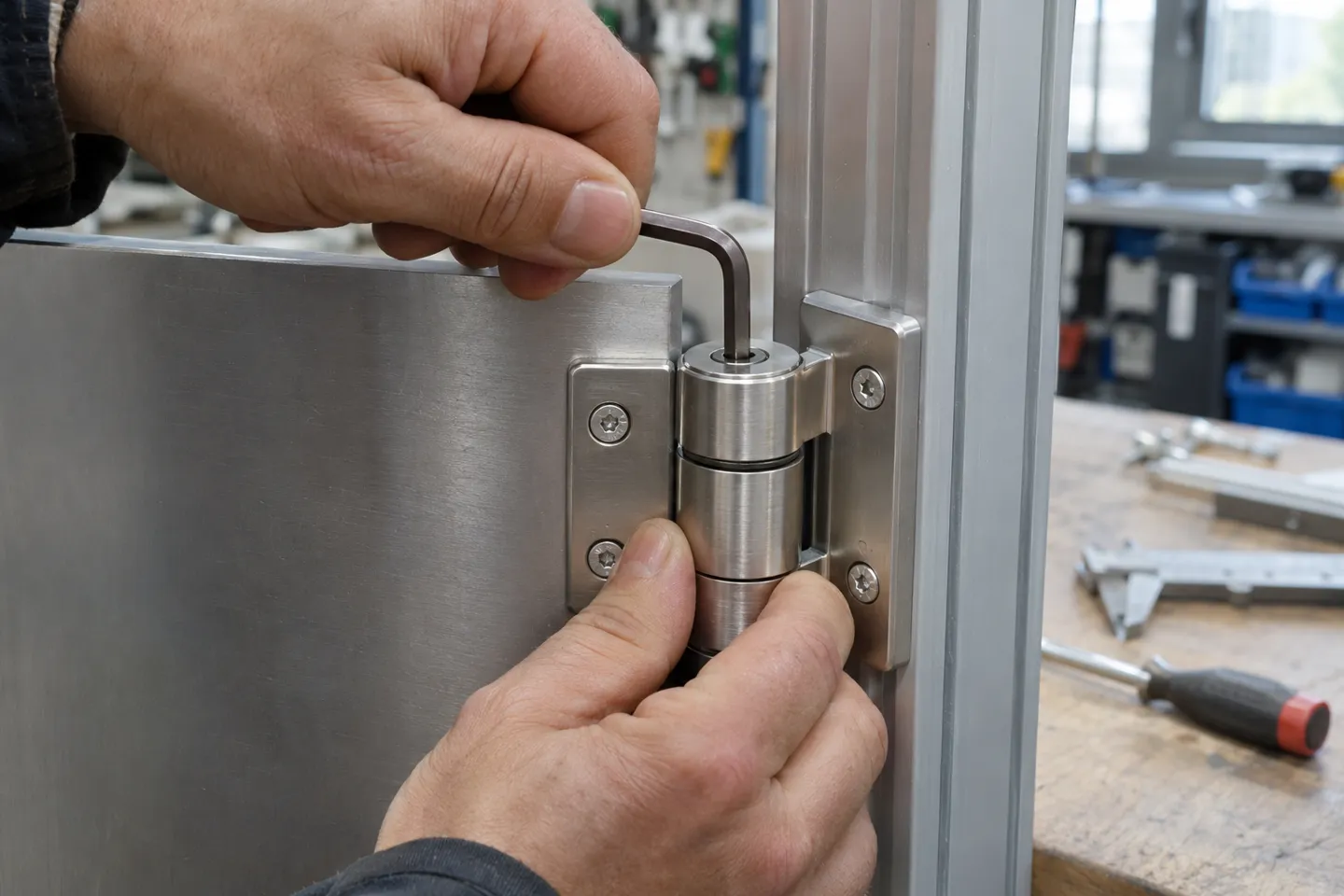
One boundary belongs here rather than later. Uncalibrated is not a defect; for a toolbox lid opened twice a week it is the economically correct choice. And a calibration rating assumes correct installation. These ratings hold only when hinge axes line up with the panel pivot, a condition suppliers state explicitly in their installation notes (published catalog listings, 2026).
Send KUNLONG your panel weight, pivot distance and working angle, and an engineer returns a calibrated hinge match with the torque value stated.
Get a torque matchSizing and Specifying: From Door Weight to Drawing Notes
Choosing well is a four-step chain from your door to the drawing.
Step 1, compute the demand torque. Use T = W × L × sin(θ). In the formula, W is the panel weight, L is the distance from the hinge axis to its center of gravity, and θ is the opening angle from vertical. The worst case is the horizontal position, where sin(θ) reaches 1, so design for the door fully open. A horizontal-axis lid fights gravity through its whole arc. A vertical-axis swing door mainly overcomes starting friction. One door weight can therefore demand very different hinge torque across the two orientations.
Step 2, add a safety factor. Multiply the result to cover wear, temperature, and tolerance stack. One guide’s table suggests 1.2x for indoor consumer use and 1.3 to 1.5x for office and commercial equipment, with industrial and outdoor installations higher still. A hinge engineer puts the same idea more simply: add a little extra resistance beyond the bare minimum to account for external forces.
Step 3, set the two switches. Decide constant against adjustable torque based on who maintains the product in the field. Decide the angle limit from the enclosure geometry, not from habit: a 90-degree stop protects a neighboring panel, while a 270-degree opening clears a tight service space.
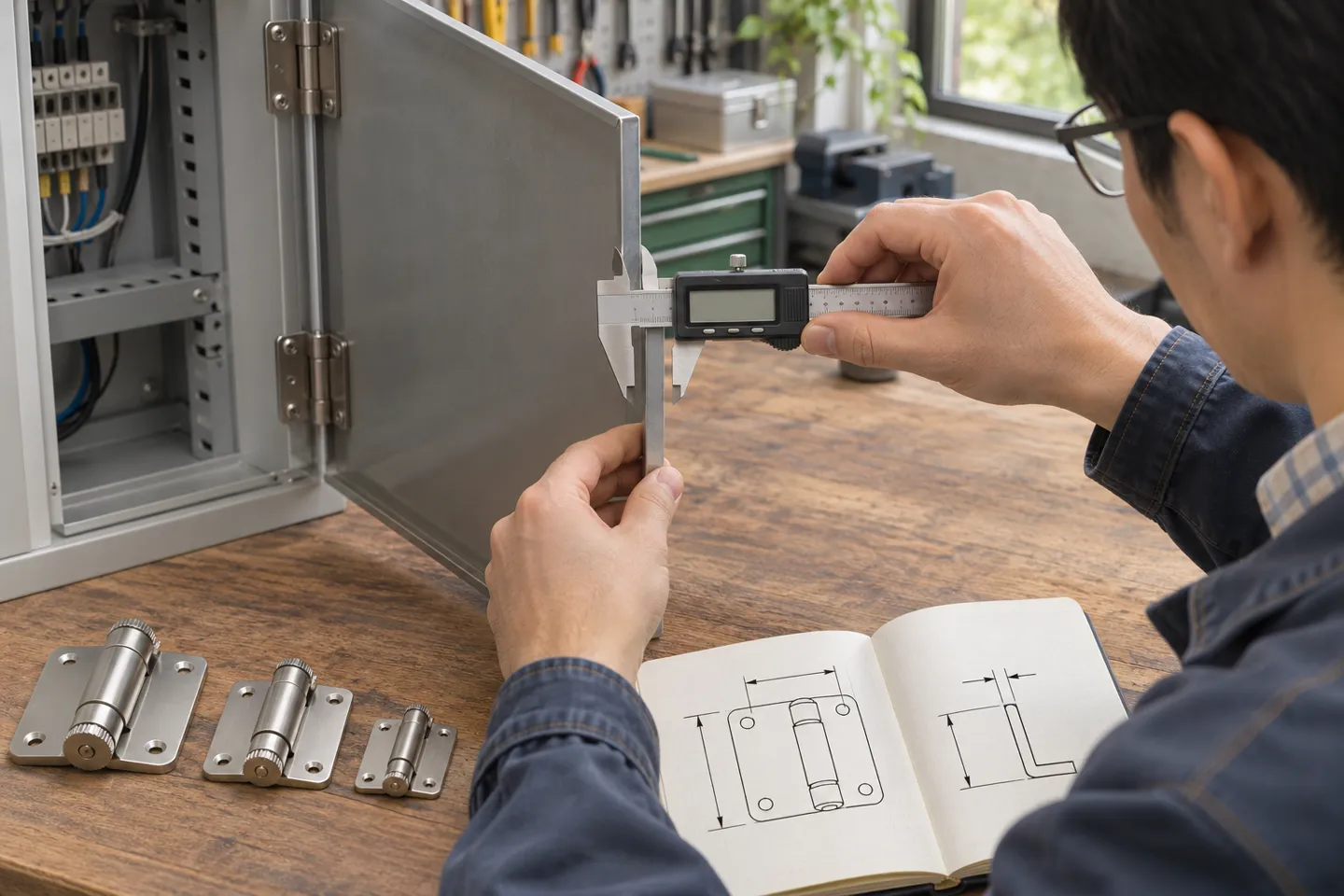
Step 4, write the parameters down. Whatever the datasheet vocabulary, your drawing or RFQ should carry six lines. If a supplier cannot fill in all six, you have learned something before the PO.
Six parameters for the drawing or RFQ
Two boundaries close this step. A long overhang shifts the center of gravity away from the axis, so compute at the worst angle rather than the closed position. And temperature moves damping performance, so chambers, ovens, and cold-chain doors need the working range confirmed against the damper type before the value is fixed.
Failure Modes and Where Each Option Stops Working
Four ways they fail, and the early signals
Torque decay comes first. Friction surfaces wear progressively. In high-cycle use, one manufacturer’s guide reports noticeable torque loss within 2,000 to 5,000 cycles, at which point the panel begins to drift or droop. Early on, the signal is quiet: a door that used to stop at 70 degrees now rests at 74. Anyone who has owned an old laptop has watched the same film, the screen that slowly stops holding its position.
Loosened fasteners come second. Daily vibration works mounting screws loose, opening gaps between hinge and mounting surface, and the load concentrates on the remaining tight fasteners, which then wear faster. You will hear it early as a creak, or see a visible gap line at the screw seats.
Axis misalignment comes third. When the hinge axis does not match the panel pivot, loading goes uneven and one side of the mechanism wears ahead of the other. Suppliers put it in the installation notes as a hard requirement: all hinge axes must have no deviation when installing (published catalog listings, 2026). Watch for travel that turns heavier through part of the range and lighter through the rest.
Temperature drift comes fourth. Damping viscosity thickens in cold and thins in heat, so a hinge tuned at room temperature behaves differently inside a chamber, an oven, or a cold room. Here the signal is seasonal: stiff on winter mornings, weak at afternoon peak temperatures.
Four failure modes, four early signals
One honesty note belongs beside these numbers. The specific decay and cycle figures above trace to manufacturer publications, and your own duty cycle will differ. That is exactly why the verification flow at the end of this article asks for test documents rather than trust.
Application boundaries: a selection matrix
The matrix below is the whole article compressed into six rows. Read your own application, take the check action, and treat the boundary column as the point where a different solution starts to make sense.
Application boundaries: what works until it does not
| Application | What works | Boundary / check action |
|---|---|---|
| Toolbox, mirror, storage lids | Uncalibrated friction hinge | Check: cosmetic duty under low cycles; do not reuse in service equipment |
| Medical and monitor panels | Calibrated constant torque | Check: state torque value, tolerance, and cycle rating in the PO; confirm surface and finish requirements |
| Up-opening heavy lids (ovens, chambers) | Calibrated torque with safety factor | Check: compute at horizontal; if required torque climbs past available parts, evaluate a counterbalance approach, rated up to 200,000 cycles on the high end |
| High-frequency equipment doors | Calibrated with cycle spec at or above half of service life | Check: re-run a sample test after the agreed cycle count, not just at incoming inspection |
| Vibrating environments (vehicles, rail, machinery) | Calibrated plus aligned axes and thread-locking | Check: schedule a fastener retorque interval and inspect the gap line |
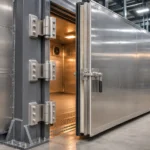
| Cold storage and walk-in heavy doors | Heavy-duty hinge first, positioning second | Check: load capacity and sealing thickness adjustment before any torque spec |
What This Means When You Buy
What each price band actually buys
Split the market into three bands and the names stop mattering. Band one runs under about $2: uncalibrated contact parts, correct for low-value lids, with no specification to verify. Band two runs roughly $1 to $6, and this is where the surprise lives. One industrial hardware manufacturer currently lists torque hinge SKUs between US$0.65 and US$5.54 (published catalog listings, 2026). Those listings carry the exact specification the premium guides reserve for the top band. That specification reads: holds in every position, constant torque, and 20,000 cycles within +20% of static torque. The top band, $15 to $80+ in the same guide, buys sealed construction, validation documents, and a brand behind the number.
A hinge you can buy today for under six dollars carries a 20,000-cycle rating within +20% of static torque. The $15-to-$80 guide price presents that same specification as something you pay a premium for. That is a more than tenfold spread across products described by the same two words. It is the strongest argument yet for buying by parameters instead of vocabulary. The price difference inside the calibrated market pays for documentation, sealing, and assurance. Demand those artifacts when a quote sits in the top band. Treat no-spec low-band parts as uncalibrated regardless of what the listing calls them.
The price of vocabulary
Published catalog price
US$0.65-5.54
vs
Guide-claimed typical price
$15-80+
Same spec on the catalog part: 20,000 cycles within +20% of static torque.
What the top of the range adds is documentation and assurance, not a different category of hinge.
From inquiry to repeat order: a verification flow
Four steps reuse the six parameters from the sizing section. First, send the RFQ with all six parameter lines filled. That alone sorts suppliers into those who work to specification and those who work to adjectives. Second, ask for two documents before samples: a cycle test report stating the standard the rating refers to, and a torque tolerance statement per unit. Third, validate samples in your own conditions. Set the door at its working angle and check for static droop, sweep the range for feel, then re-measure after the agreed cycle count. Fourth, scale the order only after the re-measurement, and put the fastener retorque interval into the maintenance schedule at the same time.
Response speed is part of the sourcing cost, not a courtesy. When comparing catalogs, check what each supplier states openly. Look for minimum order quantity on standard SKUs, SKU-level lead time, and custom torque values as an offered service rather than a special favor. One currently listed series states no minimum order on standard parts, with 7 to 15 day lead times at SKU level (published catalog and service pages, 2026). For custom work it states 3D design drawings within 7 days, delivery in 45 days, and a 12-hour response commitment. A supplier who publishes those numbers has already answered half your verification questions.
One boundary repeats here because it decides purchase outcomes. If a datasheet states no cycle rating and no tolerance, treat the part as uncalibrated whatever the price band, and buy it only for duties where drift is cosmetic.
That is the standard KUNLONG holds itself to. Our torque hinge range is published SKU by SKU with the numbers in the open. You get constant or adjustable torque, graphite-pad damping for quiet motion, and angle limits from 90 to 270 degrees. Every unit is rated for 20,000 cycles within +20% of static torque. Listed prices run from US$0.65 to US$5.54, so you can verify the numbers before you even talk to us. Browse the torque hinge range, send the six parameters, and we will match a hinge and return 3D models for your review.
Send Six Parameters, Get a Calibrated Match
Published specs, 20,000-cycle ratings and SKU-level prices from US$0.65 to US$5.54; 3D drawings within 7 days for custom work. Verify the numbers before you talk price.
Start your RFQ