


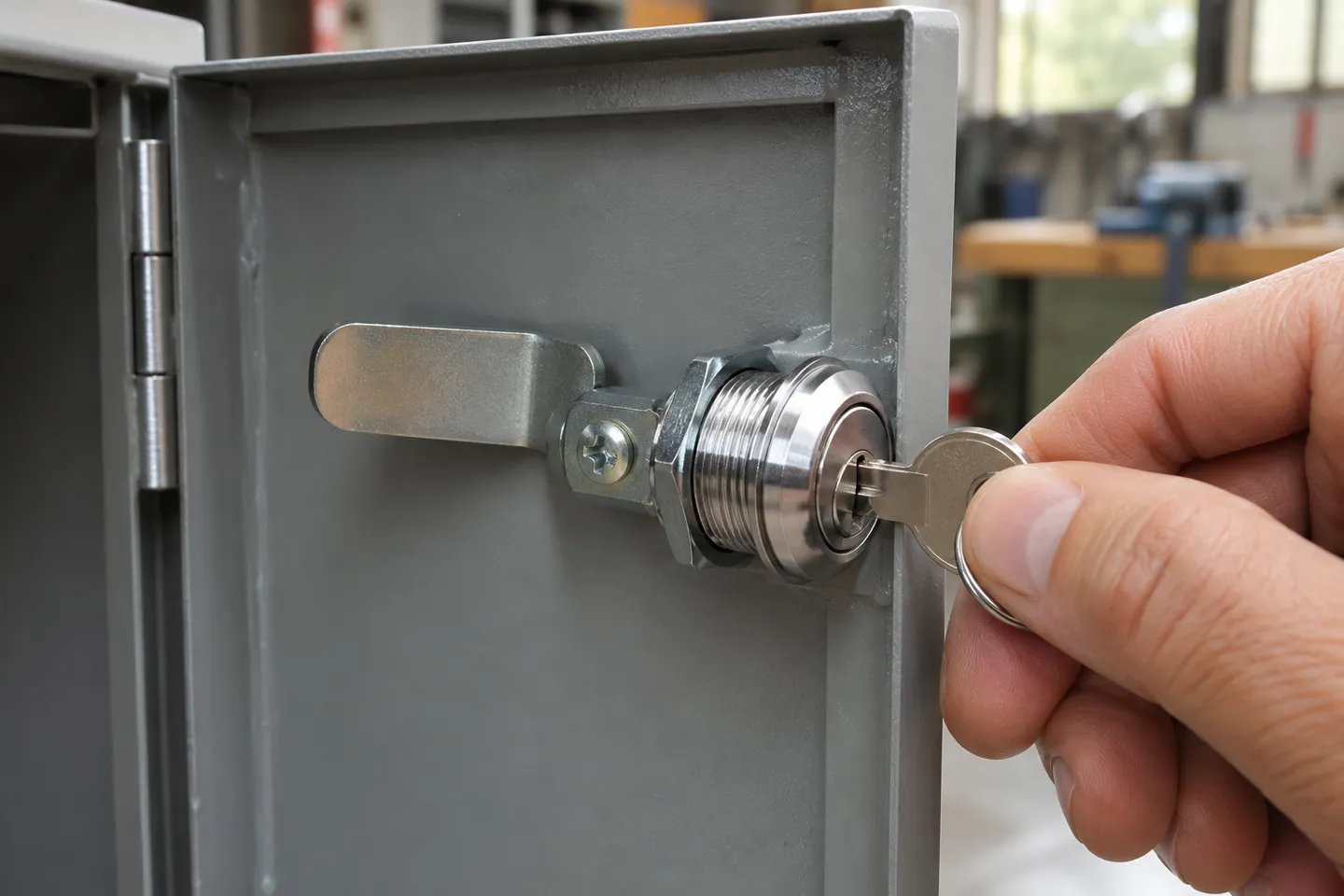
Turn the key in a cabinet lock and a small flat arm swings out behind the door panel. That arm is the cam, and the whole product family takes its name from it. The mechanism needs about three sentences to explain, which is exactly why cabinet locks look interchangeable when you first shop for one.
They are not. The same phrase covers hardware with completely different jobs. One product keeps a toddler out of the kitchen cupboard. Another is a keyed cam lock on an office file cabinet. A third pulls an oven door tight against its seal. What counts as “locked” is different in each case, so the right choice is different too.
The confusion is structural, not careless wording. “Cabinet” can mean household furniture, commercial storage, or an equipment enclosure, and each tier adds constraints the previous one never worried about: key administration, vibration, sealing, temperature. So this guide maps the types of cabinet locks by operating mechanism first, then walks up the tiers to show where each lock type stops being enough.
Cabinet Lock Types: The Full Map by Operating Mechanism
Every cabinet lock answers two questions: how is it operated, and what does it move to hold the door. Six families cover almost everything on the market. The keyed cam lock comes first because it is the only one that shows up on every tier, from nightstand drawers to switchgear doors.
Keyed Cam Locks: The Default Across Every Tier
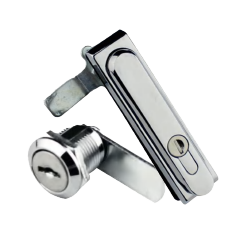
A cam lock is a cylinder with one flat steel or zinc cam fixed to its back. The key rotates the cam 90 or 180 degrees, and the cam either catches a strike behind the panel or releases it. Fit is decided by three measurements: panel thickness, cam length, and the thread of the locking nut, which is why the same lock model is sold in several cam lengths.
This is the lock type that scales across tiers. The cylinder in a furniture drawer and the one on a distribution box work the same way. The industrial versions simply use tougher materials and longer cams. On fleets of cabinets, keyed alike or master key systems let one key serve a whole row of enclosures. Most catalogs list cam locks from around US$0.49 to US$0.56 for zinc alloy bodies with a choice of independent or master keying, which tells you how standardized the mechanism is.
Its known failure mode shows up wherever vibration lives. The locking nut works loose, the cam slips on its rotation, and the door is no longer held even though the key still turns. Maintenance crews on equipment fleets report exactly this, plus the replacement headache of discontinued models, on locksmith forums.
Plunger and Push Locks
A plunger lock latches on a spring-loaded pin: push the door shut and it catches, push a button or slide it and it releases. No key is needed for routine access, which makes it the standard choice for sliding cabinet doors, vending machines, and equipment doors that get opened fifty times a day.
The boundary is travel. A plunger catches whatever comes within its short spring stroke, so a door with a wide gap, a warped frame, or a heavy seal will simply miss the strike. If the door needs to close tight, a plunger alone will not do it.
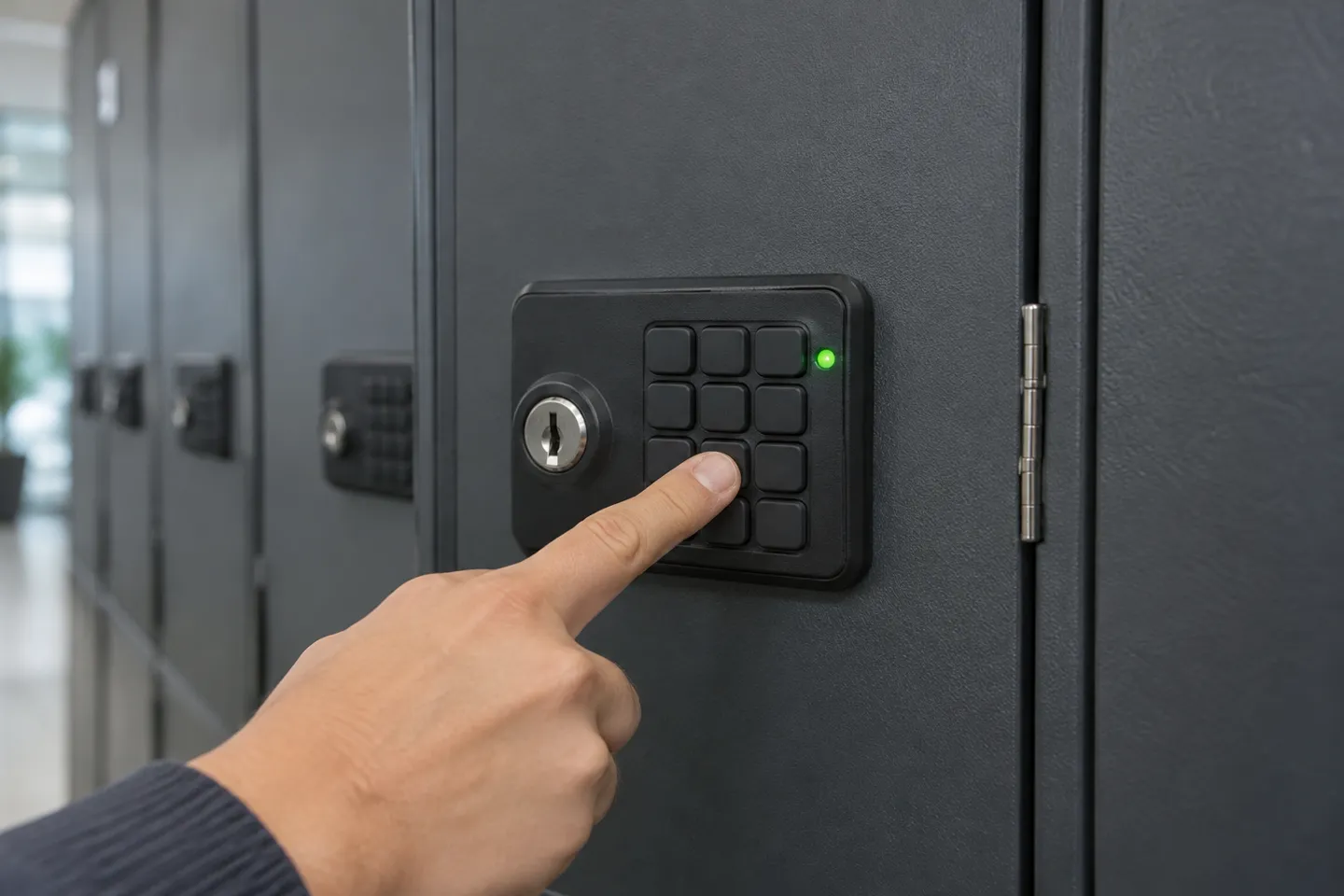
Combination and Electronic Keypad Locks
This family trades the key for a code: mechanical dial, push-button, or a digital keypad. The value is keyless permission management, which is why it dominates home safes, office storage, gym lockers, and anywhere a key copy would be a security hole.
Two boundaries matter. Battery-powered keypads die in cold rooms and outdoor winters, and the panel itself has a protection rating that decides whether rain and dust stay out of the electronics. Both boundaries become selection criteria, not footnotes, the moment you step up to equipment doors.
Drawer, File Cabinet, and Furniture Locks
Furniture hardware differs from pure cam locks in what the cam moves. Drawer locks throw a latch upward, downward, or sideways into a race. File cabinet locks are cut for specific panel thicknesses and often sold with master key systems for office administrators. On the commercial side, keyed alike sets let one facilities key open every cabinet in a bank.
Wear is the documented failure. Once the internal retaining clip or wafer is worn, the whole core can slide out with the key, which locksmith forums describe on aging file cabinets. If a key turns loosely from both sides, the lock is past its service life, not just stiff.
The Rest of the Map: Magnetic, Glass-Door, and Sliding-Door Locks
Magnetic child locks pair a catch inside the cabinet with a magnetic key held outside, so no hardware shows on the door face. They stop children, not adults; the door still opens with a firm pull. Glass-door locks clamp onto the glass edge without drilling, and sliding-door locks use hooks or the plunger principle described above. They complete the map, but they are niche answers to specific door constructions rather than a tier of their own.
Cabinet lock types at a glance
| Type | How it operates | Typical cabinets | Tier where it dominates |
|---|---|---|---|
| Keyed cam lock | Key rotates a flat cam 90°-180° behind the panel | Drawers, mailboxes, distribution boxes | All tiers, the default |
| Plunger and push lock | Spring plunger catches on push, button releases | Sliding doors, vending, equipment doors | Commercial and light industrial |
| Combination and keypad lock | Dial, buttons or keypad, no key | Home safes, office storage, lockers | Household and commercial |
| Drawer and file lock | Key throws a latch up, down or sideways | File cabinets, desks, furniture | Commercial furniture |
| Magnetic lock | Magnet and catch, no visible hardware | Kitchen cupboards, child safety | Household only |
| Glass and sliding-door lock | Clamp or hook matched to the door type | Display cases, sliding wardrobes | Niche across tiers |
The mechanism map is only half the answer. Which of these types actually fits depends on what the cabinet holds and where it stands, and that is a tier question.
Matching the Lock to the Cabinet: Tier by Tier
The fastest way to choose is to place the cabinet in its tier first, because each tier inherits every constraint of the one below it and adds its own.
Which lock type fits which cabinet
| Your cabinet | Fit | Why |
|---|---|---|
| Kitchen or household storage | Magnetic or basic cam lock | Stop children and casual opening at low cost |
| Office file cabinets and mailboxes | Keyed cam lock, keyed alike | One key for a whole bank of cabinets |
| Vending, display, high-value storage | Security-rated cam or plunger core | Resists a casual attack, key control matters |
| Equipment and electrical enclosures | Cam, compression or multi-point | Sealing, vibration and door size decide |
The first three rows are settled by budget and habit. The last row is where expectations break, and it deserves a warning of its own.
A basic cam lock is deterrence, not security. As one lost-key cabinet owner demonstrated on a home improvement forum, tilt the cabinet and the cam can be turned with a small screwdriver from outside. If the contents are valuable or regulated, step up to a security-rated cylinder or a different lock family instead of trusting the cam to do a security job.
Replacement buyers live in a harder version of the same logic. An old lock is matched by four measurements: the cutout, the panel thickness that sets the cam length and thread, the cam’s thickness and shape, and the locking nut thread. When a model is discontinued, those four numbers are the only way back. One locksmith forum thread describes hunting fifty replacement cams for a fleet of electrical cabinets after the original vanished from supply. The advice that worked was to match measurements, not part numbers.
Electronic locks are spreading through the household tier fastest, and the market numbers confirm it. The smart lock market is projected to grow from USD 2.77 billion in 2024 to USD 8.14 billion by 2030, a 19.7% CAGR (Grand View Research, 2025). Residential buyers are its largest segment. Industrial buyers stay more skeptical for a plain reason: batteries and electronics meet their worst-case conditions, and a keypad that fails at minus 20 degrees is worse than no keypad. What industrial doors actually need is the subject of the next section.
Smart lock market trajectory
Grand View Research, 2025
Inside Equipment Doors: Cam vs Compression vs Multi-Point Locks
Equipment doors change the problem. The door is heavier. The frame may be expected to seal against dust, water, temperature or electromagnetic interference. And the cabinet may be one of fifty identical units in a facility. Lock types for equipment doors therefore split by what they do to the door, not by how they are operated.
Where the Standard Cam Lock Stops Being Enough
Industrial cam locks share the furniture mechanism but carry bigger loads: thicker panels, longer cams, stiffer retaining torque, and key systems that manage fleets rather than single cabinets. For a light indoor control box in a dry room, a good industrial cam lock is still the right answer, and paying for more would be waste.
It stops being enough when any of three conditions appears. Vibration shakes the locking nut loose over time, so anti-rotation features and spring washers become mandatory. The door needs to seal, which a single rotating cam cannot guarantee. Or the door grows tall and heavy enough that one locking point lets the free corners flex.
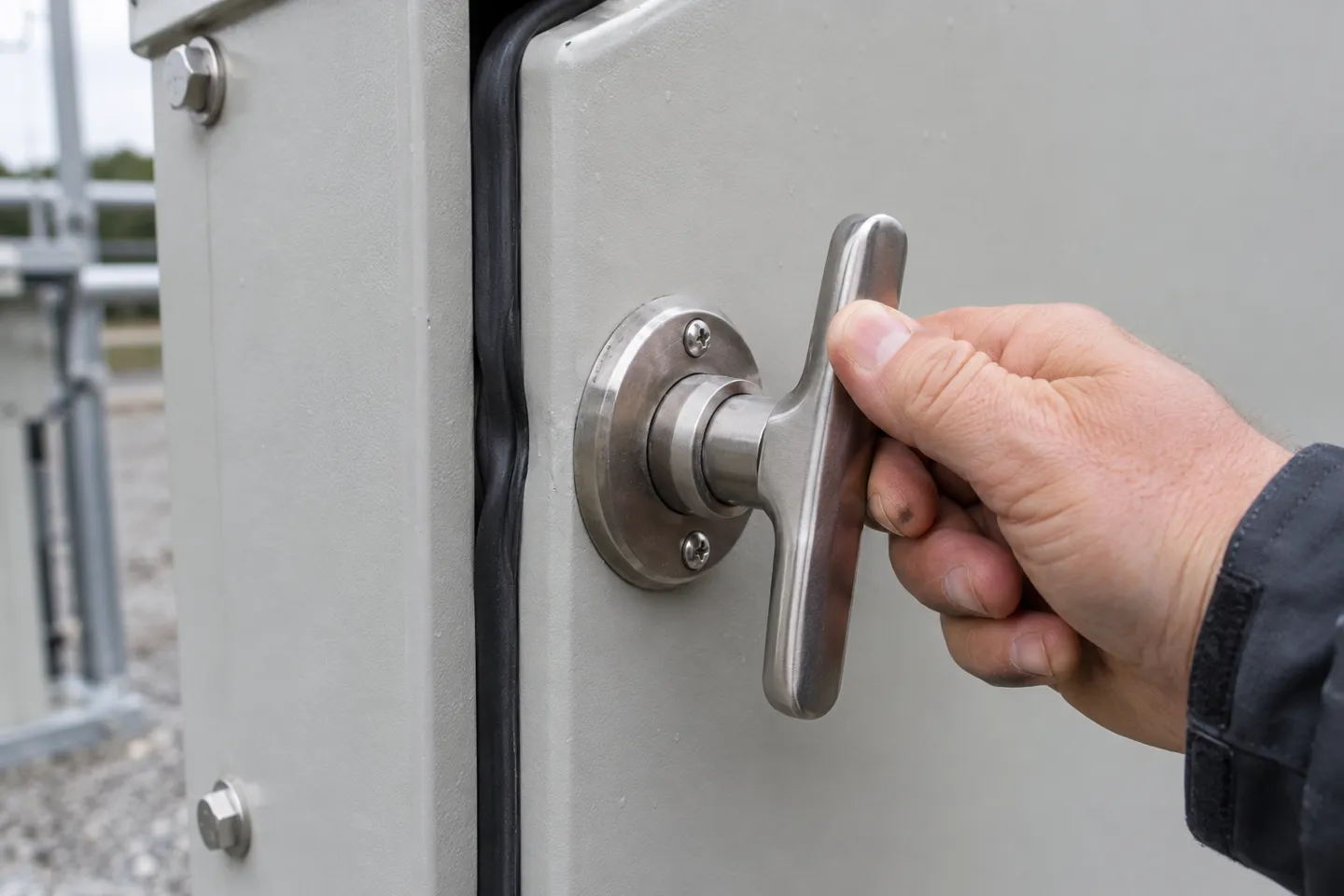
Compression Latches: When the Door Has to Seal
A compression latch does something a cam cannot: as you turn or lift the handle, a hook draws the door inward before it locks, compressing the gasket by a few millimeters. That preload is what turns a closed door into a sealed one, keeping out dust and water and holding an enclosure at its rated protection level. The ratings themselves are defined by IEC 60529, the international standard that grades enclosures against intrusion by solids and liquids (IEC, 1989).
The same logic scales to worse environments. Ovens and environmental test chambers, whose benchtop models commonly span about -73°C to +180°C, need constant gasket pressure at temperature, so their doors ride on stainless compression hardware. EMC shielded enclosures need even compression around the whole frame, because a single loose corner leaks the shielding. Stainless grades such as SUS304 and SUS316 exist in this segment precisely because cleaning chemicals, salt fog and condensation eat plated zinc.
The cost is mechanical, not financial. The frame must survive the compression travel, the gasket must be compressed evenly rather than crushed, and the hinges must carry a door that is now pulled tight. Compression hardware that ignores any of those three will fight the door instead of sealing it.
Multi-Point Rod Locks: Big Doors and the Twist Problem
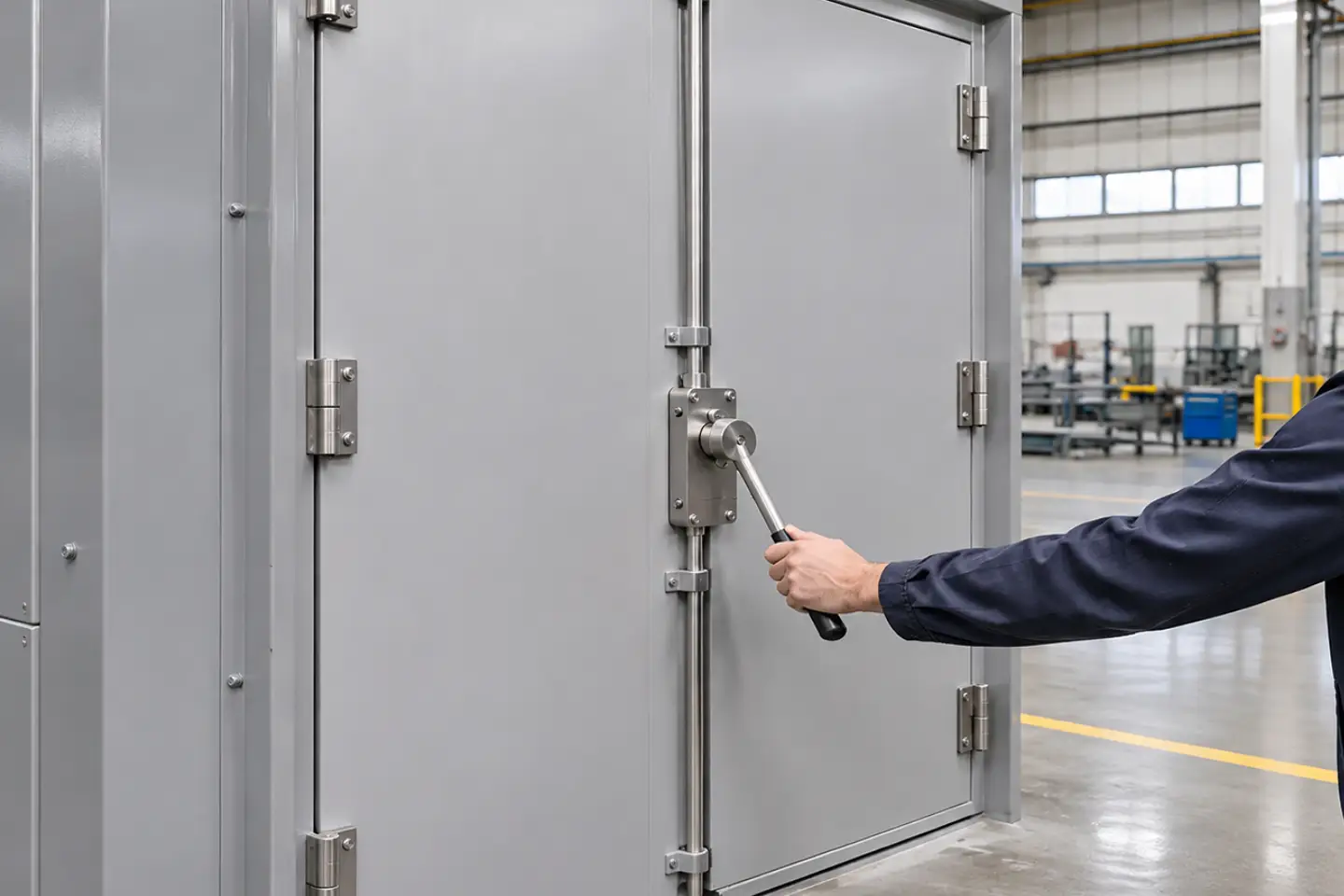
A tall door locked at one point twists: the locked edge is pulled tight while the free corners bow outward. Multi-point rod locks answer this by sending rods up and down from a single handle, engaging locking points at the top and bottom edges and pulling the whole door flat. This is the standard answer for large single doors, double doors, and cleanroom or shielded doors where even pressure matters along the full height.
It is also the easiest type to overspecify. A small wall-mounted cabinet gains nothing from rods and pays for them in cost and installation depth. The honest criterion is geometry: door height and weight decide, not status.
Specifying any of these three families comes down to the same list. It runs from panel thickness range and grip length through IP rating and operating temperature to housing material, finish, cycle life and key system options. Minimum order quantity and lead time for future replacements complete it.
Scene to lock type: what to check before you commit
| Application scene | Lock type that fits | Why it fits | Failure boundary and what to check |
|---|---|---|---|
| Household and office storage | Keyed cam lock | Cheap, one key serves many cabinets | Deterrence only: check what the contents are worth |
| Light indoor control box | Industrial cam lock | Low load, dry room | Vibration loosens the nut: check anti-rotation and spring washer |
| Outdoor telecom cabinet | Compression latch | Rain and dust on a rated door | Check panel thickness range and gasket compression |
| Cold room or freezer | Compression latch in low-temp materials | Seal at low temperature | Electronics fail cold: check temperature rating before choosing any keypad |
| Test chamber or oven | Stainless compression latch | Constant gasket pressure at temperature | Check compression travel and hinge load together |
| EMC shielded enclosure | Compression or multi-point | Even pressure around the frame | Uneven compression leaks: check gasket contact on all edges |
| Large double equipment doors | Multi-point rod lock | Rods pull a tall door flat | Overkill on small doors: judge by door height and weight |
That matrix compresses the selection logic into one screen. To put it to work, turn your own constraints into a specification you can send out.
Specification list to send your supplier
- door panel thickness range and grip length
- IP rating per IEC 60529
- operating temperature range
- housing material and finish for the corrosion environment
- cycle life in opening cycles
- key system (keyed different, keyed alike, master)
- MOQ and lead time for future replacements
Every row of that matrix reduces to the same habit: decide the constraint first, then let the constraint pick the lock. Buyers who work this way also read the market differently, which is where the money is.
What the Cabinet Lock Market Means for Your Stocking and Specs
Reread the map as a price structure and it splits cleanly. Standard keyed cam locks are a commodity. Catalog listings sit around US$0.49 to US$0.56 for zinc alloy bodies with independent or master key options. Retail shelves are full of them, and information about them is free everywhere. In the same industrial catalogs, handle latches for ovens and kitchen equipment list around US$6.86 to US$7.89. Paddle latches with lock cylinders reach US$11.00 to US$12.65. That twentyfold spread is explained entirely by application constraints, not by machining cost.
That spread is the stocking answer. Standard cam locks earn their place as a volume line: low unit cost, no minimum order friction, and steady replacement demand. The margin and the customer loyalty sit in the constrained lines: compression latches, multi-point systems, stainless upgrades and custom key systems. A buyer who needs them is choosing by parameters and support, not by the cheapest listing. Stocking by “whatever sells most” ties your capital to the commodity end and leaves the defensible business to someone else.
For OEM buyers the same logic becomes a procurement rule. A lock is a small line item, but its failure is a field incident. The specification list from the previous section belongs in the purchase order: thickness range, IP rating, temperature range, cycle life, key system. Ask the obsolescence question early, because the forum threads about fifty missing replacement cams are what happens when nobody does.
A standard keyed cam lock now costs US$0.49 to 0.56 off the shelf, with no minimum order. Compression and multi-point locking cannot be priced that way: panel thickness, IP rating and temperature range set the spec first. That gap is where the commodity ends and the engineering begins.
KUNLONG builds both ends of that ladder. Our cam locks ship from stock with 7 to 15 day lead times and no minimum order. Our compression latches, paddle latches and multi-point systems are engineered against the same panel, IP and temperature constraints described above, with free 3D models for design-in. You can compare the standard cam lock range and current lead times in our catalog, or send us your door specifications and we will match the lock to the constraint.
Get a Lock Matched to Your Door
Cam locks ship from stock in 7 to 15 days with no minimum order. Compression, paddle and multi-point systems are engineered to your panel, IP and temperature constraints.
Send Your Door SpecificationsReferences
- IEC. “Ingress Protection (IP) ratings.” International Electrotechnical Commission. https://www.iec.ch/ip-ratings
- Grand View Research. “Smart Lock Market Size, Share & Trends Analysis Report.” 2025. https://www.grandviewresearch.com/industry-analysis/smart-lock-market
- Reddit r/WhatsInThisThing. “Key was lost in the move. What’s the best way to open this?” 2021. https://www.reddit.com/r/WhatsInThisThing/comments/nlzg9t/
- Reddit r/Locksmith. “Looking for something like this electrical cabinet lock, anyone know where I can buy a large quantity?” 2023. https://www.reddit.com/r/Locksmith/comments/14cs42s/
- Reddit r/Locksmith. “Cabinet lock core comes out with key.” 2016. https://www.reddit.com/r/Locksmith/comments/5djcid/