


Turn a key on the face of an electrical cabinet and something small happens behind the panel. A flat piece of metal, the cam, swings a quarter turn, slides behind the door frame, and the door stops coming open. That is the entire mechanism. A good cam lock diagram is a picture of three things: the parts, the 90-degree movement, and the way the cam lands against the frame. Get those three right on paper and the lock works on the first try. Get one of them wrong and you join the queue of maintenance threads about keys snapped in cylinders and doors that never quite latched.
This article follows the same path, from the outside in. Catalogs and articles lump three unrelated products under this one name, so the parts breakdown below starts by clearing that up. From there it moves through the mechanism variants and the sizing sequence that turns a diagram into drawing numbers. It ends with the failure modes that repair communities document over and over.
What a Cam Lock Actually Is: Parts, the 90-Degree Turn, and What It Isn’t
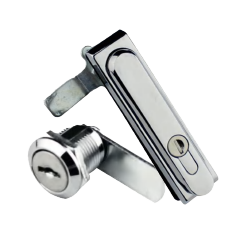
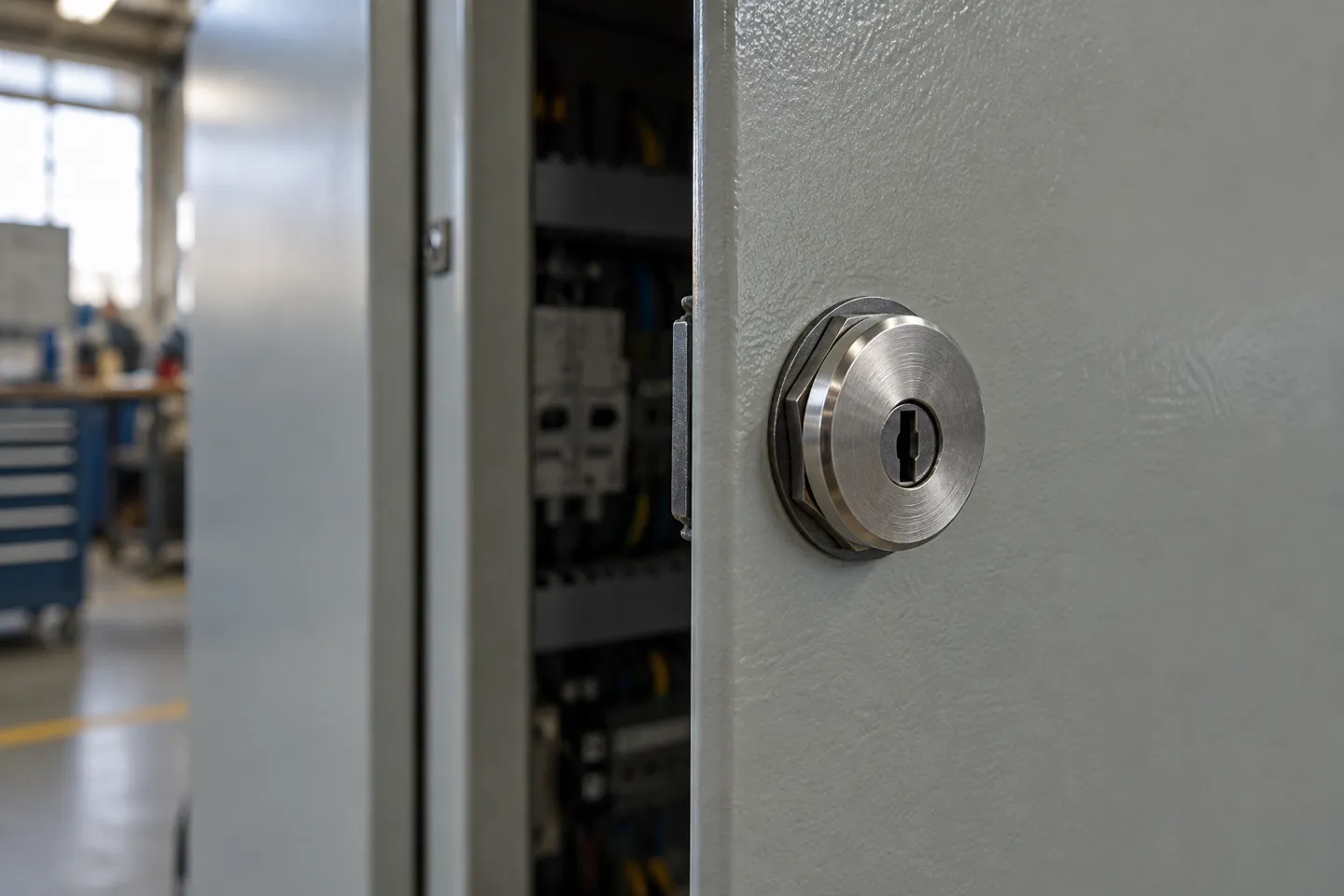
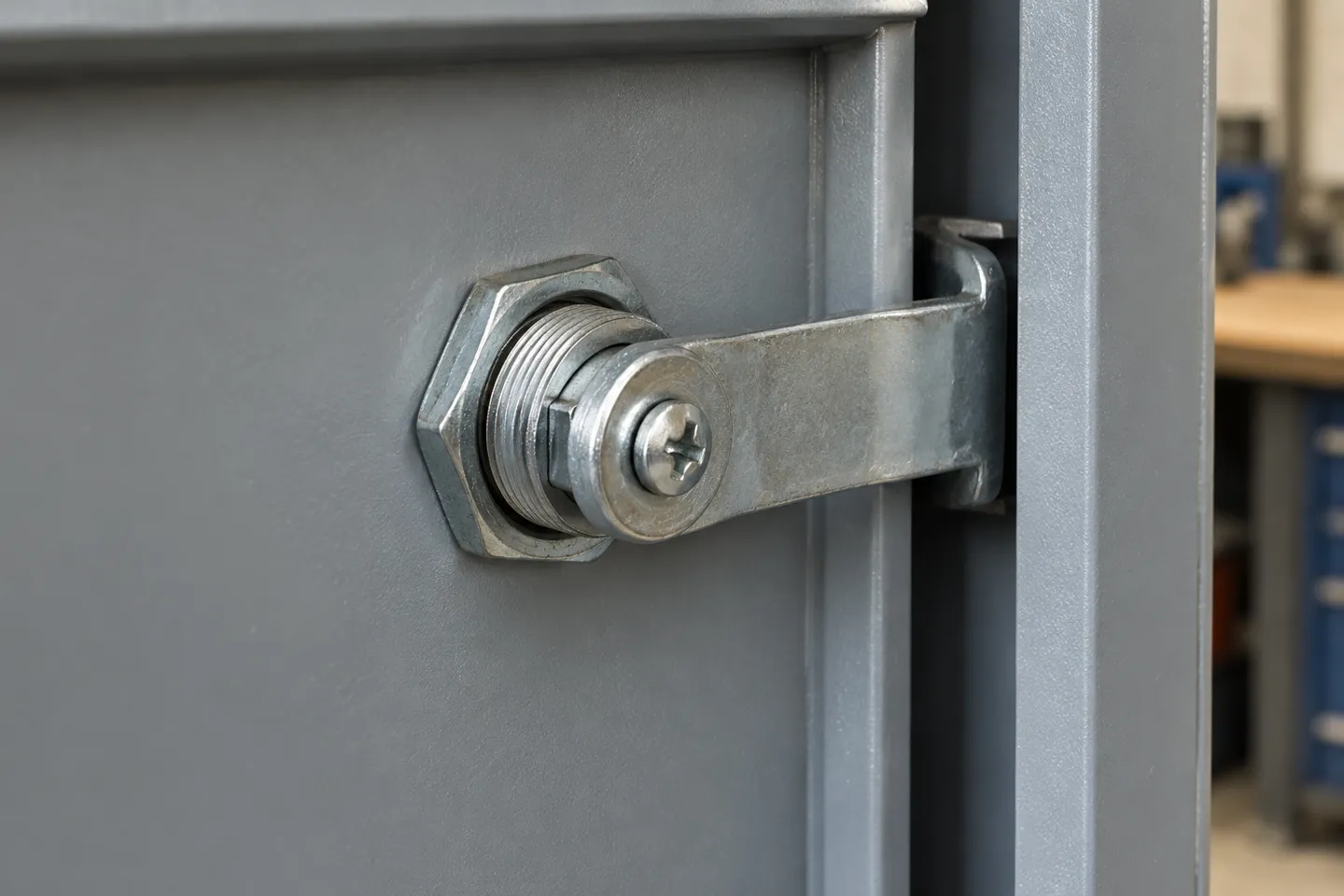
A cam lock has four parts you can name from a cross-section diagram, and every one of them shows up in the spec you will eventually write.
Cam Lock Parts and What Each One Does
| Part | Where it sits | What it does |
|---|---|---|
| Lock body (shell + cylinder) | Front of panel, inserted through the mounting hole | Houses the key mechanism; the threaded sleeve sets how thick a panel it can clamp |
| Lock nut | Back of panel, threaded onto the body | Clamps the lock to the door; loose here means a spinning lock later |
| Cam (tongue) | Rear of the body, held by a screw or integral lug | The flat plate that swings behind the frame and actually stops the door |
| Key or wing knob | Front face | Rotates the cam 90 degrees; knob versions skip the key entirely |
The movement is the second thing the diagram shows. At rest the cam sits parallel to the door face and the door opens freely. Insert the key, rotate 90 degrees, and the cam turns perpendicular to the panel, reaching behind the frame or a strike plate. Rotate back and the door releases. Most cam locks ship set for one hand of opening and can be reconfigured for left- or right-hand doors by repositioning the cam. Settle that before you drill.
One clarification belongs in any cam lock diagram, because the name is overloaded:
Name check
Three products share this name. A furniture cam lock is a two-piece plastic cam and dowel pressed into pre-drilled holes, no cylinder, no key, and it belongs to flat-pack assembly guides. A Cam-Lok electrical connector is a single-pole high-amperage cable termination for temporary power, hundreds of amps per pole, again no key. This article is about the third one: the keyed, panel-mounted quarter-turn lock used on cabinet and enclosure doors.
With that settled, the rest of this page is about cabinet cam locks only.
Cam Lock Types: Key Mechanisms and Operating Styles
Type differences in this category are mechanism differences. The useful way to sort them is two axes: what turns the cam, and how the door is captured.
On the first axis, a pin tumbler cylinder with a flat key is the general-purpose choice when the lock has to mean something. Tubular (seven-pin) keys raise picking difficulty and are common on vending and payment cabinets. Tool-slot heads, the kind a flat screwdriver or triangle key turns, trade security for convenience on low-risk doors. Wing knobs skip the key altogether for doors that only need to stay closed. A fourth family, push-to-open and slam-latch styles, removes the rotation from the user entirely: press the face and the cam retracts, or shut the door and it latches.
The second axis is keying, and it is a bigger decision than the mechanism. Independently keyed locks mean every door has its own key, which is straightforward until a fleet reaches dozens of cabinets. Keyed-alike sets open every door with one key, which maintenance teams prefer and security reviews question. A master key system sits between the two: each lock has its own key, and a hierarchy key opens groups or all of them. Locksmith forums fill with retrofits that got expensive precisely because this choice was deferred.
Cam Lock Mechanisms at a Glance
| Mechanism or style | How it operates | Security posture | Typical homes |
|---|---|---|---|
| Pin tumbler, flat key | Key rotates cam 90 degrees | Moderate; general purpose | Electrical cabinets, machinery covers |
| Tubular key | Seven-pin circular keyway | Higher picking resistance | Vending, kiosks, payment cabinets |
| Tool slot (screwdriver, triangle) | Tool rotates cam | Deterrence only | Distribution boxes, interior panels |
| Wing knob | Twist by hand | None; access control only | Covers, guards, low-risk doors |
| Push-to-open / slam latch | Press face or close door to latch | Varies with cylinder behind | Equipment doors needing one-hand entry |
When a Cam Lock Is the Right Answer, and When to Step Up
A cam lock earns its place on three conditions. The door is a panel door, the security requirement is low to medium, and you want one hardware line repeated across many doors. Enclosure doors, machine covers, distribution boxes, parcel and vending cabinets all fit.
Three situations call for something else. If there is no security requirement at all, a paddle latch or toggle latch does the same job with less hardware and nothing to key. If the door is large and heavy, a single cam gripping one point of the frame becomes the weakest link. Multi-point rod locks spread the load across two or three engagement points and belong on doors in the hundred-kilogram class. And if the door faces weather, an unsealed cam lock is the wrong part regardless of brand. You need a sealed variant or a different latch family.
The category itself is also moving. Market trackers put the overall cabinet lock market on roughly 4.6% annual growth through 2035 (Market Research Future, 2025). Electronic and smart lock segments are forecast to compound several times faster. Electronic cabinet locks with audit trails and remote management are already standard catalog items at major manufacturers. The question of mechanical versus electronic is joining the sizing conversation, especially for equipment that needs access logs.
Three questions that pick the hardware family
- 1Does the door need to resist anything more than casual opening? If no, look at latches instead of locks.
- 2Is the door heavy or does it seal something valuable? If yes, count engagement points, not locks.
- 3Do you need to know who opened it and when? If yes, shortlist electronic variants now, not after installation.
Sizing and Specifying: Matching the Lock to Panel, Frame, and Environment
This is where a cam lock diagram stops being anatomy and starts being engineering. Every dimension on the drawing maps to a fitting condition somewhere else, and the matching follows a fixed order: panel, then frame, then environment, then keys.
The four-step matching sequence
Panel
Body length passes fully through; hole per the lock’s drawing
Frame
Cam throw clears frame depth; strike at the landing arc
Environment
Material, seal, temperature, vibration
Keys
Independent, keyed-alike, or master — set at drawing time
Match the body to the panel
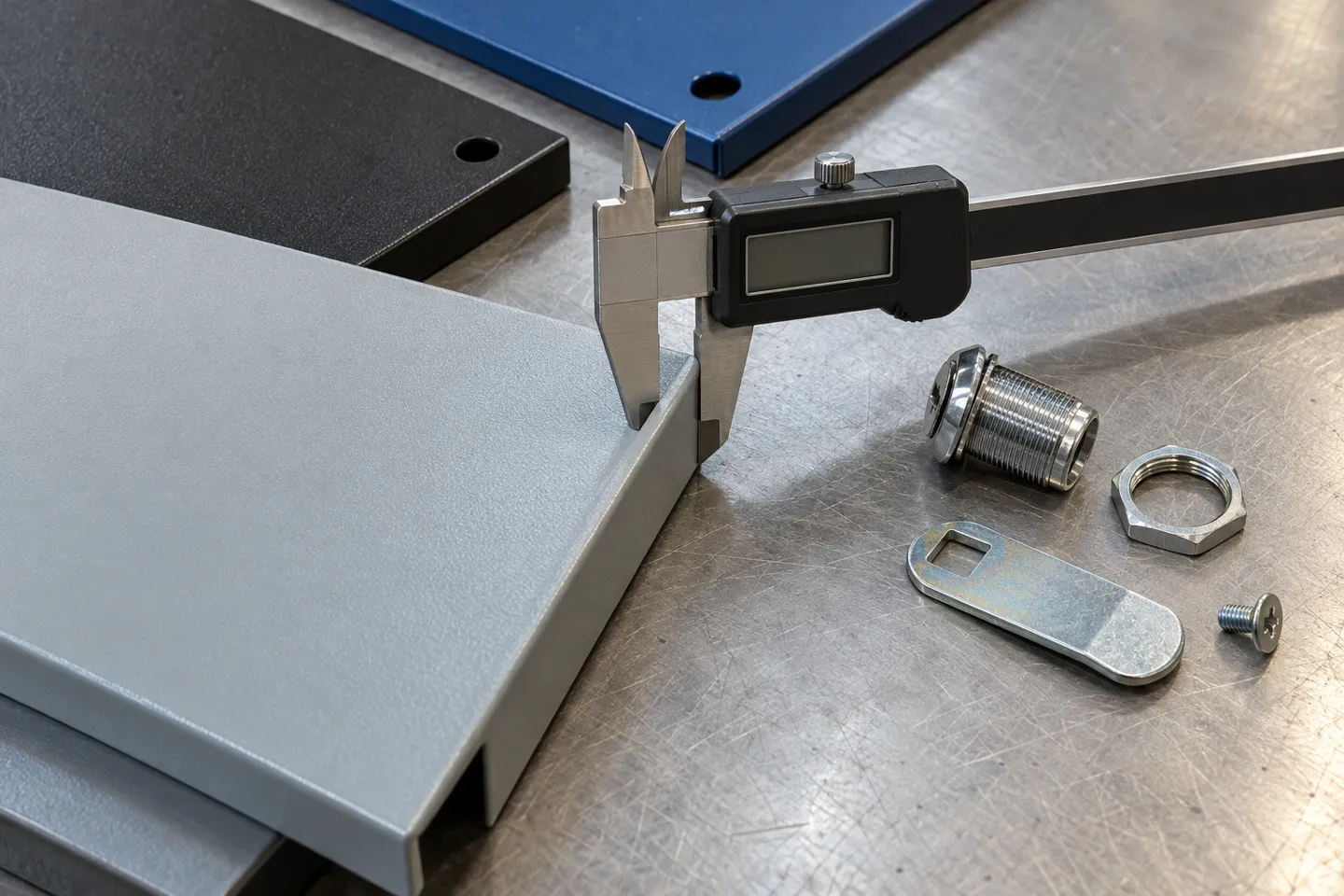
Start with panel thickness, because the threaded body has to pass fully through it so the lock nut can clamp. Cylinder length is what sets the panel-to-tongue depth a given lock can span (Rencol Tolerance Systems, 2025). Mounting holes for the common quarter-turn families are typically 19 mm, though series vary, so the hole diameter comes from the specific lock’s drawing rather than habit. On painted or powder-coated doors, cut the hole before coating; finishing over a burr-thin margin around the hole is a corrosion starting point.
Match the cam to the frame
Check what the cam actually lands on. Repair threads document the lock installed on a door with nothing behind the cam to catch. The fix required fabricating a bracket after the fact (r/Locksmith).
Three checks before the drawing is signed off
- Hole position matches the drawing.
- A strike or frame return exists at the cam’s landing arc.
- The cam rotates fully without contacting the frame or gasket.
Match the material and seal to the environment
Indoors and dry, a die-cast zinc body with a plated finish is the economic default and nothing more is needed. Damp, washed-down, or outdoor doors change the list: a sealing gasket behind the lock face, and where corrosion is aggressive, stainless construction for the exposed components. Ingress protection ratings follow the IEC IP code: the first digit covers solids, the second covers water (Wikipedia: IP Code). Treat any IP claim on a lock as a question about its gasket and its hole seal, because the door opening is the leak path. Temperature is the third axis. Catalog hardware lines for test chambers and cold-chain equipment quote usable ranges from −70 up to 260 degrees Celsius at the material and gasket level. A chamber door lock is a material selection first and a security selection second. Vibration is the quiet fourth: mounts near compressors, fans, or vehicle chassis need anti-rotation measures, either thread lockers or cam designs that resist back-driving.
Decide the key architecture at drawing time
Independent, keyed-alike, or master hierarchy is a one-line note on the drawing and a plant-wide retrofit if it is wrong. Decide it with the same seriousness as the hole diameter, because the cost curve on keying runs the wrong way. Specify it late and you re-key; re-key a fleet and you pull every door.
The matrix below compresses the four steps into the form most useful at review time.
Cam Lock Configuration Matrix: Scenario × Spec × Failure Boundary
| Scenario | Configuration to require | Boundary: what breaks it |
|---|---|---|
| Indoor machine cover | Zinc body, tool-slot or flat key, standard cam | Keying security expectations beyond deterrence |
| Outdoor distribution cabinet | Sealed gasket lock, plated or stainless, keyed alike per site | Unsealed face or hole; gasket aging unchecked |
| Test chamber, heavy insulated door | Material rated for chamber range, multi-point or rod engagement, master keying | Single-point cam on a door over ~100 kg; material below chamber minimum |
| Vending or parcel cabinet | Tubular key, reinforced face, keyed to route | Face attack; master keys held too widely |
How Cam Locks Fail: Four Real Failure Modes and the Specs That Prevent Them
Field failures in this category are repetitive, which is good news, because a short list covers most of what you will ever see.
The four failures repair communities keep documenting
Cam Lock Failure Modes: Symptom → Root Cause → Design-Stage Counter
| Symptom | Root cause | Counter to apply at design time |
|---|---|---|
| Key snaps in the cylinder | Soft key stock or aggressive turning; extraction is fiddly and can kill the lock | Specify hardened key stock; brief users on snug, not forced, rotation |
| Cam spins, lock never grabs | Loose cam screw or loose lock nut behind the panel | Thread locker on the cam screw; torque check on the clamp nut at assembly |
| Nothing for the cam to catch | Door built without a strike or frame return at the landing arc | Strike position belongs on the fabrication drawing, not the install sheet |
| Wrong lock ordered, repeated returns | Body length or thread size guessed instead of measured | Put body length, hole diameter, and panel thickness on the BOM line |
Each row above has a documented twin in public maintenance threads. There is the cabinet lock installed with no strike to land on (r/Locksmith). And there is the steel-cabinet replacement that went smoothly only because someone knew to order a 7/8-inch lock by length (r/Locksmith). The pattern across all of them is the same: the failure is in the fit, not the mechanism.
0 of 4
documented failure modes involved a defeated lock cylinder
Broken keys, spinning cams, missing strikes, wrong lengths: all fit and environment problems, not security problems.
Turning the failure list into spec lines
Every failure above converts into a line you can demand from a supplier. Gaskets are wear parts, so a sealed lock should have a replaceable gasket and a suggested inspection interval. Published cycle ratings give a baseline: mainstream specifications quote 20,000 or more operating cycles of service life, a figure that describes switching cycles, not years in the field. Keying needs a loss plan: a master hierarchy limits a single lost key to a re-keyed group instead of an entire site. Vibration and salt environments accelerate every mechanism in the table, which is why the environmental row in the sizing matrix is not optional.
Reading Cam Locks as a Procurement Line: What Goes Into the Spec
The unit prices in this category look almost fictional next to the cost of the door they secure. Catalog listings run from well under a dollar for basic zinc cylinders to several dollars for sealed stainless variants. A mis-specified lock shows up as a door that has to be re-drilled, re-fitted, or re-keyed across a production run. That asymmetry is the whole procurement argument: the price difference between two cam locks is noise, and the cost of a wrong fitting parameter is signal. On standard high-volume doors with no environmental demands, buying on price is rational. The moment a spec includes sealing, temperature, or keying architecture, parameter compliance outranks unit price. The rework sits on your side of the shipment.
Spec lines to lift into the RFQ
- Mounting hole diameter and panel thickness range
- Body (cylinder) length
- Cam length and offset against frame depth plus gasket
- Seal type and gasket replaceability
- Body and cam material with temperature rating
- Key architecture (independent / keyed alike / master)
- Rated operating cycles
- Drawings and 3D models supplied per SKU
Supplier capability matters as much as the part number here. A manufacturer that supplies a dimensioned drawing and a 3D model for every SKU lets your drafting team finish the door design without waiting on a sample. Keying services, sample policy, minimum order terms, and lead time decide whether the line item is smooth or painful across a production cycle.
If you want a benchmark while assembling that list, KUNLONG publishes cutout and panel-thickness data on every SKU page across its cam lock range. We hold stocked standard hardware to about a 7-day ship, with 7 to 15 days on regular SKU lead times. Our published cam lock listings currently span roughly US$0.49 to US$8.46 depending on material and sealing. Minimum order is listed as “no request” on those pages, and free samples are available on stocked standard items with freight collected.
Turn your spec into the right cam lock
Send your panel and frame details — KUNLONG returns drawings, samples, and a quote. Stocked standards ship in about 7 days.
Start a Cam Lock RFQReferences
- Market Research Future. “Cabinet Lock Market Size, Share, Growth | Report, 2035.” 2025. https://www.marketresearchfuture.com/reports/cabinet-lock-market-36353
- Wikipedia. “Camlock (electrical).” n.d. https://en.wikipedia.org/wiki/Camlock_(electrical)
- Wikipedia. “IP Code.” n.d. https://en.wikipedia.org/wiki/IP_Code
- r/Locksmith. “Looking for cam cabinet lock part.” n.d. https://www.reddit.com/r/Locksmith/comments/u289cj/looking_for_cam_cabinet_lock_part/
- r/Locksmith. “Help finding replacement lock for steel cabinet.” n.d. https://www.reddit.com/r/Locksmith/comments/1m9xdww/help_finding_replacement_lock_for_steel_cabinet/