


What PCB Baking Actually Does (and What It Can’t)
PCB baking — also called PCB drying; the two terms describe the same process — is a pre-assembly step that drives absorbed moisture out of the board. FR4 laminate is hygroscopic: it pulls water from the air during storage and shipping. When that moisture hits reflow temperatures (240°C+ for lead-free solder), it vaporizes almost instantly, expanding roughly 1,700 times its liquid volume. Trapped steam separates internal layers (delamination), cracks IC packages (popcorning), and leaves white spots in the laminate (measling). Baking before soldering is the standard answer, governed by IPC-1601.
One clarification before we go further, because search results mix two very different activities: this article is about pre-assembly moisture removal, not the “bake your GPU to fix it” repair trick. That repair myth is a different beast entirely — boards heated in a kitchen oven in the hope of reconnecting cracked solder balls. Baking cannot reflow solder: lead-free solder melts at 180-215°C, far above any drying temperature, so heating below that range fixes nothing, and heating above it destroys the board (eevblog forum thread). Similarly, a PCB reflow oven is a soldering machine, not a drying one. If you’re baking to repair, stop here — this guide is about making new assemblies reliable.
Two different “bakes”: moisture removal before soldering (IPC-1601, the subject here) vs. reflow “repair” myths (kitchen-oven GPU fixes — not reflow, not durable, often destructive). If your goal is repair, a drying oven is the wrong tool.
So how does the process work in practice? An oven heats the board to a controlled 100-130°C range. Surface moisture evaporates first, then deep-layer moisture moves out by diffusion — which is why time matters as much as temperature. That’s the whole mechanism. What’s surprisingly under-discussed is the equipment, because every rung of the oven ladder handles this job very differently.
Four Rungs on the PCB Baking Oven Ladder
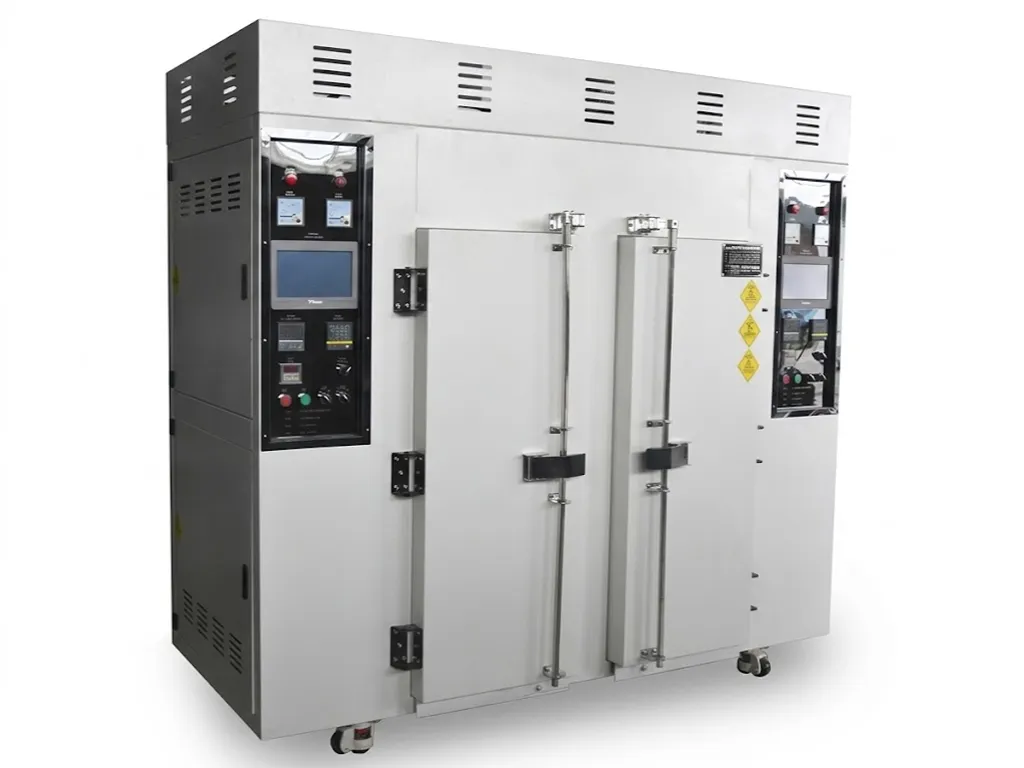
Baking ovens are not all the same machine. They form a clear capability ladder, and matching the right rung to your production reality is the first equipment decision you’ll make.
| Rung | Temperature control | Airflow | Exhaust & humidity | Fits |
|---|---|---|---|---|
| Household kitchen oven | Wide thermostat cycling, hot spots | No forced convection | No exhaust design; food residue contamination | Emergency/repair use only, never production |
| General lab drying oven | PID control (commonly 50-300°C) | Natural or basic forced convection | No humidity design | Small batches, R&D, one-off boards |
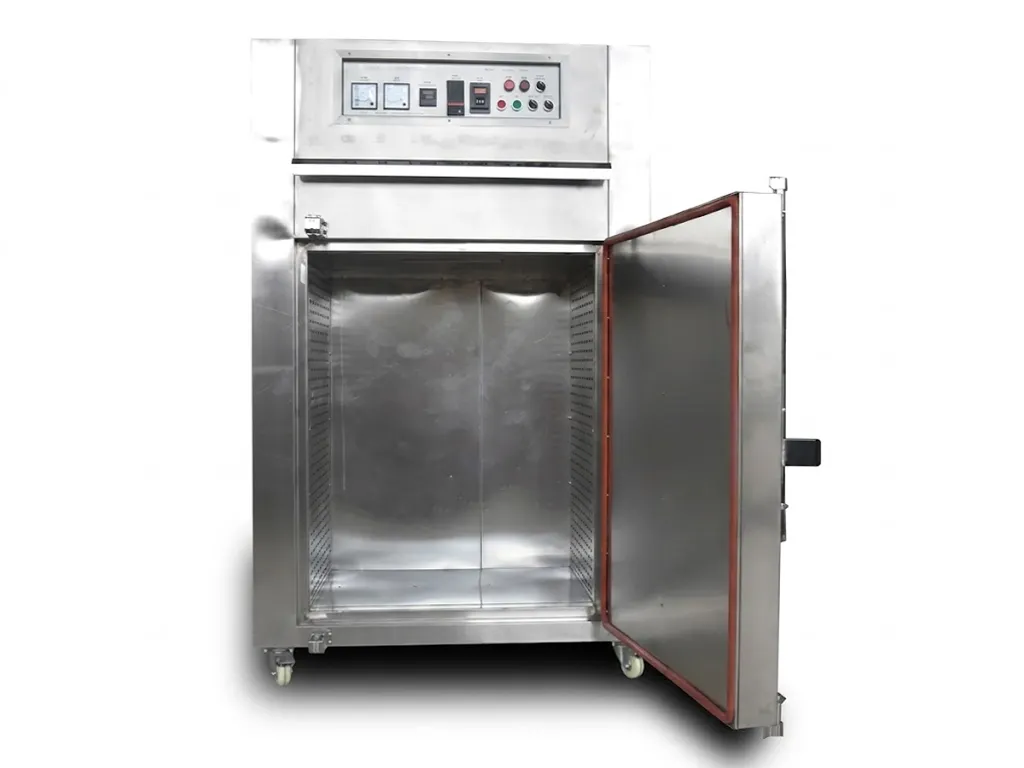
| Industrial forced-air convection oven | ±5°C uniformity across chamber | Forced-air circulation | Vented exhaust, interior <5% RH capability; programmable profiles with data logging | SMT line standard |
| Productized oven (built by equipment OEMs) | The industrial rung as a designed product | Door sealing, load rating, hinges, tray systems engineered for process duty | This rung gets its own section below | Equipment OEMs building ovens for others |
The line between rungs isn’t price — it’s whether the machine can hold the conditions the process actually needs. A lab drying oven will reach 120°C, but without exhaust and low-humidity capability the evaporated moisture stays in the chamber and boards re-absorb it: you’ve baked, and nothing changed. That boundary failure (oven reached temperature, process didn’t happen) is the most common reason a “baking line” underperforms.
Temperature reached ≠ moisture removed. Without exhaust and interior-humidity control, a drying oven re-humidifies the boards it’s supposed to dry. Check for exhaust ventilation and <5% RH interior capability before you check the temperature display.
Do You Actually Need to Bake?
Before spending on equipment or time, run this three-step check — a large share of boards don’t need baking at all, and baking boards that don’t need it degrades them.
Step 1 — Check the packaging. A vacuum-sealed moisture barrier bag with a passing humidity indicator card (HIC), unopened within about two months of manufacture, doesn’t need baking — the sealed environment is doing the drying for you. The “bake everything” habit exists, but per IPC-1601 handling guidelines properly sealed boards are exempt.
Step 2 — Check the storage clock. Unsealed boards are on a countdown: within 5 days of manufacture, assemble directly; 5-60 days unsealed, bake 1 hour at 120±5°C; 2-6 months, 2 hours; 6-12 months, 4 hours; over 12 months, baking can’t reverse chemical degradation — corrosion and solder-mask aging aren’t water, and such boards aren’t recommended for use at all (pcbsync, PCB baking guide, 2026).
Step 3 — Check the surface finish. This is the hard red line that most temperature advice ignores: OSP boards must not exceed 105°C. Bake an OSP board at the “standard” 125°C and you’ve degraded its solderability. Finish limits are covered in the full matrix in the next section.
Now, the numbers you’ll find online disagree: 85-105°C in one beginner guide, 100-130°C in another, 100-150°C in a third. The resolution is simple. Follow IPC-1601’s 120±5°C for the bake, and let the surface-finish limit (not the oven’s capability) set the ceiling. The lower numbers are conservative hobby values; the higher ones drift toward tempering, which is a different process (heat treatment above the material’s Tg, used to relieve stress, not dry moisture).
One more thing worth planning for: bake records. Medical and automotive customers increasingly audit moisture-control procedures, and programmable ovens with data logging are quietly becoming the compliance baseline — treat the oven as a process-data node, not a heating cabinet.
Baking decision checklist
- Vacuum-sealed with passing HIC within ~2 months of manufacture? No bake needed.
- Unsealed or older? Bake per storage duration (1h / 2h / 4h at 120±5°C).
- OSP finish? Ceiling is 105°C, never 125°C.
- Over 12 months old? Don’t bake, replace.
How to Spec a PCB Baking Oven
This is the section to bookmark: the parameters that decide whether your oven does the job — or quietly doesn’t.
Temperatures and times: the IPC-1601 table
| Storage condition | Bake temperature | Bake time |
|---|---|---|
| Within 5 days of manufacture | No bake | Assemble directly |
| Vacuum-sealed, within ~2 months, HIC passing | No bake | — |
| Unsealed, 5-60 days | 120±5°C | 1 hour |
| 2-6 months from manufacture | 120±5°C | 2 hours |
| 6-12 months from manufacture | 120±5°C | 4 hours |
| Over 12 months | Not recommended for use | Baking cannot reverse chemical degradation |
Data source: pcbsync, PCB baking guide, 2026 (IPC-1601-based)
Surface finish: the limit matrix
This is the limit matrix that decides how hot you’re allowed to go:
| Surface finish | Max bake temperature | Watch for |
|---|---|---|
| OSP | 105°C | Degrades quickly above this; solderability loss |
| HASL | 125°C | Robust; intermetallic formation if very thin |
| ENIG | 125°C | Most forgiving; withstands repeated bakes |
| Immersion silver | 105-110°C | Tarnishes; minimize bake cycles |
| Immersion tin | 105°C | Whisker risk; handle carefully |
| Silver / bare copper | Cannot be baked | Re-plate instead; oxidation is irreversible |
Beyond the matrix, two discipline rules: limit boards to 2-3 bake cycles max — each cycle oxidizes the finish — and if a board has been baked repeatedly, run a solderability test before committing it to production.
Oven hardware: what the spec sheet must include
A production baking oven is not a heating box with a PID. Minimum spec for SMT duty:
- Temperature range to 150°C at least (you’ll live at 120°C, but headroom matters)
- Uniformity ±5°C across the full chamber — hot spots are the #1 silent killer
- Forced-air circulation — natural convection can’t move moisture out
- Vented exhaust — evaporated moisture must leave the chamber
- Interior humidity <5% RH capability
- Programmable profiles + data logging — audit-ready bake records
- Vertical loading / spaced trays preferred over flat stacking (30-40 boards max if you must stack)
Vacuum vs. convection: the one real either/or
If flex or rigid-flex boards are in your mix, this decision matters: vacuum ovens dry at lower temperatures and shorter times (80-100°C, 2-3h) than convection (100-120°C, 2-4h) and are gentler on the board — but note that vacuum drying at reduced temperature is explicitly not recommended for flex materials, which need 130-150°C regardless of oven type (Multi-CB, PCB drying and tempering guide). Vacuum costs more; if your throughput is rigid FR4, convection with proper exhaust is the standard, and flex boards become a scheduling exception, not a second oven.
Vacuum vs. convection, side by side
Vacuum oven
80-100°C, 2-3h — lower temperature, shorter cycle
Gentler on the board; first choice for flex / rigid-flex
Higher equipment cost
Convection oven
100-120°C, 2-4h — standard bake window
Right choice for rigid FR4 throughput
Lower equipment cost; needs proper exhaust
Flex and rigid-flex boards need 130-150°C in either oven type — vacuum drying at reduced temperature is not recommended for them.
When the Oven Is Your Product
If you manufacture baking ovens, environmental chambers, or drying equipment for a living — this section is written for you, and it’s the part that guides for end users almost never cover. Everything in the spec section above is, from your side, a design constraint. Uniformity, exhaust, and humidity control are chamber engineering. But there’s a component of that spec that lives in the door.
The door is a process component. The <5% RH interior humidity is maintained by the door seal — a failing seal re-admits workshop humidity, and the chamber’s uniformity work is undone before the cycle finishes. This is the single most under-appreciated failure point in oven design: a door seal failure equals humidity re-entry equals a bake that didn’t happen — the oven reached temperature, the process didn’t occur, and nobody knows until the first reflow defect appears.
Seal failsHumidity re-entersThe bake never happened
The door is the most-operated component on an oven. Its seal and hardware are process parameters, not trim.
Door hardware carries real duty on these machines: single oven doors frequently exceed 100 kg, with environmental chambers going heavier; the hinge must hold that load across tens of thousands of cycles; the oven’s 5-day post-bake window means doors open and close constantly during shift runs; and chamber builders serving test labs often rate their machines to -70~260°C — a far harsher window than the 150°C bake profile, where hardware must hold up at both temperature extremes without seizing or embrittling.
Oven door duty, real numbers
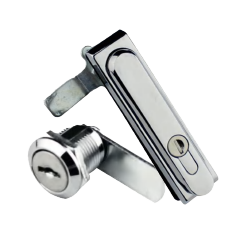
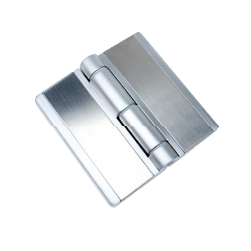
That’s why, when the oven is your product, door hardware deserves process-grade selection, not decorative-grade purchasing. At KUNLONG, we build the hinge series, handles, locks, and compression latches for exactly these enclosures — our hinge range includes oven-specific limit hinges, rated for the loads and temperature windows above, with a 1-year warranty and 20,000+ cycle guarantee (our hinge series), and custom door and tray systems are built per your BOM — material, dimension, function, and finish configurable, with MOQ at 100 and 10+ surface treatments available (custom door and tray systems). When you spec your next chamber, ask your hardware supplier for the same things you promise your customers: verified temperature range, load rating, and cycle life — not adjectives.
What Can Go Wrong
Even with the right oven, failures happen — and they’re diagnosable. Recognizing them is the difference between a process fix and a scrap bin.
Failure signatures. Delamination shows as bubbling or discoloration in the laminate; popcorning as visible cracks in IC packages (BGA and QFN with MSL 3+ are the classic victims); measling as white spots following the glass-weave pattern; blowholes as voids in solder joints. All four trace to the same root: moisture that should have been baked out. If you see them after a bake cycle, suspect the oven, not the board: calibration drift, blocked exhaust, or overloading all recreate the moisture problem silently.
Over-baking is real. A Reddit poster who accidentally baked boards at 150°C found themselves asking whether the batch was garbage — and the honest answer is, above finish limits the damage is cumulative and often invisible until soldering. OSP boards past 105°C, finishes oxidized by repeated cycles, and warped boards (IPC allows 0.75% bow — for a 300 mm board that’s 2.25 mm before stencil printing breaks down) all fail downstream, not in the oven. More is not better: one manufacturer baked every board regardless of condition and watched yield drop as the OSP finish degraded (pcbsync, PCB baking guide, 2026).
The 5-day rule. After baking you have a maximum of about 5 days to assemble. Beyond that, boards re-absorb workshop moisture — the bake is spent. Re-store properly (vacuum-seal with desiccant, or nitrogen cabinet below 10% RH) or re-bake. Scheduling baking to coincide with assembly is a process decision, not a convenience one.
Verification. Weigh boards before and after (measurable loss = moisture actually removed); check HICs; run solderability tests on sacrificial boards. If a batch still fails after a correct bake, look upstream at storage or packaging — the bake is downstream of both.
If defects appear after baking: check oven calibration and exhaust first, then loading discipline, then surface finish — in that order. Blindly increasing temperature or time is how OSP boards get destroyed.
The Oven Business Equation
Pull the threads together and the equation is simple: an oven sells process capability — uniformity, exhaust, humidity control — but a customer experiences that capability at the door. Every acceptance test opens the door; every shift run opens it a hundred times; and a door that seals, holds, and survives is the visible half of the process spec you wrote. The invisible half is the hardware spec behind it.
We build the door and tray hardware behind industrial ovens and environmental chambers — hinges rated for the loads and temperature windows above, handles, latches, and custom tray systems, with KUNLONG standard items shipping within a week from our 3,000+ standard hardware items in stock (send us your spec). When the door is a process component, the components in the door deserve the same verified specs as the chamber itself — and if you’ll send us your spec, we’ll show you the numbers, not the adjectives.
Put Verified Numbers in Your Next Door Spec
Hinges, handles, latches, and tray systems rated for your temperature window — built for oven OEMs, MOQ 100, standard items out in a week.
Request oven-hardware specificationsReferences
- [Multi-CB]. “Drying / Tempering — Printed Circuit Boards.” Multi-CB Design-Aid. https://www.multi-circuit-boards.eu/en/pcb-design-aid/surface/drying.html
- [Eevblog Forum]. “Fighting the myth of baking as a repair.” Eevblog. https://www.eevblog.com/forum/repair/fighting-the-myth-of-baking-as-a-repair/
- [pcbsync]. “PCB Baking: Complete Guide to Temperature, Time & IPC Standards.” 2026. https://pcbsync.com/pcb-baking/
- [KUNLONG]. “Hinges.” https://www.kunlonghardware.com/hinges/
- [KUNLONG]. “Bespoke Services.” https://www.kunlonghardware.com/bespoke-services/
- [KUNLONG]. “Reliable Package & Delivery.” https://www.kunlonghardware.com/reliable-package-delivery/
- [KUNLONG]. “Contact Us.” https://www.kunlonghardware.com/contact-us/
- [KUNLONG]. “Homepage.” https://www.kunlonghardware.com/