


What Is a Multi-Point Lock?
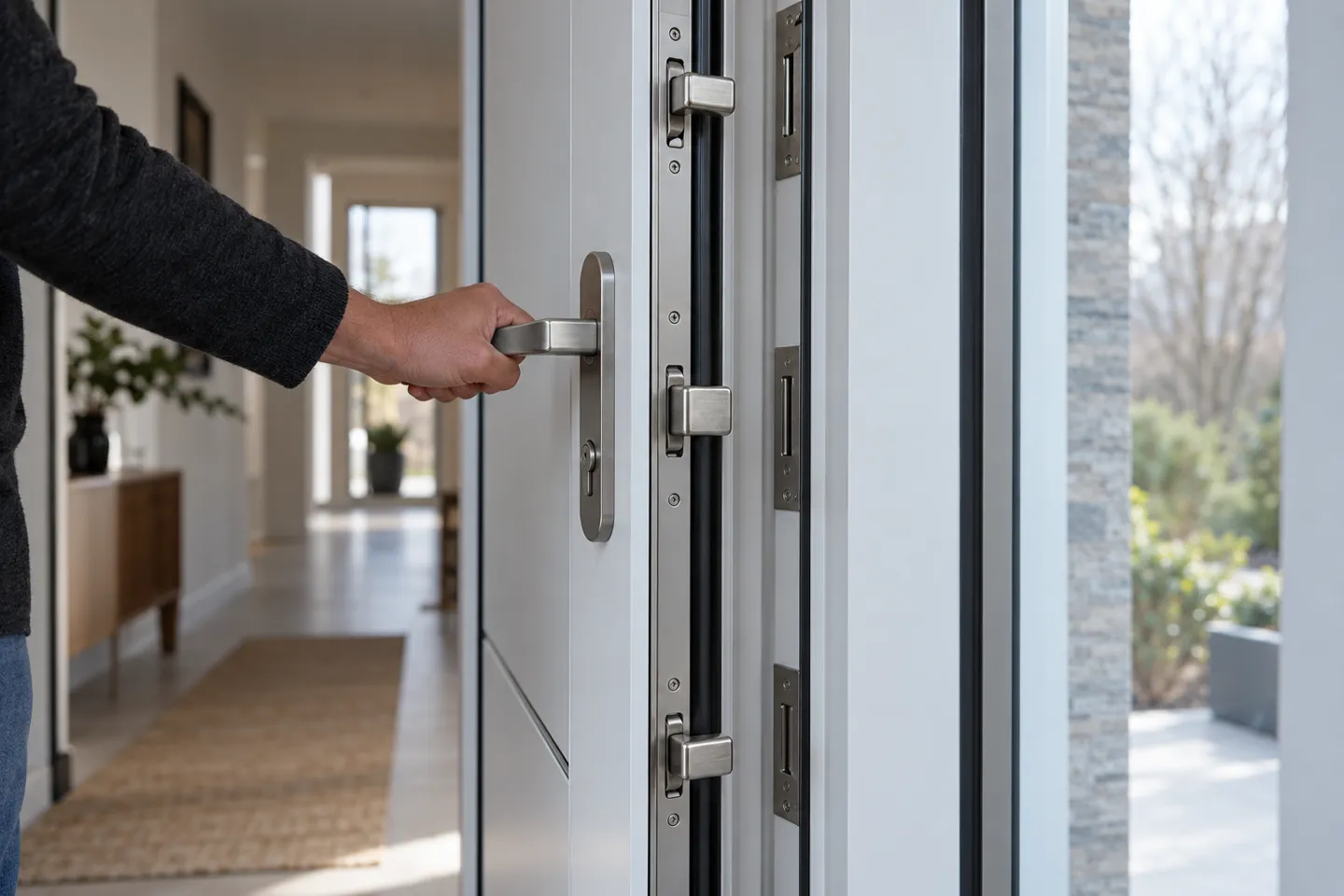
Lift the handle on a modern front door and you hear it happen: three bolts drive into the frame in the same second. Turn the key and all three lock. One action, several locking points, one mechanism linking them. That is the whole idea behind a multi-point lock.
A multi-point lock is a locking system in which a single operator drives two or more locking points along the door edge through a linked transmission. The operator is usually a handle or a key cylinder. A conventional deadbolt throws one bolt at one height. A multi-point locking system spreads the same job across the full height of the door: a gearbox converts the handle’s rotation into the linear travel of a lock rail, and the rail throws every point at once.
Two things follow from that arrangement. Security improves because an attacker prying the door meets resistance at several heights, so the force spreads across the frame instead of concentrating at one bite point. Sealing improves because the extended points pull the door tight against its gasket around the whole perimeter. The second benefit explains why multipoint locks are standard on insulated entry doors, and on equipment doors that have to keep out dust, water, heat, or cold.
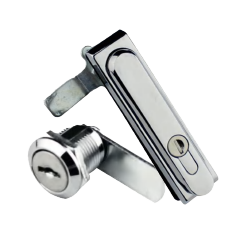
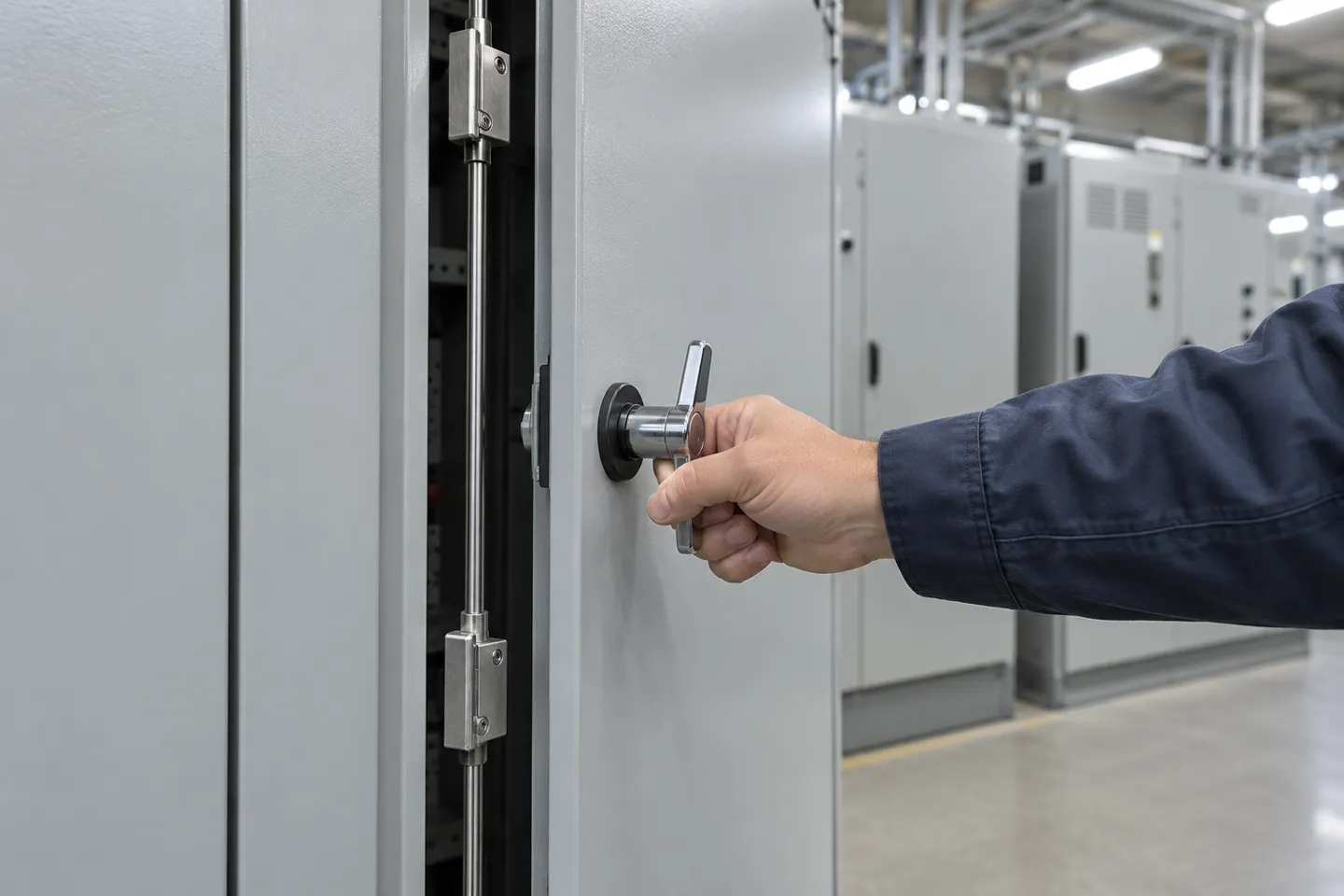
The phrase covers two related worlds. On homes and commercial entrances, the mechanism lives in a gearbox and a long lock rail inside the door leaf. On industrial cabinets and equipment enclosures, the same job belongs to a rod control lock: a handle turns 90 degrees, and rods carry the motion up and down the door until locking blocks bite into the frame. Different doors, same principle: one operator, multiple points.
How much of this you need depends on which door you are standing in front of. A homeowner mostly needs to know why the handle must lift before the key turns. An engineer specifying an enclosure needs panel thickness, throw, and point count. Both answers come from the same drive, so the drive is where this starts.
How the Drive Works: Gearbox, Lock Rail, and Point Types
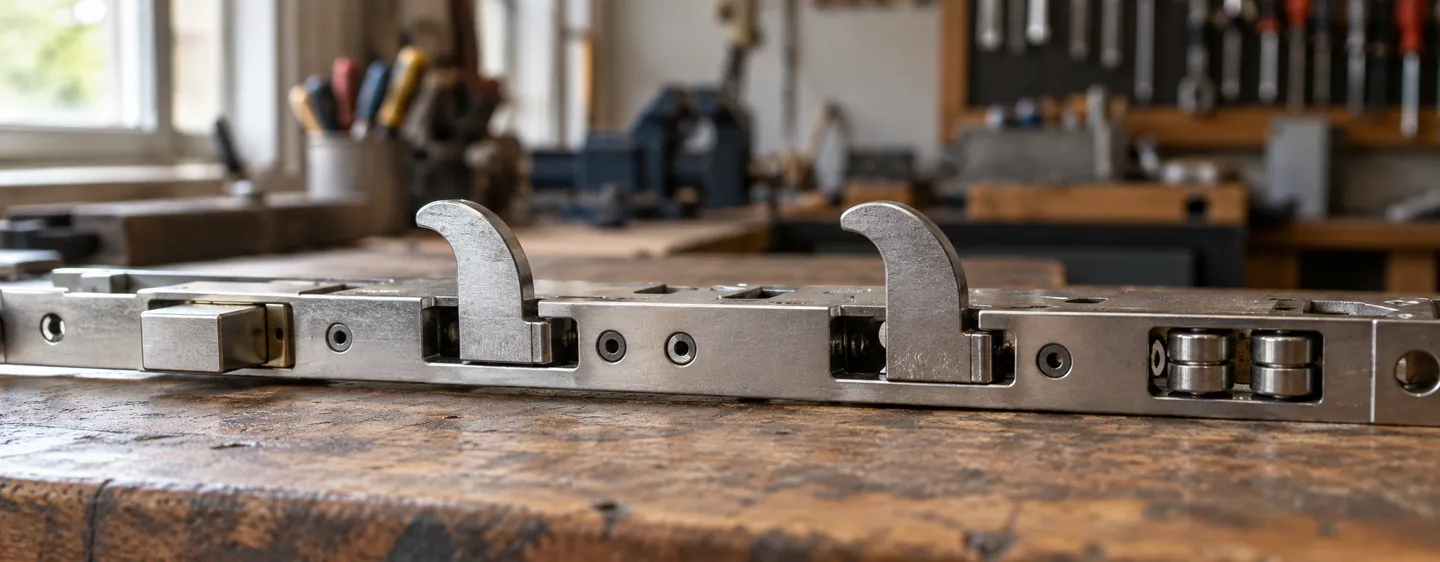
Every multipoint lock, domestic or industrial, is a power transmission problem. The operator provides a short rotation. The locking points need straight-line travel at two or more heights. The parts in between decide how smoothly that conversion happens and what breaks first.
The Gearbox: One Turn, Many Points
In a door lock, the gearbox sits behind the handle. Its spindle turns, an internal cam set converts rotation into push, and the lock rail above and below moves outward, throwing each point into its keep. The gearbox is the hardest-working part of the system. It takes the most torque, and when a multipoint lock fails outright, the gearbox is usually the part that has simply worn out.
Industrial versions make the same conversion with a 90-degree handle and a transmission plate, often sealed against dust and water, driving rods instead of a flat rail. Same job, different housing. The pattern to remember: the operator is cheap, the transmission is the part worth specifying.
Locking Point Types: What Each One Resists
The points at the end of the rail are not interchangeable. Each form exists because it resists a different load, and each fails in its own way.
Locking point types and their failure modes
| Point type | What it resists | How it fails |
|---|---|---|
| Deadbolt (square bolt) | Prying the door leaf away from the frame | Wear and rattle; a worn bolt stops seating fully |
| Hook bolt | Pull-out on a door that has sagged or dropped | Hook deforms and will not re-engage the keep |
| Roller | Continuous gasket compression and smooth guidance | Roller flattens or loosens and the seal relaxes |
| Mushroom cam | Compression seating against a matching keep | Misalignment stops it seating; wear opens the gap |
| Rod and locking block (rod control) | Top, bottom, and mid-door bite on tall panel doors | Rod fixings loosen; blocks wear and the bite goes shallow |
The hook bolt deserves a second look, because it is the point most often blamed when “the door won’t lock”. When a door drops on its hinges, hooks are the first points that stop re-engaging cleanly. The symptom is real; the cause lives in the hinges and the alignment, not in the hook. That pattern, a symptom at the lock with a cause elsewhere, repeats all the way up to cabinet-sized doors.
Why You Lift the Handle Before Turning the Key
Domestic multi-point operation is deliberately two-step. Lifting the handle extends the points and presses the door into its gasket: that is the pre-compression. Turning the key then locks the gearbox so the points cannot retract. Skip the lift and the key turns a mechanism with nothing to hold, so the door rattles or fails to latch. A large share of “my multipoint lock is broken” calls start exactly here.
Industrial handles collapse the same logic into one clearly marked 90-degree turn: travel first, lock second, in one motion. The engineering intent is identical. Compression is a separate step from locking, and the handle exists to do both in the right order.
None of this says every door needs three points or more. A small, light, rarely used door does fine with a single bolt. The decision rests on door size, sealing duty, and how often the door moves, which is where the comparison belongs.
Single-Point vs Multi-Point: Where Extra Points Pay Off
The honest comparison runs across three dimensions.
Security: a single bolt gives an attacker one bite point to work on. Distributed points spread the load and close the latch-side and hinge-side gaps at once. The gain is real but conditional. It assumes a sound door leaf, sound hinges, and a square installation; a multi-point lock on a sagging frame performs worse than a good deadbolt on a solid one. Locksmiths keep repeating that the door matters as much as the lock because they keep seeing the reverse.
Sealing: this is where a single point cannot compete at any price. One latch presses one spot, and a gasket needs perimeter compression to seal against weather, dust, water, or temperature difference. Multi-point is the only arrangement that produces that compression from one lock. It is the reason the mechanism migrated from front doors to test chambers, outdoor cabinets, cold rooms, and any enclosure with a seal worth protecting.
Cost and maintenance: single-point is cheaper and nearly maintenance-free. Multi-point costs more upfront and has more parts to keep adjusted. The trade pays back wherever the door is large, heavy, sealed, or opened often, and nowhere else.
How many points, then? The numbers you meet are conventions, not grades. UK door literature says “three or more”. North American entry-door specs often mean a deadbolt plus two additional points. Industrial cabinet practice settles on three as the working default for tall doors. Treat the count as configuration: it follows the height and sealing duty of the door, not a quality scale.
One more figure belongs in a 2026 decision. The mechanical multi-point locks market is projected to grow from USD 5.10 billion in 2025 to USD 8.99 billion by 2034 (Data Insights Reports, 2025). The electrified side of the same market is moving much faster: the smart door lock segment is projected to grow from USD 2.7 billion in 2024 to USD 11.9 billion by 2034 (Market.us, 2024).
Market trajectory, 2025–2034
6.5%
Mechanical multi-point locks
CAGR, 2025–2034
16.0%
Electric and smart door locks
CAGR, same window
Roughly 2.5× faster
The ratio is the message. A platform designed this year will outlive several lock generations, and electrified locking is where that market is going. Choosing a drive that can take an electric actuator later, without redesigning the door, is the cheapest future-proofing available at the specification stage.
The ceiling on all of this is door reality. A light cabinet door opened twice a day gains nothing from five points and an actuator. Over-speccing is its own failure mode.
Running the opposite problem? If your door is the large, heavy, or sealed kind that has outgrown its latch, send KUNLONG the door dimensions and sealing duty — point count, throw, and material come back as a spec, not a guess.
Send Your Door SpecSpecifying a Multi-Point Lock for Cabinet and Equipment Doors
Cabinet doors change the question. A steel enclosure door is thin, commonly 1.0 to 3.0 mm panel, sealed, sometimes very large and heavy, and opened by people who did not design it. “Is multi-point more secure” is the wrong question here. The right one is: what exactly goes into the RFQ so the lock that arrives fits the door, the seal, and the production line?
Match the Drive: Rod-Control vs Multi-Cam
Two drives dominate industrial doors. A rod-control system runs rods up and down from a central 90-degree handle, so locking blocks bite at the top, the bottom, and often the middle of the leaf. It is the natural choice for tall doors where the corners must pull in against a gasket. A multi-cam system drives several cams in one plane through a bar, which suits doors whose points can share the lock-edge height. Both come in left-hand and right-hand versions. Decide the handing at the drawing stage; changing it after tooling is a re-order, not an adjustment.
The Parameter Sheet: What Goes Into the RFQ
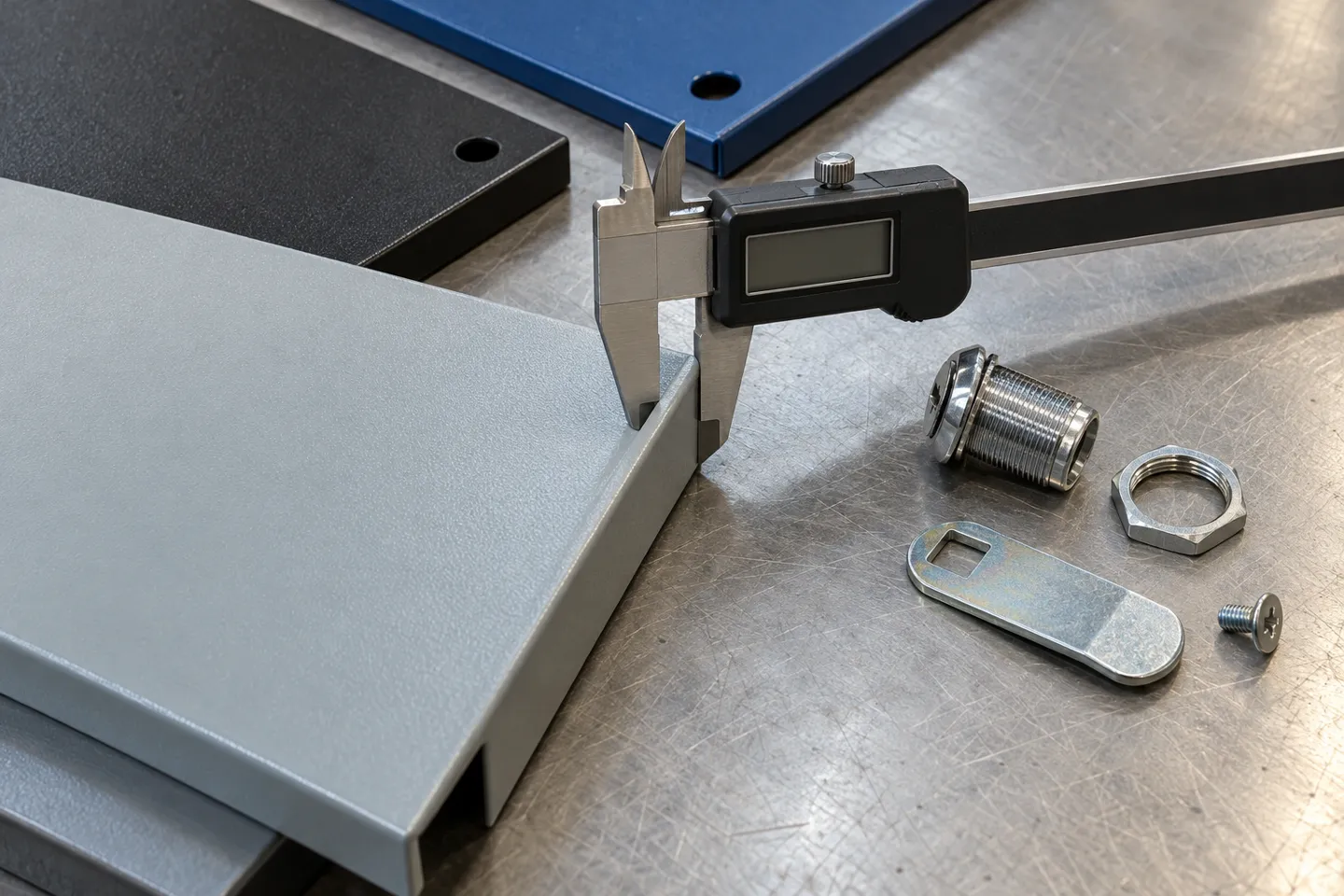
Publicly listed industrial multi-point locks make the working ranges easy to benchmark. Panel thickness fit: most catalog locks cover 1.0 to 3.0 mm steel doors. Lock-point throw: around 30 mm on typical rod-control models. The throw is what compresses the gasket, so it must be matched to the seal profile rather than guessed. Points: one to three, switchable on several models, set by door height. Operation: keyed 90-degree handles as the default, quick-open levers where a door is opened many times per shift, and DC12V electric versions where the platform wants remote locking.
Sealing, Materials, and Corrosion
Environment picks the material. Dry indoor panels do well with zinc alloy bodies and a painted finish. Dusty locations want a dust cover over the handle aperture. Outdoor, washdown, and cold-chain doors want stainless steel, SUS304 being the common grade, with waterproof sealing at the handle boss, because a lock is also a hole in the door. Two acceptance numbers belong in writing: salt-spray endurance for the finish and cycle life for the mechanism. Established makers publish warranty benchmarks in the region of one year or 20,000-plus operating cycles; ask your supplier to state their own numbers in the quote instead of assuming.
The Selection Matrix
The table below compresses the above into starting points. Confirm the third column before committing to any row.
Cabinet and equipment door multi-point lock selection matrix
| Scenario | Sensible starting configuration | Confirm before you commit |
|---|---|---|
| Small control box, light door | Single-point cam lock or two-point | Hinge count vs door weight; multi-point may be overkill |
| Standard distribution or telecom cabinet, tall and sealed | 3-point rod-control lock, keyed 90-degree handle, zinc alloy | Panel thickness fit (1.0–3.0 mm); handing fixed at drawing stage |
| Large heavy doors: test chambers, shielded rooms, single leaves over 100 kg | 3-point or more, stainless or reinforced zinc, gasket-matched throw, hinges specified together | Hinge load rating matched to real door weight; adjustable keeps for alignment |
| Outdoor, washdown, coastal | SUS304 body, waterproof sealing at the handle boss, dust cover | Salt-spray endurance in writing; seal material vs cleaning chemicals |
| Cold chain and hygiene, -40 °C and below, washdown | SUS304/316, low-temperature lubricant, smooth finish | Lowest rated temperature; thermal contraction of the door |
| Electrified platform: remote locking, audit trail | DC12V electric multi-point, or mechanical drive with actuator interface | Power budget; fail state on power loss; retrofit path |
The price band on public catalogs runs from roughly US$5.8 for a zinc three-point model to about US$20.7 for a heavy-duty unit. Stock designs ship in 7 to 15 days. Treat those as sanity anchors. A quote far below the band usually means a shallower throw, an unsealed handle boss, or an unspecified cycle life.
Why Multi-Point Locks Fail—and How to Prevent It
Field failures are repetitive, which is good news: four patterns cover most of them, and all four can be designed out at specification time.
The four failure patterns at a glance
Alignment drop — the door sags on its hinges and the points stop engaging. Prevention: adjustable keeps, hinges rated to the real door weight.
Transmission wear — the gearbox finishes its cycle life and stops throwing points. Prevention: cycle life in the acceptance criteria, mechanism graded to door traffic.
Point deformation — hooks and blocks loaded beyond their rating bend instead of biting. Prevention: point material and count matched to door weight.
Operation error — the two-step sequence not completed, the classic “didn’t lift the handle”. Prevention: marked 90-degree travel, labeled direction.
The dominant pattern is alignment. A door that drops on its hinges, even by a few millimeters, puts the points out of engagement: the handle lifts hard, the key grinds, the door “will not lock”. Forum threads on stuck multipoint doors almost always end in hinge replacement or keep adjustment, not lock replacement. Prevention sits on the spec side: adjustable keeps, hinge ratings matched to the real door weight, and a maintenance instruction that names alignment as the first thing to check.
The second is transmission wear. Gearboxes and rod mechanisms are torque parts with finite cycle lives. When a unit a few years old stops throwing its points, the gearbox has usually done its work. Prevention is contractual: put cycle life into the acceptance criteria alongside the warranty period, and match the mechanism grade to door traffic. A door cycled fifty times a shift needs a heavier mechanism than one opened twice a day.
Third comes point deformation. Hooks and blocks asked to hold a door heavier than their rating bend instead of biting, and the symptom surfaces as intermittent locking. Match point material and count to door weight, and keep slamming out of the handling instructions; that is cheaper than returns.
Fourth is operation error. Two-step domestic locks generate a steady trickle of “won’t lock” calls that are really “didn’t lift the handle”. Industrial handles reduce this with a single marked 90-degree travel; label the travel direction anyway, because the person opening the door did not read this article.
One boundary closes the list. Know what the user may fix: lubrication and re-tightening rod fixings are user territory. A worn gearbox, a bent hook, or a failed rail means replacing the lock plate, which on a cabinet door is usually a short swap. That, too, argues for getting the panel-thickness fit right in the RFQ.

What This Means for Your Cabinet Platform and Sourcing
For an equipment or cabinet OEM, the mechanism argument collapses into one sentence: specify the locking system by the door, not by the budget line. Points follow door height, weight, and sealing duty. The common default of one latch plus a bigger hinge gives up gasket compression on every large door and hands the lock’s work to the hinges. Electrified locking is growing roughly 2.5 times faster than the mechanical segment (16.0% vs 6.5% CAGR in the windows above). A drive with an actuator path is therefore the cheapest hedge a new platform can buy.
For distributors and wholesalers, the same facts sort the catalog into a volume line and a margin line.
Inventory structure for industrial multi-point locks
| Volume line | Margin line | |
|---|---|---|
| Typical spec | Zinc alloy, keyed 90-degree handle, 3-point rod control, painted finish | SUS304 waterproof model, dust-cover variant, DC12V electric |
| Demand source | Standard distribution and telecom cabinets | Harsh-environment builds, coastal sites, cold chain, electrified platforms |
| Why it earns its slot | Every quote needs one; it is the price-comparison item | Bare locks are commoditizing; seal grade, verified cycle life, and customization response are not |
The margin line looks quieter and turns slower. It is also the line competitors cannot take on price alone. A seal rating, a verified cycle life, and a custom variation do not sit on a catalog price row. The volume line pays the warehouse; the margin line pays the margin.
When the time comes to send the inquiry, the specification shrinks to six lines.
RFQ checklist for a multi-point locking system
- Panel thickness fit range, stated against your actual door.
- Lock-point throw, matched to your gasket profile.
- Point count and handing, fixed at drawing stage.
- Material and sealing: zinc/painted, SUS304, waterproof boss, dust cover.
- Proof in writing: salt-spray endurance, cycle life, warranty period.
- Engineering support: downloadable 3D models, sample policy, lead time for stock and custom designs.
Do this work once and it keeps paying: the locks arrive fitted, the doors seal, and every later quote gets compared against numbers instead of adjectives.
Everything above assumes a door worth engineering: large, heavy, sealed, or harsh-environment. A light cabinet door opened twice a day should stay on a simple single-point lock. An electrified upgrade only pays on platforms that will live three to five years or more.
Every number in this article can be checked against a working catalog. Our multi-point lock range at KUNLONG lists panel-thickness fit, throw, waterproof and dustproof variants, and downloadable 3D models for each lock, so you can benchmark your next RFQ against something real.
Compare Quotes Against Numbers, Not Adjectives
Door dimensions, seal profile, and environment in — panel fit, throw, and cycle-life numbers back, with the quote.
Start Your RFQReferences
- Data Insights Reports. “Multi Point Locks Market Forecast: Trends to 2034.” 2025. https://www.datainsightsreports.com/reports/multi-point-locks-market-272628
- Market.us. “Smart Door Lock Market Size, Share | CAGR of 16.0%.” 2024. https://market.us/report/smart-door-lock-market/