


Why Door Hardware Makes or Breaks Industrial Oven Performance
When engineers talk about industrial oven design, the conversation almost always starts with heating systems, airflow patterns, and insulation. The door gets treated as an afterthought: a sheet of metal on a couple of hinges. That assumption is expensive.
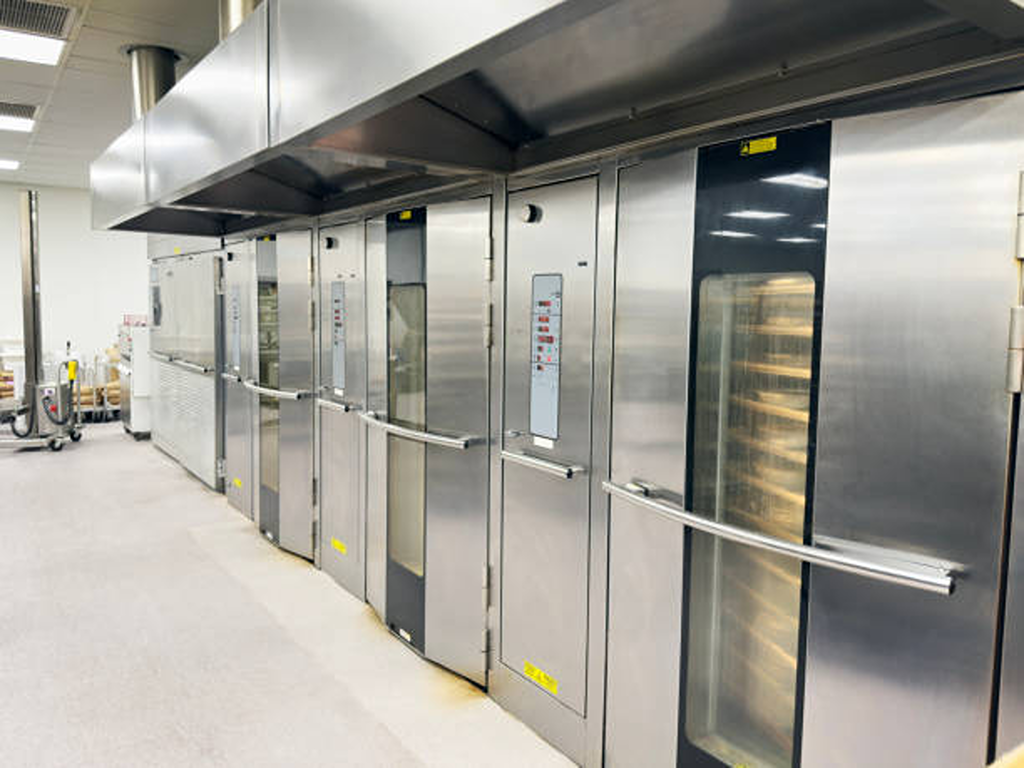
The oven door is the only subsystem that endures thermal load, mechanical cycling, and safety compliance requirements simultaneously. A production batch oven might see its doors opened 20 to 200 times per day. Every single cycle subjects the hardware to a thermal-mechanical shock: the hinge pins expand against their bushings, the latch mechanism cools slightly between batches and heats again on the next cycle, and the gasket compresses and relaxes under a temperature gradient that runs from ambient on the outside to several hundred degrees on the inside.
Three facts put this in perspective. First, door seal degradation is one of the most common and most overlooked causes of industrial oven energy waste. While insulation breakdown gets the attention, a hardened or misaligned gasket leaking heated air at the door perimeter can bleed 15-30 percent more energy through the exhaust system over the oven’s service life. Second, NFPA 86, the dominant North American safety standard for ovens and furnaces, mandates safety interlocks on fuel-fired oven doors. This requirement transforms a seemingly simple latch into part of a safety instrumented system. Third, operators interact with the door more than any other oven component, making handle ergonomics and thermal protection not just comfort issues, but workplace safety ones.
The performance of an industrial oven door is determined by four categories of hardware working together: hinges carry the weight, latches provide the seal compression, handles determine how operators engage with the system, and gaskets form the thermal interface between the door and the chamber. Each one deserves its own engineering attention.
Hinge Selection: Load, Temperature, and Cycle Life
Choosing an oven door hinge comes down to three variables: static load (door weight), operating temperature (which degrades material properties), and design cycle count (fatigue life). Miss any one of them and the failure mode is predictable: door sag leads to seal gap, seal gap causes temperature non-uniformity, and non-uniformity means scrapped product.
Heavy-Duty Butt Hinges: The Workhorse for Standard Oven Doors
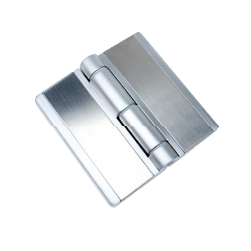
The butt hinge is the most common choice for industrial oven doors, but “common” does not mean “interchangeable.” A hinge suitable for a cabinet door at room temperature has almost nothing in common with one spec’d for a 120 kg oven door operating at 250°C.
Material choice is the first decision point. Type 304 stainless steel provides adequate corrosion resistance and mechanical strength for most applications, with a continuous service temperature ceiling around 870°C. However, in applications involving chlorine-bearing compounds or high humidity (common in food-processing ovens with washdown cycles), Type 316 stainless steel is the safer bet. Its molybdenum content (2-3%) raises the pitting resistance equivalent number (PREN) above 24, substantially reducing the risk of crevice corrosion at hinge pin interfaces.
The second decision is load rating, and this is where a common mistake occurs. A hinge rated for 50 kg at room temperature does not carry 50 kg at 250°C over 50,000 cycles. Thermal expansion changes clearances; oxidation builds surface roughness on bearing surfaces; lubricants degrade or evaporate entirely. The practical rule: apply a static safety factor of at least 3× for the cold rating, then assume elevated-temperature cyclic loading will consume roughly 40 percent of that margin over the design life. For a 100 kg door, that means sourcing hinges with a combined rated capacity of no less than 300 kg at ambient.
A third factor worth specifying upfront is detachability. In cleanroom or pharmaceutical oven applications where periodic deep cleaning is mandatory, lift-off butt hinges with removable pins allow the door to be taken down in under 30 seconds without tools. This cuts maintenance downtime and eliminates the risk of cleaning chemical residue trapped in hinge crevices.
Torque and Friction Hinges: When Position Control Matters
Laboratory ovens, inspection stations, and test chambers often require doors that stay put at any opening angle. That means a torque hinge: a hinge with an internal friction mechanism that provides constant rotational resistance regardless of position.
The critical specification here is torque value, which must be calculated from three inputs: door weight, the horizontal distance from the hinge axis to the door’s center of gravity, and the maximum opening angle. The basic relationship is T = W × L × sin(θmax) × 1.5, where the 1.5 factor accounts for operator push force and minor impacts. But the calculation alone isn’t enough. You also need temperature derating.
Most torque hinges achieve their friction through polymer-based components: nylon cams, acetal bushings, or elastomeric O-rings compressed against metal surfaces. These materials have hard temperature limits. Nylon and acetal begin losing mechanical properties above 85°C in continuous service; by 120°C, torque output can drop 30-50 percent from the room-temperature rating. For oven doors operating above 120°C at the hinge location, full stainless steel torque hinges (where friction is generated by spring-loaded metal-on-metal interfaces) are the only reliable option. Products in this category, is rated for over one million open/close cycles and use food-grade grease compliant with NSF H1 for incidental food contact.
Concealed and Detachable Hinges: Cleanability and Maintenance Access
Food, pharmaceutical, and semiconductor cleanroom ovens share a requirement that conventional butt hinges cannot satisfy: no exposed crevices. The 3-A Sanitary Standards for food equipment require product contact surfaces to have a roughness average (Ra) of 0.8 µm or less, with no exposed threads, blind holes, or crevices that could harbor microbial growth. The European Hygienic Engineering and Design Group (EHEDG) extends this logic to all equipment surfaces in the processing zone.
Concealed hinges solve the hygiene problem by mounting entirely inside the door and frame profiles, presenting a smooth, flush exterior. The trade-off is load capacity: the hinge pivot moves closer to the door edge, shortening the lever arm and concentrating stress on a smaller cross-section. A concealed hinge will generally carry 30-50 percent less than an equivalently sized external butt hinge.
For maintenance access on large ovens, detachable hinge designs offer a valuable middle ground. Spring-loaded detent pins allow the door to be lifted off in a partially open position, but lock automatically in all other positions to prevent accidental removal. This is as much a safety feature as a convenience one: a 150 kg oven door dropping unexpectedly under gravity is a serious workplace hazard.
Latch Mechanisms: Security, Sealing Force, and Safety Interlocks
A latch on an industrial oven does three jobs. It pulls the door against the gasket with even pressure. It keeps the door closed if internal pressure builds. And, in fuel-fired ovens, it feeds a state signal to the burner management system that says “door secure safe to ignite.” The mechanical and the electrical are inseparable.
Compression Latches: Uniform Sealing for High-Temperature Doors
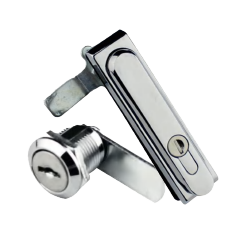
The compression latch is the most widely used closure mechanism for industrial oven doors, and its principle is straightforward: rotating a handle drives a cam, roller, or wedge along a ramp profile, converting rotary motion into inward linear force that compresses the door against its gasket.
The parameter that matters most is compression stroke, defined as the distance the latch pulls the door inward from first gasket contact to fully locked position. For a silicone gasket with a free height of 12 mm, the recommended compression is 25 to 35 percent, or 3.0 to 4.2 mm of stroke. Below 20 percent, the seal is unreliable under thermal cycling because the gasket hasn’t taken a sufficient set. Above 40 percent, the gasket experiences accelerated compression set: permanent deformation that reduces sealing force over time.
Latch spacing is equally important. As a practical guideline, compression latches should be spaced no more than 600 mm apart along the door height. A door taller than 800 mm in width benefits from an additional latch at the top and bottom edges, where thermal bowing tends to open the largest gaps. For a typical 1.2 m × 1.8 m oven door, four to five compression latches evenly distributed around the perimeter provide reliable, uniform sealing force. The total clamping force across all latches typically ranges from 500 N for small laboratory oven doors to over 3,000 N for large production units.
Multi-Point Locking Systems: When a Single Latch Isn’t Enough
Large industrial oven doors (those exceeding 1.5 meters in height or 150 kg in weight) require multiple latch points that actuate together. The engineering challenge is synchronization. If three latch points along the left edge of a door don’t engage simultaneously, the door tilts, the gasket compresses unevenly, and the resulting thermal leak can be worse than having fewer latches.
Three actuation architectures are common. Mechanical linkage systems use tie rods connecting all latch points to a single handle, providing built-in synchronization at the lowest cost. The drawback is thermal expansion: a 2-meter stainless steel linkage rod heated from 25°C to 250°C grows roughly 7.6 mm, which can throw off latch timing by mid-cycle if expansion joints are not designed in.
Gear-synchronized systems replace rods with rack-and-pinion or bevel-gear trains, offering tighter synchronization and better tolerance for thermal growth, at roughly twice the cost of a linkage system. For the largest automated ovens, independent electric latch actuators controlled by a PLC eliminate mechanical synchronization entirely. Each latch reports its position back to the controller. This approach adds complexity but enables condition monitoring: if one latch begins requiring more torque to close, maintenance can be scheduled before it fails.
Safety Interlocks: Beyond the Mechanical Latch
A latch that closes perfectly still needs to prove it’s closed. NFPA 86 requires that Class A and B fuel-fired ovens interrupt the fuel supply within seconds of detecting an unsafe condition, including a door that is not fully latched. Meeting this requirement means the latch system must include a position sensor whose signal is hardwired into the burner management system’s safety relay chain.
Sensor selection depends on the operating environment. Mechanical limit switches are the most common choice: they’re simple, direct, and cost under $50 per point. But their mechanical contacts wear. Rated for one to ten million cycles at room temperature, their life drops sharply above 150°C as internal springs lose temper and plastic housings embrittle.
Non-contact alternatives offer longer life at higher cost. Magnetic reed switches are sealed, tolerate humidity, and work up to about 150°C before the magnet begins to demagnetize. RFID-coded safety switches, the most robust option, use a coded transponder in the latch bolt and a reader in the frame. They achieve Safety Integrity Level (SIL) 2 per IEC 61508 when paired with a safety-rated evaluation unit, and high-temperature variants operate at up to 180°C. The price is roughly ten times that of a limit switch, but for ovens in classified environments or with high consequence-of-failure, the reliability premium is justified.
Handles, Gaskets, and the Thermal Interface
Handles are where an oven’s mechanical design meets its operators. An operator might grip the same handle two hundred times per shift, often wearing heat-protective gloves. If the handle is too thin, it’s hard to grip with gloves. If it’s too close to the door surface, knuckles brush against hot metal. If it lacks a thermal break, heat conducts straight through to the grip surface.
Three design parameters cover most requirements. Diameter: 25 to 40 mm provides a comfortable power grip for gloved hands; below 20 mm requires a pinch grip that fatigues operators over repeated cycles. Standoff distance: at least 60 mm from grip center to door surface to clear gloved knuckles. Thermal isolation: a two-piece handle construction with a glass-fiber-reinforced thermal break between the mounting bracket and the grip section reduces conducted heat by an order of magnitude compared to a single-piece metal handle. Stainless steel with a brushed or bead-blasted surface finish provides both corrosion resistance and a non-slip texture, even when operators’ gloves carry oil residue.
Gaskets are a world of their own, and the material choice depends on four variables: continuous operating temperature, peak excursion temperature, chemical exposure, and regulatory requirements. The table below summarizes the four most common industrial oven gasket materials.
| Material | Continuous Temp | Peak Temp | Compression Set | Chemical Resist. | Food Contact | Cost |
|---|---|---|---|---|---|---|
| Silicone (VMQ) | -60°C to +230°C | +300°C | Good | Poor (oils) | FDA CFR 177.2600 | $ |
| FKM / Viton | -20°C to +250°C | +300°C | Excellent | Excellent | Limited | $$$$ |
| PTFE | -200°C to +260°C | +300°C | Poor | Outstanding | FDA compliant | $$$ |
| Graphite Composite | -200°C to +450°C | +550°C+ | Moderate | Excellent | No | $$$ |
Silicone is the default choice for most general industrial ovens: it’s cost-effective, handles the temperature range, and is readily available in a wide range of extruded profiles. Switch to fluorocarbon when oils, solvents, or aggressive cleaning chemicals are present. PTFE is the choice for semiconductor and pharmaceutical applications where outgassing must be minimized. Graphite composites are reserved for high-temperature furnaces operating well above the ceiling of polymer-based materials.
Gasket cross-section matters as much as material. D-shaped profiles provide uniform compression with a wide sealing footprint, ideal for large flat doors. P-shaped (bulb-and-tail) profiles offer a softer initial touch and are more tolerant of door misalignment. Lip seals provide the lowest closing force but demand the tightest manufacturing tolerances on the door and frame.
From Design to Procurement: Specifying Hardware That Lasts
The most common failure mode in industrial oven hardware procurement is not choosing the wrong type of hinge or latch. It’s writing a specification that omits the parameter that turns out to matter most.
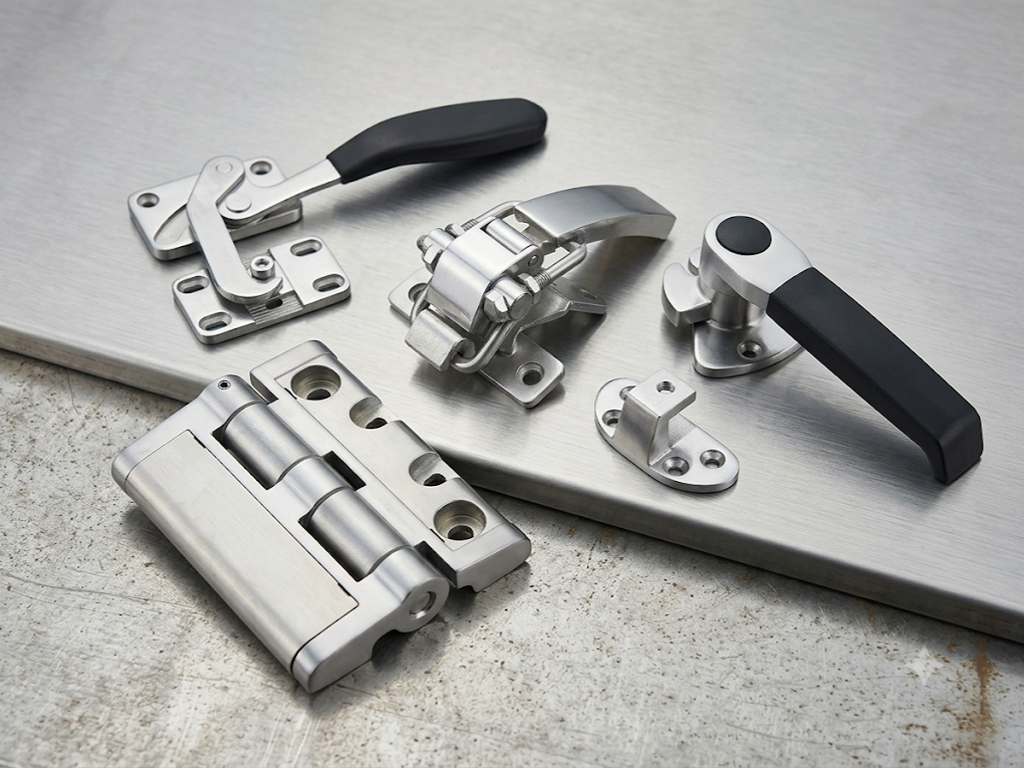
Three omissions appear again and again. The first is cycle life. A specification that reads “stainless steel butt hinge, 100 kg capacity” without stating the required number of cycles invites a supplier to quote a hinge tested to 5,000 cycles at room temperature, when the actual application needs 50,000 cycles at 200°C. The fix is simple: every hardware specification should include a minimum cycle count at the declared operating temperature.
The second omission is lubricant specification. Standard bearing grease carbonizes within weeks at oven door temperatures, turning from lubricant to abrasive paste. The specification must state either “high-temperature solid lubricant” (graphite or molybdenum disulfide based, rated to the operating temperature plus a 50°C margin) or “dry-running / self-lubricating bearing material.”
The third is the interface signal. If a latch needs to talk to a PLC, the specification must declare the signal type (dry contact, PNP, NPN, 4-20 mA), the required safety integrity level if applicable, and the connector type. A $200 latch that arrives without the right signal output is a $200 paperweight until an electrician retrofits a sensor.
When the specification is tight, the next question is whether to buy standard catalog hardware or go custom. The decision framework is straightforward: if a standard product satisfies all five criteria (load, temperature, cycle life, material, and interface), buy it. If any one criterion fails, the cost of a field failure almost always exceeds the premium for custom hardware. Custom industrial hinges and latches typically carry a minimum order quantity of 100 to 500 units, a tooling lead time of 15-30 days, and a total project timeline of four to eight weeks from design freeze to first article delivery.
Engineers designing industrial oven door systems do not need to source every component from scratch. Manufacturers with deep experience in industrial hardware can substantially reduce both the engineering time and the procurement risk. Look for suppliers that offer downloadable 3D CAD model libraries covering thousands of standard and configurable parts, in-house engineering teams that can turn a custom design around in seven days, and quality systems that verify every unit against its rated specifications. KUNLONG, for example, maintains a library of over 6,000 3D CAD models across its hinge, handle, and latch product lines, and provides design support with a five-dimension customization capability spanning material grade, dimensional tolerances, functional configuration, intelligent control integration, and surface finish specification. For engineering teams specifying oven door hardware, starting with a supplier that already understands industrial thermal applications means fewer iterations and a shorter path from design to production.