


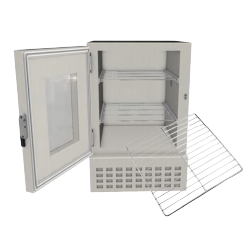
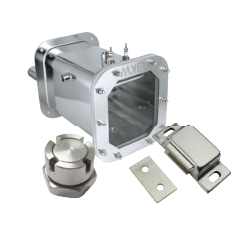
A stability test chamber is a precision cabinet that holds one temperature and one humidity level for months at a stretch. Inside it, a drug, a package, or a component can be watched as it ages. Every expiration date printed on a medicine carton started as a row of samples inside one of these chambers. The whole job is narrow and unforgiving: hold the setpoint, hold the humidity, record everything, and never surprise anyone.
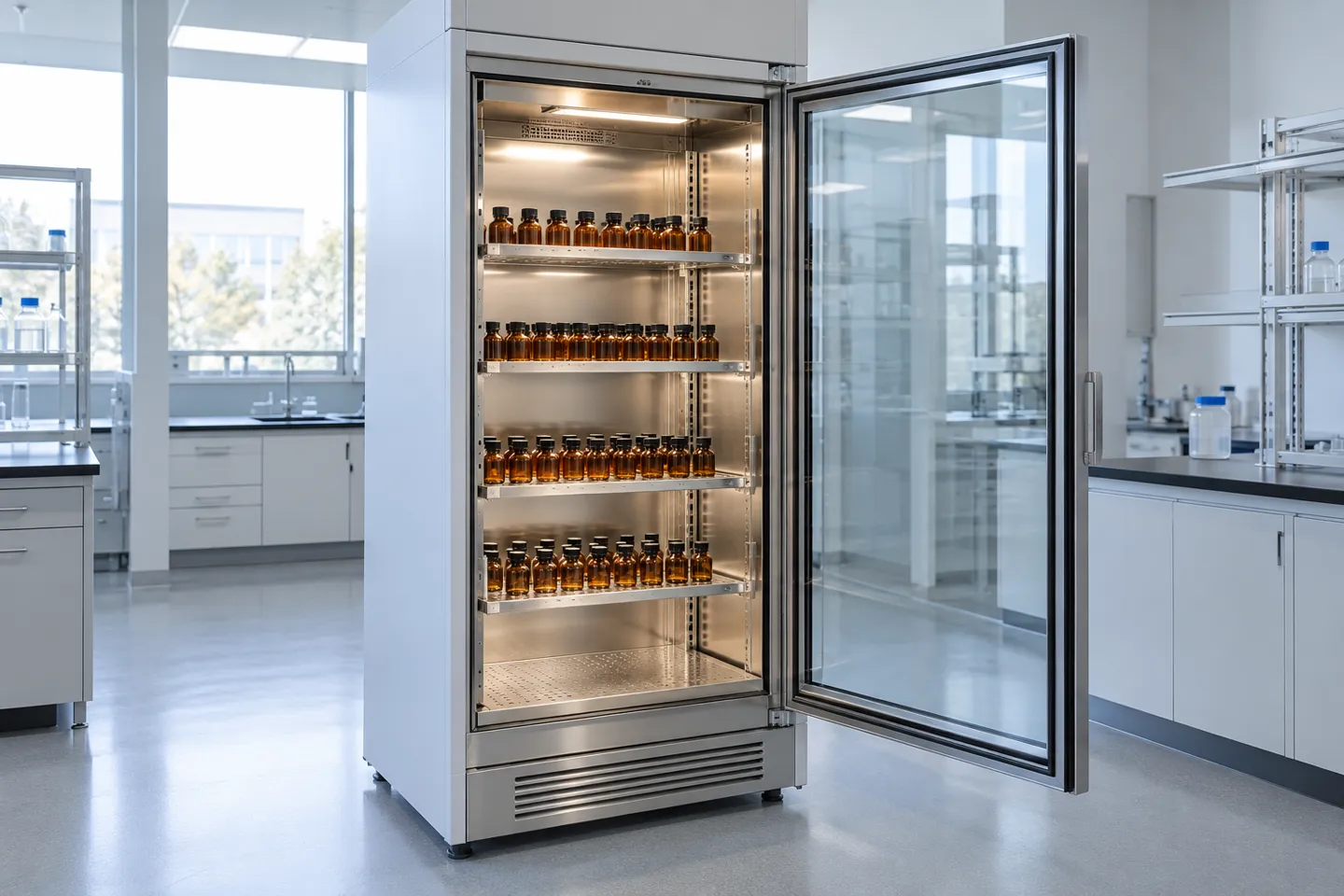
One naming note before going further. In pharmaceutical labs, “stability test chamber” means a storage-stability cabinet, typically running anywhere from 5 °C to 40 °C, operated under the ICH stability guidelines. Some industrial labs use the same words for a thermal-cycling chamber that pushes hardware from -70 °C to +180 °C to find its limits. This article is about the first kind. The two share one trait that will matter later: both live or die by the door, the seal, and the hinges that keep the inside world separate from the room.
The conditions a chamber must hold come from guidelines, not preference. The ICH guideline Q1A(R2) defines the storage conditions behind nearly every shelf-life claim (ICH, 2003).
ICH Storage Conditions for Stability Studies
| Condition | Set point | Tolerance | Typical use |
|---|---|---|---|
| Long-term | 25 °C / 60% RH | ±2 °C / ±5% RH | Shelf-life claim for most markets |
| Intermediate | 30 °C / 65% RH | ±2 °C / ±5% RH | Added when significant change shows up at accelerated conditions |
| Accelerated | 40 °C / 75% RH | ±2 °C / ±5% RH | Harsher, faster stress used to predict degradation |
| Hot-humid long-term (Zone IVb) | 30 °C / 75% RH | ±2 °C / ±5% RH | WHO climatic zone IVb markets |
The family is bigger than one cabinet. The reach-in unit, from benchtop boxes to full-height cabinets, is the workhorse most labs picture. Walk-in chambers are rooms you step into when sample volume outgrows shelves. Photostability chambers add controlled light exposure per the ICH Q1B guideline, and freeze-thaw chambers cycle samples across zero to stress formulations. The reach-in does most of the work in most labs, which is why it anchors most equipment shortlists.
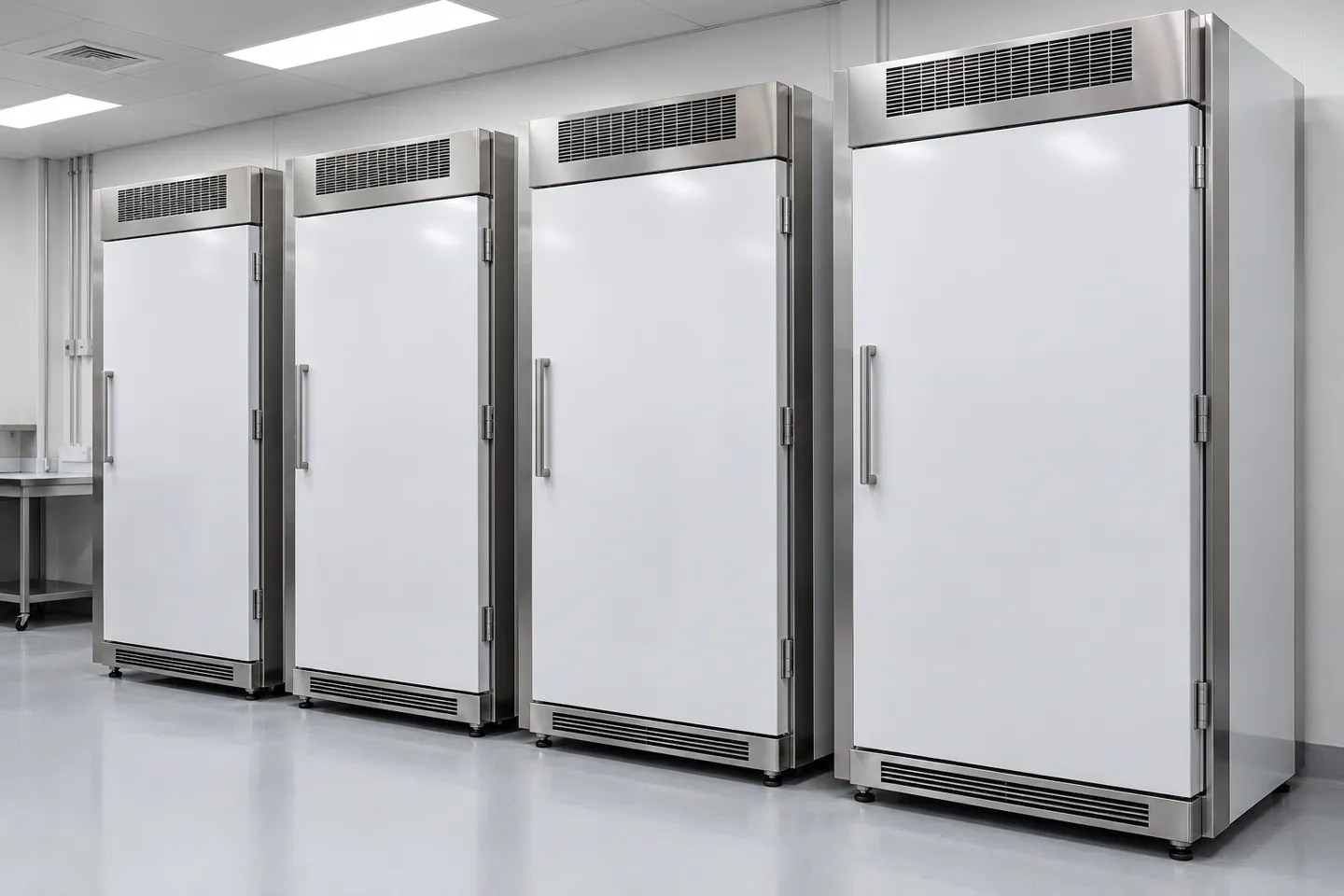
Testing itself follows a simple pattern. Samples go in at two or three of the conditions above. They get pulled on a schedule (commonly 0, 1, 3, and 6 months, then yearly) and assayed against fixed acceptance criteria. Chambers also serve development work, packaging confirmation, and compliance batches for regulated markets. The equipment differs mainly in how much of this it can hold at once, and how visibly it can prove that conditions never slipped.
When the Alarm Sounds: How Stability Testing Runs, and What an Excursion Costs
Most of a stability study is uneventful. Samples queue up by time point, chambers log conditions around the clock, and sensors get calibrated once a year against known standards. Staff walk past the units daily without a second thought.
The routine breaks when an alarm fires, and the first mental shift is the one that matters: an excursion is a period, not a point. The question is never just “did the chamber recover” but “what was inside between the first bad reading and the first good one.” That window defines the workload ahead.
- 1Confirm the reading with a calibrated portable meter.
- 2Mark the period: pull the exact start and end timestamps from the chart.
- 3List every sample that sat inside during that window.
- 4Hand the list to the stability professional who judges product impact.
- 5Act on the verdict: continue the study, relabel the data, or restart the time points.
A documented case shows the full weight of this. At 02:14, the humidity in an accelerated chamber crossed its upper limit. The next morning, staff opened and closed the door and the reading stayed out. Only at 15:00 the following day, after a new door seal went in, did conditions return to range (LabLynx, 2026). Thirty-two hours out of specification. Eighteen sample time points sat inside that window, and each bottle had to be assessed individually before the study could move.
One caveat belongs here: this response chain assumes modern monitoring and alarm routing. Older unmonitored chambers hide their excursions until the next scheduled pull, which turns a bad afternoon into a much worse quarter.
The detail worth noticing in that case: nothing was wrong with the compressor, the refrigerant, or the controller. The failure came from a rubber gasket. Acting on that requires a map of where reliability actually breaks.
Why Chambers Drift: The Four Layers Where Reliability Breaks
When a chamber drifts, the cause sits in one of four layers. It is the environment system, the door and its seal, the power and monitoring setup, or the people and loading habits. Published risk-assessment frameworks for stability chambers group their failure modes into almost exactly these buckets. Door seal integrity even gets its own scoring category (Pharma Stability, 2025). Treating all of it as one vague “equipment problem” is why the same failures keep coming back.
Layer 1: The Environment System
Refrigeration, heating, humidification, the circulation fan, and the sensors make up the layer most people think of first. Compressor aging slows pull-down after door openings. Humidifier reservoirs scale up and under-deliver. Worn fan bearings create gradients between shelves that a mapping study will expose. Sensors drift on their own schedule, which is why annual calibration against a reference standard is standard practice rather than bureaucracy. The symptoms are characteristic: oscillation around the setpoint, slow recovery, and shelf-to-shelf differences that show up in a loaded mapping run.
Layer 2: The Door and Its Seal
This is the layer the case study lived in. A door gasket is a flexible barrier with a finite compression life. It ages, flattens, and eventually cracks, and every door opening pushes room air against chamber air across that barrier. When the room air carries more moisture than the chamber, humidity climbs; when the room is drier, it falls. Either direction violates the tolerance band.
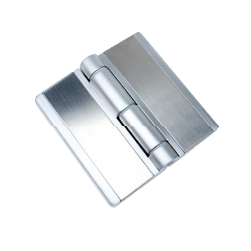
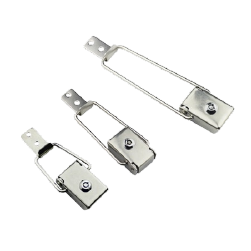
The door also concentrates mechanical stress. Chamber doors are heavy, and larger cabinets and walk-ins swing well over a hundred kilograms on their hinges with every opening. Hinges wear, door drop misaligns the gasket contact, and latch mechanisms lose the even compression a seal needs to work. An unevenly compressed gasket leaks at one corner first. In busy labs the door opens every day, so the seal, hinges, and latches are consumables on a schedule, not permanent fittings.
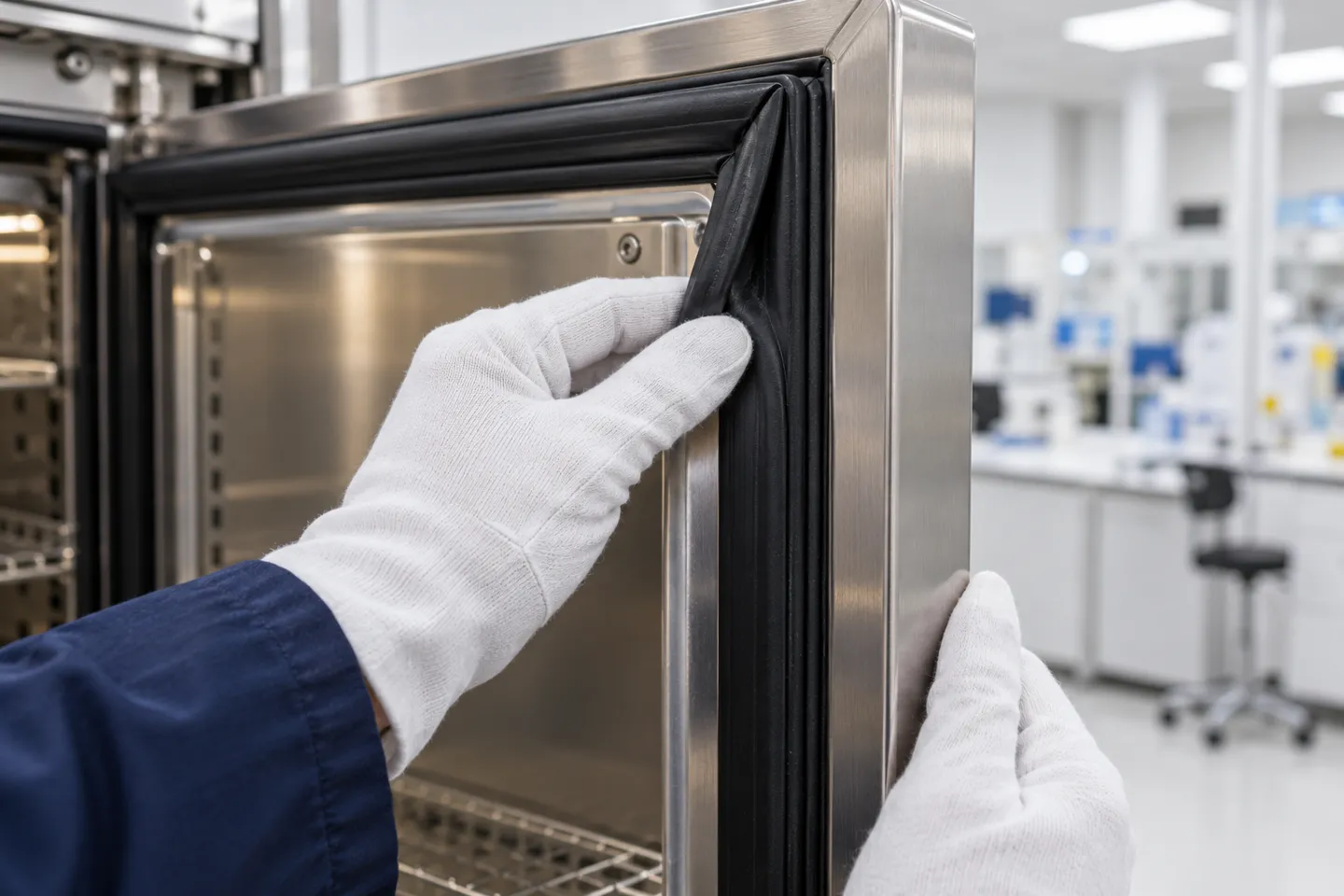
In documented failure analyses, no mechanical part is blamed more often than the door seal.
The documented failure analyses
32 hours
out of specification on one aging gasket
18 time points
sample time points assessed individually
Layer 3 and 4: Power, Monitoring, and People
The quieter failure classes sit behind the hardware. A power outage is only as serious as its length and the chamber’s behavior after it. Does the program restart automatically? Did the alarm actually reach a person at 02:14? A logging gap during an outage is itself a finding, because regulators ask about the record, not just the conditions. Human factors fill the rest of the list. Long door openings during sample pulls, racks pushed against the back wall, and loading above the rated capacity all produce excursions. They look like equipment failures, but they are not.
Four-Layer Troubleshooting Matrix for Stability Chambers
| Layer | Typical symptom | First check | Rule this layer out when |
|---|---|---|---|
| Environment system | Gradients between shelves / slow pull-down / oscillation around setpoint | Loaded mapping study; compare sensors to a calibrated reference | Mapping shows uniformity within tolerance under load |
| Door and seal | Humidity creeps after door openings / misting at the gasket line / single-corner drift | Sight-and-feel gasket inspection; paper-pull test around the frame; check latch tension | Seal is intact, evenly compressed, and door hardware cycles cleanly |
| Power and monitoring | Logging gaps / unexplained restarts / alarms nobody received | Verify auto-restart settings and alarm routing with a short controlled test | Records are continuous and alarms reach someone around the clock |
| People and loading | Excursions clustered at pull times / shelf-to-shelf variation after restocking | Review door-open duration and rack placement against the loading pattern | Door discipline holds and airflow paths stay clear |
The fourth column is the one worth printing: each layer comes with the check that clears it. That is how a two a.m. response stops being guesswork.

What the Chamber Cannot Protect You From
A chamber that holds 25 °C and 60% RH perfectly can still sit at the center of a failed study. The first cause outside its control is the room itself. Chamber specifications assume a reasonable lab environment, and an HVAC failure during a heat wave pushes every chamber in the building toward its limits at once.
The second cause hides in the packaging. Moisture that reaches a tablet through a faulty blister seal or a loose cap is not a chamber problem. The chamber proves the environment. The packaging has to prove protection. Conflating the two sends teams chasing equipment ghosts.
The third cause is the gap between qualification and reality. An empty-chamber mapping proves the design; a fully loaded chamber behaves differently, and racks stuffed against the return vent strangle the airflow the design depends on. Loading discipline belongs to the operating team, not the manufacturer.
Finally, the machine itself can simply be the wrong purchase. Light-exposure studies need a photostability chamber. Thermal-cycling to extremes belongs to industrial environmental chambers. A lab pulling a handful of samples a year may be overbuying a full stability cabinet. A short self-check keeps the scope honest:
- Room HVAC is sized for a heat-wave day, not an average one.
- Packaging integrity is validated separately from storage conditions.
- Mapping was repeated under full load, not just empty.
- Airflow paths stay clear at maximum loading.
- The chamber type matches the study: storage stability, photostability, or thermal cycling.
The chamber is a necessary condition for trustworthy stability data. It is never the sufficient one.
Necessary, never sufficient.
Choosing One You Can Trust: Capacity, Real Cost, and the Specs That Matter
Two decisions dominate the outcome of a stability chamber purchase: the form factor and the total cost you commit to. The sticker price decides neither.
Reach-in or Walk-in
A reach-in fleet and a walk-in room solve the same problem at different scales, and the choice is a genuine fork for buyers.
Reach-in Fleet vs Walk-in Room
| Factor | Reach-in fleet | Walk-in room |
|---|---|---|
| Capacity growth | Add another cabinet | Rebuild or expand the room |
| Redundancy | Each unit fails independently | One room is one risk envelope |
| Recovery after door openings | Faster, smaller air mass | Slower, larger air mass |
| Qualification scope | Per unit | Whole-room mapping, longer and costlier |
| Human access | Door openings only | People walk in with large disturbances |
The switch triggers are concrete. Sample volume that doubles across two studies, several teams sharing one room, or a floor plan with no wall space for another cabinet all push toward walk-in. Conversely, a lab whose risk analysis cannot tolerate a single point of failure may buy a third reach-in instead of one big room. Three cabinets failing independently beat one room failing once.
The Real Cost Structure
The purchase price is the entry ticket, not the bill. Four line items follow it. Qualification comes first. IQ/OQ/PQ documentation is a vendor deliverable, and its completeness varies enough to ask about explicitly. Ask whether mapping under load is part of the package. Energy comes second, since a chamber runs 24/7/365 and the refrigeration plus humidification load quietly becomes one of the lab’s larger electrical lines. Service and spares come third over a three-to-five-year horizon. Gasket kits, sensors, and compressors are all wear items, and the vendor’s guaranteed response time decides how long an outage lasts. The fourth item is the least visible: the cost of your own team’s time during qualification, alarm response, and audits.
Qualification
IQ/OQ/PQ documentation and mapping under load, asked for explicitly.
Energy
Round-the-clock refrigeration and humidification on the lab’s electrical line.
Service and spares
Gasket kits, sensors, compressors, and the vendor’s guaranteed response time.
Team time
Your own people during qualification, alarm response, and audits.
Public price ranges are scarce because vendors quote against configuration. The practical move is to interrogate the structure rather than the number. Ask what the qualification package contains. Ask what the spare-parts stocking looks like for door seals and controllers. Ask what the guaranteed response time is, in writing.
The Spec Lines That Belong in the Purchase File
The troubleshooting matrix above established where chambers actually fail, and the purchase file should carry that knowledge. Beyond the qualification and service terms, three door-system lines deserve explicit numbers from any vendor. The first is the rated cycle life of the door hardware. The second is the service temperature envelope within which gaskets and handles keep their properties. The third is the door-load rating on the hinges. A fourth line covers consumables: gasket and hinge replacement parts available off the shelf, not six weeks of lead time. These four lines cost nothing to ask and exclude the suppliers who never engineered the door as a system.
What Buyers’ Failures Teach the People Who Build Chambers
Read everything above from the other side of the door. Buyers remember the night the alarm went off, not the brochure. The one subsystem they touch every single day is the door: its seal, its hinges, its latches. The same subsystem tops the documented failure analyses, and the same four spec lines are now migrating into procurement files.
For the people who build chambers, that is a positioning decision, not a component note. Treating door hardware as a specifiable reliability subsystem converts the buyer’s excursion anxiety into sales evidence. The subsystem is defined by three numbers: rated cycle life, a stated service temperature envelope, and a load rating that appears in the IQ/OQ/PQ file. Buying hinges and latches by casting price leaves that differentiation on the table.
In pure price-war segments this argument carries less weight. Where buyers write procurement specifications, it wins rooms. The practical entry is small. Publish the parameter trio (cycle life, temperature envelope, load rating) on the datasheet. Then make sure gasket and hinge spares ship as fast as the troubleshooting matrix demands.
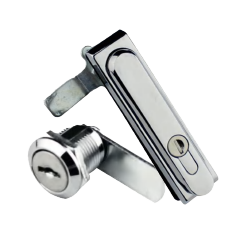
KUNLONG builds the door hardware this conversation is about: hinges, latches, locks and handles for test chambers. The range carries a 20,000+ cycle lifespan guarantee and is catalogued in 3D for direct download on our test chamber door hardware page. Stocked items ship within a week.
Equip Your Chamber With Door Hardware That Holds
Hinges, latches, locks and handles for test chambers, backed by a 20,000+ cycle lifespan guarantee. Catalogued in 3D for direct download, with stocked items shipping within a week.
Request a Door Hardware QuoteReferences
- ICH. “Q1A(R2): Stability Testing of New Drug Substances and Products.” 2003. https://database.ich.org/sites/default/files/Q1A%28R2%29%20Guideline.pdf
- LabLynx. “Environmental Monitoring: The Excursion Isn’t the Event.” 2026. https://www.lablynx.com/resources/articles/laboratory-environmental-monitoring-excursions/
- Pharma Stability. “Risk Assessment Template: Stability Chamber Failure Modes and Mitigations.” 2025. https://www.pharmastability.com/risk-assessment-template-stability-chamber-failure-modes-and-mitigations/